
Pre-order
Overall ranking

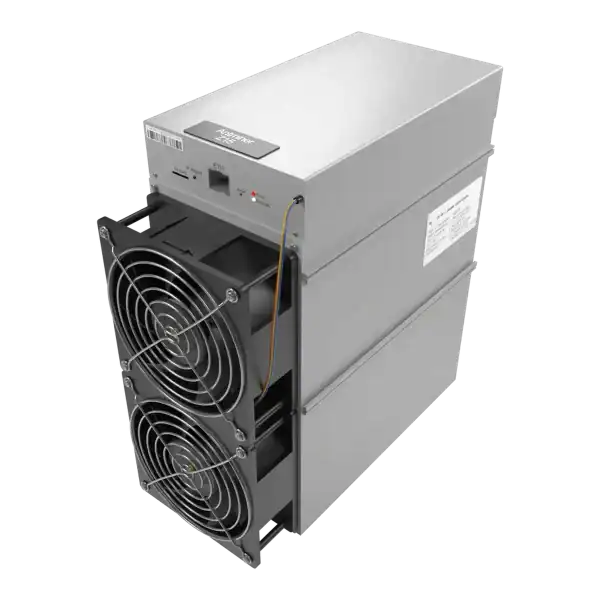
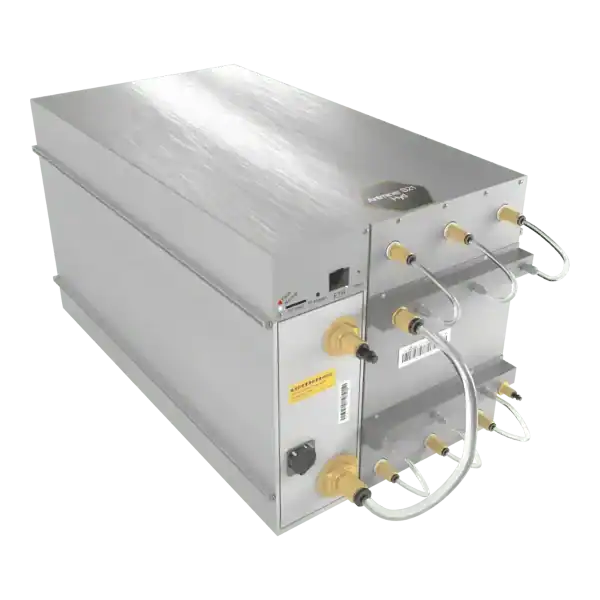
Overall rank#1of 163AvailableAll: #3 / 836

Pre-OrderFree Shipping
Hashrate
525KSOL
Efficiency
4.73W/KSOL
Power
2483W
Earns/kWh
£0.286
Plan home Bitcoin mining around the exact miner, AC or DC supply, heat, sound, network and electricity cost. Compare compact setups with full-size ASICs.
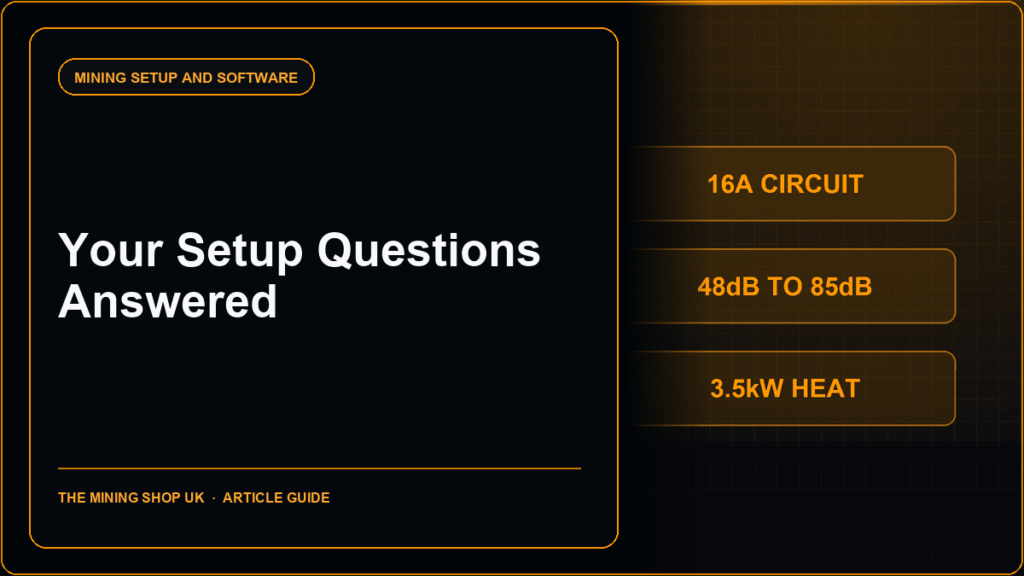
Plan home Bitcoin mining around the exact machine, electrical supply, heat, sound, network and running cost. Compact hobby miners and full-size ASICs need different setups; choose the equipment your space can support.
The catalogue comparison helps shortlist hardware. This guide helps check the space and operating plan; it does not certify an installation or report a physical test of a machine.
A workable home setup depends on the exact device and where it will operate. Write down the intended purpose, available space, expected operating hours and practical limits for heat and sound. A compact learning device and a full-size mining installation are different projects.
Check the requirements that apply where you will operate, using the separate UK mining rules guide when reviewing the wider context. Electrical suitability, property permissions and acceptable operation need their own checks; this page does not replace those assessments.
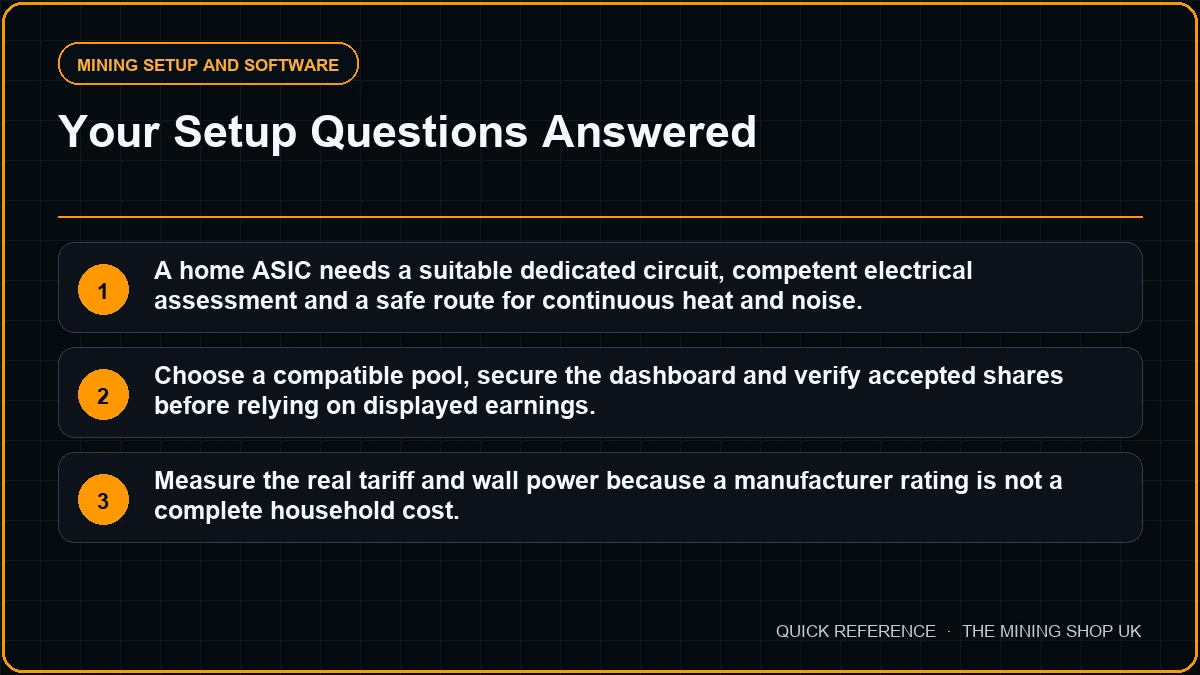
Start with the manufacturer’s exact device, adapter, connector and input requirements. A current figure or plug label alone does not establish that an installation is suitable for continuous operation. Have a competent person assess the real load and supply where required; do not select a circuit or breaker from a headline wattage alone.
Compact DC equipment: the Bitaxe Gamma project specifies a 5V DC device input. That is separate from the external adapter’s AC mains input. Check the approved output, current capacity, connector and polarity; do not use the device’s DC current to size a household AC circuit.
Full-size hardware: use the exact manual, including the power equipment and input rating. For example, BITMAIN’s S21 Pro specification defines its electrical and operating requirements. It is not a substitute for assessing the installation. HSE’s equipment guidance explains supply suitability, condition checks and competent assistance.
Check the exact model and the conditions behind any published sound figure. A manufacturer rating, catalogue estimate and measurement at your listening position are different evidence. This guide does not provide workshop or household noise measurements.
Consider operating mode, fans, pumps or external cooling equipment, vibration through the building, placement and distance from occupied rooms. A miner without fans does not make a complete cooling installation silent. Confirm that the proposed setup fits the space and surroundings before ordering; avoid relying on an enclosure that compromises the required cooling.
Plan heat removal alongside the electrical load. As an approximate heat-load reference, 3500W of electrical draw is 3.5kW that must be accommodated by the cooling arrangement. A small room’s useful heating demand and a miner’s continuous output may not match.
Check the manufacturer’s inlet, airflow or cooling-loop requirements, and provide a route for heat that is not useful. Only credit heat reuse when it replaces heating you would otherwise buy. Season, room demand and operating hours matter. Read the heat-reuse guide and cooling and airflow guide for planning context.
Connection is model-specific. The Gamma project describes Wi-Fi operation, while BITMAIN lists Ethernet for the S21 Pro reference. Check the supplied device’s instructions rather than assuming every miner uses the same connection.
Identify the device’s local management address and use the pool operator’s current endpoint, port and worker or payout format. Verify the intended destination and accepted work in the pool’s own view. Review its fees, payout method and threshold; local hashrate alone does not confirm a payout relationship.
Use the Bitaxe setup guide for a compact Wi-Fi first run or the ASIC setup guide for the broader commissioning checklist. Check any agreed pre-dispatch configuration and verify it on receipt rather than assuming the machine arrives ready for your particular pool.
Shortlist by purpose and site fit before comparing hashrate. A compact solo or learning device does not offer predictable block rewards. A larger machine can require substantially more electrical and cooling infrastructure, even when its efficiency per unit of work is better.
Use the home-miner comparison, Bitaxe category and Nano 3 versus Nano 3S guide to identify exact models. For full-size alternatives, compare the S21 variants. Check current condition, availability and included equipment on the individual listing and written order.
Electricity-only cost = watts ÷ 1000 × active hours × price per kWh. Use measured whole-setup power where available; otherwise identify what the stated figure includes. External supply losses, networking and cooling may sit outside a device-only rating.
| Example continuous load | Energy per day | Electricity per day |
|---|---|---|
| 100W | 2.4kWh | £0.60 |
| 800W | 19.2kWh | £4.80 |
| 3500W | 84kWh | £21.00 |
These are example inputs at 100% runtime, not model specifications, a current tariff quote or a profit forecast. Substitute your own electricity price and operating hours. Include any additional running loads and compare purchase, installation, fees, downtime and maintenance separately.
Use the Bitcoin mining calculator for your own assumptions, or the solo block-odds calculator for probability. The UK home-versus-hosting example explains how to compare complete operating costs.
Reconsider the chosen setup if its electrical requirements cannot be met, heat or sound cannot be accommodated, or the complete cost does not fit your purpose and budget. A smaller machine, different operating plan or decision not to proceed may be more suitable than forcing a full-size installation into the space.
If considering ASIC hosting, check eligibility, capacity, cooling compatibility and all charges in a written site-specific quote. Do not assume that an existing miner is eligible or that a headline energy rate covers the whole service. Use the contact page to discuss the exact model and proposed setup.
Start with your purpose, continuous power, heat, sound and available space. Compact home or hobby miners and full-size ASICs have different requirements. Compare the home-miner category and exact model instructions before selecting equipment; a high hashrate alone does not establish that a machine suits a living space.
No. Networking is model-specific. Bitaxe Gamma supports Wi-Fi, while BITMAIN lists Ethernet for the S21 Pro reference. Other models can have different requirements. Use the exact manual and check how the device will reach both the pool and its local management interface.
The miner’s DC input is the low-voltage side of the power supply. The adapter has its own AC mains input and DC output ratings. For example, the Gamma project specifies a 5V DC device input. Match the approved supply, current capacity, connector and polarity to the exact board; do not treat device DC current as a mains-circuit rating.
Divide watts by 1000, multiply by active hours, then by the price per kWh. As an illustration, 100W running for 24 hours uses 2.4kWh and costs £0.60 at £0.25/kWh. Include the external supply and auxiliary equipment where they are outside the stated power figure. This is electricity cost, not a profit forecast.
They are a starting point, not a measurement of your room. Check the exact model, operating mode, measurement conditions, cooling equipment and placement. Sound and vibration at bedrooms or neighbouring property can differ from the published test conditions. Confirm suitability before committing to the installation.
No. You still pay for the electricity used. Credit heat only when it replaces heating you would otherwise pay for, during the periods and in the spaces where it is useful. Heat that must be removed remains a cooling and ventilation requirement.
Choose according to the purpose and the pool’s actual rules. Pool payout methods, fees and thresholds vary. Solo mining has highly variable outcomes: accepted shares do not mean a Bitcoin block has been won. Use the solo probability calculator to understand the assumptions rather than treating expected time as a payout deadline.
Compare a smaller model, a different operating plan or hosting eligibility and a complete site-specific quote before buying. Do not assume a hosting provider accepts an existing machine or that a headline electricity rate includes every charge.
Confirm the exact model, power equipment, connection, cooling, condition and order contents. Check the space, calculate costs using your own assumptions, and retain a first-run record of accepted work and operating conditions. Resolve unknown requirements before buying or commissioning.
References checked 28 October 2026. Use the instructions and limits for the exact hardware and revision; this guide provides planning examples rather than installation design or physical test results.
ASIC fleet management software: Create an exact model-by-function matrix because reading telemetry, changing pools, tuning and updating firmware can have.
Complete an IceRiver AE0 setup with the correct 19 to 20V supply, Ethernet, private interface, Aleo pool, accepted-proof checks and official firmware controls.
Set up ASIC Telegram alerts with a dedicated bot, protected token, private chat, minimal data, actionable thresholds, rate limits, test messages and incident.

Join the ASIC Mining Discussion
Members can read and join the discussion
Log in to read comments from other miners. Create a free account if you would like to ask a question or share your experience.
Membership helps us protect the discussion from spam and keep answers useful.