

Sealminer A4 Ultra Hydro
Bitcoin & Bitcoin Cash ASIC Miner


886TH
HASHRATE
9.45W/TH
EFFICIENCY
8373W
POWER
£903.43
EST. MONTHLY
NO PAYBACK
EST. ROI
Use a solo mining calculator correctly: enter productive hashrate, network conditions, uptime and time horizon, then read expected time and probability without.

A solo mining calculator turns productive hashrate and Bitcoin network conditions into an expected block interval and a probability for a chosen time window. It cannot predict the date of a win.
A sound calculator states its network snapshot, converts units correctly, uses uptime and fees where relevant, and distinguishes expected value from the chance of at least one block. This guide focuses on calculator inputs, outputs and reporting. The site's target-arithmetic article remains the technical reference for decoding nBits.
At the same time, the solo-mining variance guide covers financial reserves.
A useful solo mining calculator answers a defined question such as: what is the estimated probability that this measured fleet finds at least one Bitcoin block during the next year if its productive hashrate and the assumed network state remain constant?
A miner wants to understand solo mining calculator. It does not answer whether the fleet will definitely win or when a particular block will arrive.
A useful solo mining calculator answers a defined question such as: what is the estimated probability that this measured fleet finds at least one Bitcoin block during the next year if its productive hashrate and the assumed network state remain constant? It does not answer whether the fleet will definitely win or when a particular block will arrive.
Expected time, probability, expected gross reward and electricity cost are different outputs. Combining them into one return figure can hide the extreme variance of solo mining. Display each separately and label the period and currency basis.
Choose whether the calculation represents direct solo operation or a solo pool. A solo service may provide infrastructure and charge a fee if a block is found. Its terms, coinbase arrangement, payout address and validation model should be reviewed separately from the mathematical odds.

First record productive hashrate in a consistent unit. Use sustained accepted or independently verified output after rejects and downtime, not the sum of catalogue labels. Convert TH/s, PH/s and EH/s carefully: one EH/s is one million TH/s.
Second record a network state. A calculator can use network difficulty and exact target arithmetic, or an estimated network hashrate with an expected network block rate. Date the input because both the estimate and difficulty change.
Third choose the time horizon and expected uptime. A 200 TH/s miner available for 90 per cent of a year does not perform the same number of attempts as one available continuously. Planned curtailment, repairs and connectivity should be reflected.
Fourth record reward and cost assumptions if the tool reports financial values. Block subsidy, transaction fees, solo-service fee, electricity, auxiliary power and tax treatment do not change the probability of a qualifying hash. But they change the business result if one occurs or if none occurs.
A simple planning approximation divides productive miner hashrate by estimated network hashrate to get the miner’s share of total work. Multiplying that share by the expected network blocks in the chosen period gives an expected block count under constant inputs.
Expected time is the reciprocal rate. It is meaningful across many repeated trials but does not create a countdown. After a long losing period, the next independent hash is not more likely merely because the miner feels overdue.
For a constant idealised rate, probability of at least one success can be estimated as one minus the probability of zero successes. A Poisson form, one minus exp of negative expected blocks, is convenient for rare events. An exact per-hash calculation can instead start from the decoded target, as explained in the target-arithmetic guide.
Use enough numerical precision. Rounding an extremely small daily chance to zero destroys the annual calculation. At the same time, displaying many unexplained decimals gives false confidence in uncertain future inputs.
Assume a miner delivers 200 TH/s and the illustrative network estimate is 1,000 EH/s. This network figure is chosen for transparent arithmetic and is not presented as the live value. Converting units gives a work share of 200 divided by 1,000,000,000, or 0.0000002.
At an idealised 144 network blocks per day, expected blocks for the miner are 0.0000288 per day. The reciprocal expected interval is about 34,722 days, or roughly 95 years. This does not mean a win will occur in year 95.
Across 365 days at full uptime, the expected count is about 0.010512. The Poisson probability of at least one block is about 1.05 per cent. At 90 per cent productive uptime, use 328.5 equivalent days. This lowers the expected count and probability.
| Output | Illustrative result | Correct reading |
|---|---|---|
| Share of 1,000 EH/s | 0.0000002 | Relative work under stated estimate |
| Expected blocks per day | 0.0000288 | Long-run average rate |
| Expected interval | About 95 years | Not a predicted win date |
| One-year probability | About 1.05% | Chance of at least one under constant inputs |
| Chance of no block | About 98.95% | A normal outcome under the model |
A common error is mixing TH/s and EH/s or treating a percentage as a decimal incorrectly. Reproduce one result by hand and display the converted units. Another is using current network hashrate for a multi-year calculation without any growth or decline scenario.
Do not equate pool shares with Bitcoin blocks. A solo service can assign an easier share difficulty so the dashboard shows that a weak device is operating. Braiins explains that those shares support performance reporting. Only a result meeting the much higher Bitcoin network target finds a block.
Do not add probabilities from overlapping periods. Twelve monthly chances cannot simply be summed when reporting the chance of at least one annual success. Calculate the whole period from its combined expected count or apply the correct complement method.
Finally, confirm that the calculator models the selected route. A standard payout pool, hashpower marketplace and solo pool have different reward distributions even when the same ASIC work is involved.
Save the input snapshot with the output. When difficulty changes, the old result remains an honest historical calculation rather than becoming silently wrong. A live tool should show its refresh time and avoid words such as guaranteed, due or break-even date for a solo outcome.
A useful solo mining calculator answers a defined question such as: what is the estimated probability that this measured fleet finds at least one Bitcoin block during the next year if its productive hashrate and the assumed network state remain constant?
A useful solo mining calculator answers a defined question such as: what is the estimated probability that this measured fleet finds at least one Bitcoin block during the next year if its productive hashrate and the assumed network state remain constant?
First record productive hashrate in a consistent unit. Use sustained accepted or independently verified output after rejects and downtime, not the sum of catalogue labels.
A simple planning approximation divides productive miner hashrate by estimated network hashrate to get the miner's share of total work.
A solo mining calculator is valuable when it makes uncertainty visible. Productive hashrate, a dated network state, uptime and a defined period produce an expected count. That count can be converted into an expected interval and a chance of at least one block. None of those outputs is a promise.
Keep the arithmetic reproducible, show the chance of no success and model network change before using the result in an equipment decision.
Review the target-arithmetic and solo-variance guides, then compare the cost of a solo experiment with standard pool mining before assigning hardware and electricity.
Enter productive pool-side or independently measured hashrate, not an optimistic nameplate total. Expected block time is a long-run average. Probability of at least one block over a period is a separate output and neither is a deadline.




Understand mini ASIC solo mining at home through SHA 256 compatibility, block-finding probability, node and pool options, power, heat, noise and secure setup.
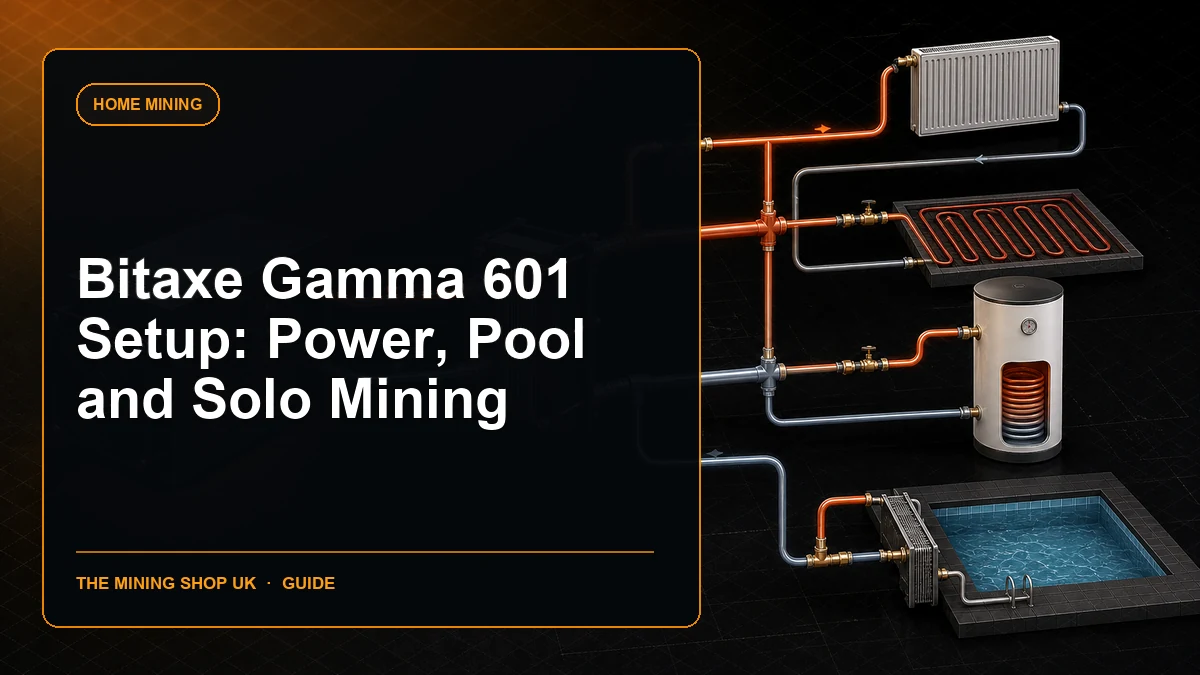
Complete a safe Bitaxe Gamma 601 setup with the correct 5 V supply, active cooling, Wi-Fi, AxeOS, pool details, first-share checks and recovery plan.

Trace a self-hosted solo mining template path from a validating Bitcoin node through work creation, ASIC submission, block validation and payout control.
Join the ASIC Mining Discussion
Members can read and join the discussion
Log in to read comments from other miners. Create a free account if you would like to ask a question or share your experience.
Membership helps us protect the discussion from spam and keep answers useful.