

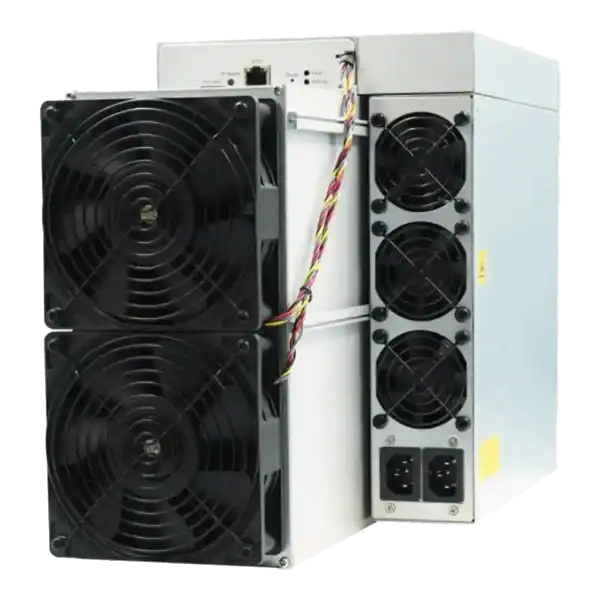
Antminer X9
Monero ASIC Miner

1000KH
HASHRATE
2.47W/KH
EFFICIENCY
2470W
POWER
£1029.33
EST. MONTHLY
5.6
Months
EST. ROI
Home Bitcoin mining: A home ASIC needs a suitable dedicated circuit, competent electrical assessment and a safe route for continuous heat and noise.
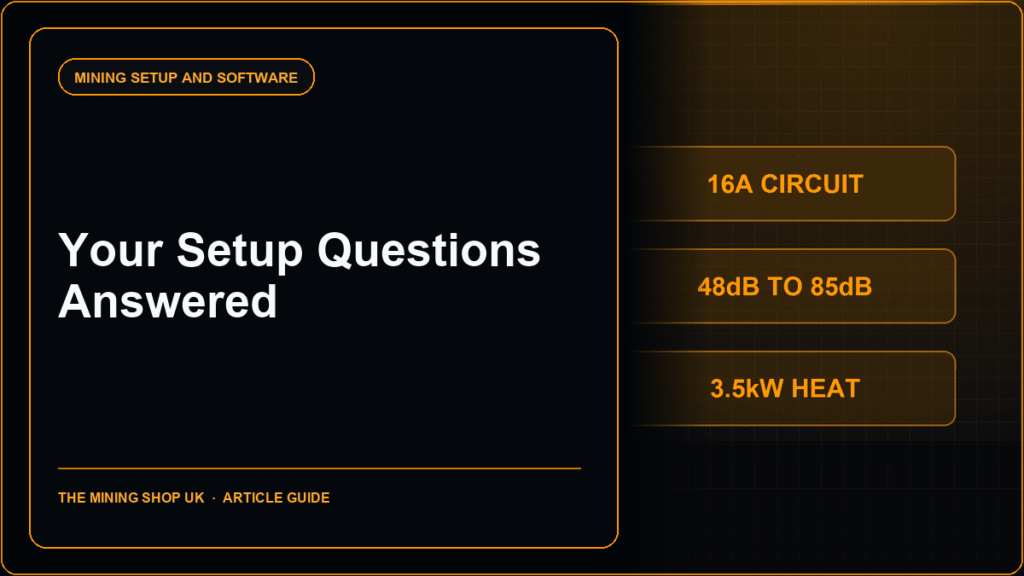
Home Bitcoin mining: A home ASIC needs a suitable dedicated circuit, competent electrical assessment and a safe route for continuous heat and noise.
Home Bitcoin mining: The simple part. Miners connect by Ethernet cable, not wireless. So you need a router or switch within cable reach.
A miner wants to understand home Bitcoin mining. If you would rather not touch any of it, we configure pools before dispatch. An S19k Pro at 2,530W uses 60.72kWh a day: at an illustrative £0.25/kWh domestic rate that is about £15.18 a day, before the machine has earned anything.
Running an ASIC miner at home is completely doable, thousands of people do it, and most of the problems that end a home mining project are avoidable with an hour of planning.
This guide answers the questions we get asked most, in plain English, with the real numbers: what your sockets can supply, how loud these machines actually are, where the heat goes and how to get your first payout.
Yes. Mining is legal in the UK and most of Europe, and a single machine in a garage or outbuilding is a realistic project for a careful beginner. The three things that decide whether it works are power, noise and heat, in that order.
Get those right and the rest is configuration. Get them wrong and the machine ends up switched off in a corner. Everything below exists to keep you out of the second group.

This is the question that matters most, because the numbers are bigger than most people expect. A standard UK 13A plug can safely supply about 3kW. Now look at real machines:
The right answer for any full size ASIC is the same: a dedicated circuit installed by a qualified electrician, no extension leads, no shared sockets with other heavy loads, and cabling rated for a continuous draw. Electrical Safety First has good guidance on what domestic wiring can and cannot do.
The electrician’s invoice is part of the cost of mining at home. Budget for it from the start.
Loud. Our air cooled miners list their measured range on every product page, and a machine like the L9 spans 48dB to 85dB depending on load. The top of that range is comparable to standing near a motorway. Nobody lives in the same room as one, and in most houses, nobody lives in the same building comfortably either.
What works: a garage, a shed with power, an outbuilding, a basement with the door sealed. What also helps: rubber matting under the machine to stop vibration travelling through the structure, and distance from bedrooms, yours and your neighbours’. Hydro and immersion machines run much quieter. But they cost more and need more complex installation.
This is why most home setups start with air cooling in a detached space.
Every watt a miner draws becomes heat. A 3,500W machine is a 3.5kW heater running around the clock, roughly two domestic fan heaters on full, permanently. In a sealed room the temperature climbs until the machine throttles or fails.
You need cool air in and hot air out: an intake at one end of the space, extraction at the other, and ducting if the machine shares a wall with living space. In winter this flips from problem to feature, and some home miners duct the exhaust to heat a workshop or greenhouse.
Warm exhaust air you were going to pay for anyway is one of the quiet advantages of mining at home, and it changes the sums in our profitability guide.
The simple part. Miners connect by Ethernet cable, not wireless. So you need a router or switch within cable reach. Configuration is a web dashboard: find the miner’s address in your router’s device list, log in, change the default password, and enter your mining pool details and worker name. Payouts go to the wallet address you set in your pool account.
We publish a full walkthrough in our Antminer L9 setup guide, and the same steps apply to almost every Antminer. If you would rather not touch any of it, we configure pools before dispatch. So the machine arrives ready to plug in and mine.
Start with a machine whose power draw your space can actually support, not the biggest number in the shop. For most first time home miners that points to something like the S19k Pro 110Th: 2,530W, air cooled, 23 W/TH, and a much smaller outlay than the flagships. It teaches you everything about running a miner without demanding industrial infrastructure.
Compare current machines side by side on our live Top 10 rankings, and check the estimated earnings on any listing at today’s prices. Whatever you choose, buy from a supplier who can repair it when a fan or hashboard eventually fails, because one will.
Multiply the machine’s power in kilowatts by 24, then by your electricity rate. An S19k Pro at 2,530W uses 60.72kWh a day: at an illustrative £0.25/kWh domestic rate that is about £15.18 a day, before the machine has earned anything.
That single line of arithmetic is why our profitability guide treats your electricity rate as the number that decides everything. Run it for your own rate before you buy, and check the result against the live figures on the listing. This are estimates, not guarantees.
Be honest about three situations. If your electricity rate is at full domestic price and the arithmetic above does not work, the machine will lose money at home. If you have nowhere detached enough for the noise, you will switch it off within a month. And if your wiring cannot take a dedicated circuit, do not improvise around it.
None of those end the project; they just move it. Hosting from £0.04/kWh puts your machine in a facility built for power, noise and heat, with rewards paid to your own wallet, and our hosting vs home mining guide works through which side of that line your situation falls on. Still unsure?
Our full ASIC miners FAQ covers the questions this guide has not, or talk to the team: we have mined at home and at scale since 2011, and we will tell you which one fits your house, your rate and your budget.
Home Bitcoin mining: The simple part. Miners connect by Ethernet cable, not wireless. So you need a router or switch within cable reach.
Mining is legal in the UK and most of Europe, and a single machine in a garage or outbuilding is a realistic project for a careful beginner.
This is the question that matters most, because the numbers are bigger than most people expect.
Our air cooled miners list their measured range on every product page, and a machine like the L9 spans 48dB to 85dB depending on load.
A home ASIC needs a suitable dedicated circuit, competent electrical assessment and a safe route for continuous heat and noise. Choose a compatible pool, secure the dashboard and verify accepted shares before relying on displayed earnings.

ASIC fleet management software: Create an exact model-by-function matrix because reading telemetry, changing pools, tuning and updating firmware can have.
Complete an IceRiver AE0 setup with the correct 19 to 20 V supply, Ethernet, private interface, Aleo pool, accepted-proof checks and official firmware controls.
Set up ASIC Telegram alerts with a dedicated bot, protected token, private chat, minimal data, actionable thresholds, rate limits, test messages and incident.
Join the ASIC Mining Discussion
Members can read and join the discussion
Log in to read comments from other miners. Create a free account if you would like to ask a question or share your experience.
Membership helps us protect the discussion from spam and keep answers useful.