
Pre-order
Overall ranking

Overall rank#1of 163AvailableAll: #6 / 836
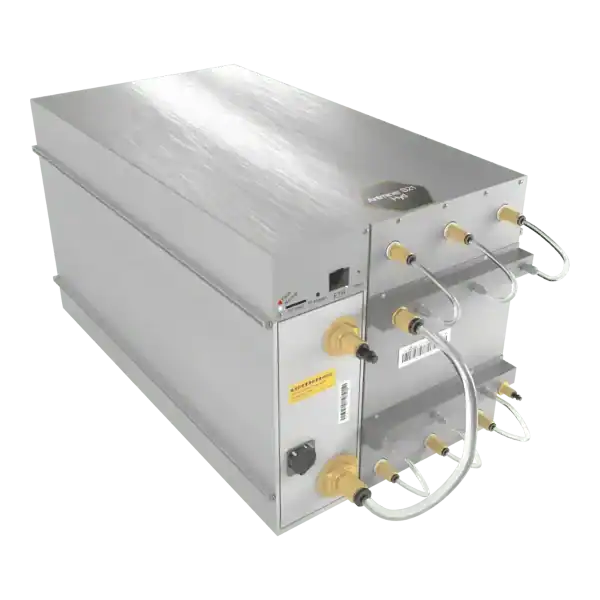

Pre-OrderFree Shipping
Hashrate
395TH
Efficiency
15W/TH
Power
5925W
Earns/kWh
£0.057
Check Bitcoin mining calculator inputs, electricity costs, fees and uptime. Load the correct miner and compare estimates using your own operating assumptions.
Before choosing a Bitcoin miner, check what the calculator assumes about hashrate, power, electricity, fees and running time. Use the exact model and your own costs, then check the date of the Bitcoin and network values.
This guide explains how to read and compare estimates. Use the Bitcoin mining calculator for current values and calculations.
Open a model in the existing Bitcoin calculator, or choose it from the model list. The link loads its current listed hashrate and power; it does not set a personal electricity tariff or confirm stock.
Use your measured power and productive hashrate when available. The S21 buying guide explains model differences; the home-miner comparison helps assess smaller setups.
Gross revenue is an income estimate before the costs specified by the tool. Net operating result subtracts the costs entered in that calculation. Payback also needs the hardware and setup cost, an ownership period and assumptions about future income and expenses.
Check the labels on each result. A figure before electricity cannot be compared directly with one after electricity, fees and hosting charges. A positive daily result can still leave the hardware purchase unrecovered.
| Input | What to check | Common mistake |
|---|---|---|
| Hashrate and unit | Use the exact model and productive rate while running. 1TH/s = 1000GH/s. | Entering a GH/s figure as TH/s. |
| Power | Check the stated rating and what your complete setup draws, including additional equipment. | Ignoring supply losses, cooling or other loads outside the rating. |
| Electricity price | Use pounds per kWh in a £/kWh field. 25p/kWh is £0.25/kWh. | Entering 25 instead of 0.25, or leaving power cost at zero. |
| Pool fee and reward | Check the pool’s actual fee and credited reward basis. | Deducting a fee twice or assuming every pool credits the same amount. |
| Uptime | Apply downtime once, with fixed charges and standby use handled separately. | Reducing an already downtime-adjusted hashrate a second time. |
| Bitcoin and network values | Check the timestamp, price, difficulty and block-reward assumptions. | Comparing estimates made with different market values. |
| Other daily costs | Add relevant hosting or other operating charges without double counting. | Treating electricity as the entire hosting bill. |
The Bitcoin developer mining guide explains shares, block rewards and why pool methods differ. Your pool’s actual payment rules, rejected work and payout conditions can affect what is credited.
Open the calculator’s network, price and reward assumptions and check the displayed timestamp. Current values are a starting point for an estimate; they do not fix future Bitcoin prices, difficulty or pool rewards.
When comparing offers, note the model, inputs, time and costs included. Returning to a live page later can show different values. If a current value is unavailable or marked out of date, verify it before relying on the result.
Energy in kWh = watts ÷ 1000 × active hours. Multiply the energy by your price per kWh to obtain electricity cost.
Fixed teaching example: a 1000W load running for 24 hours uses 24kWh. At an illustrative £0.25/kWh, it costs £6.00. This is unit arithmetic, not a specification for a named miner, a current tariff quote or a profit forecast.
Compare the calculator’s electricity result with that formula. If your power figure excludes an external supply, pump or fan, allow for its consumption. Include standby energy if the miner still draws power during inactive hours.
The home-versus-hosting estimate helps compare operating locations. Use the complete hosting-bill guide to check charges beyond a headline electricity rate.
Once a miner is running, compare a consistent period of productive work, whole-setup energy and credited pool income. A short local dashboard reading and a longer pool-side average may describe different windows.
Use the measured operating conditions to review your assumptions. Keep the model, firmware, mode and dates with the record so changes have a clear explanation. This guide does not provide measured results for your hardware.
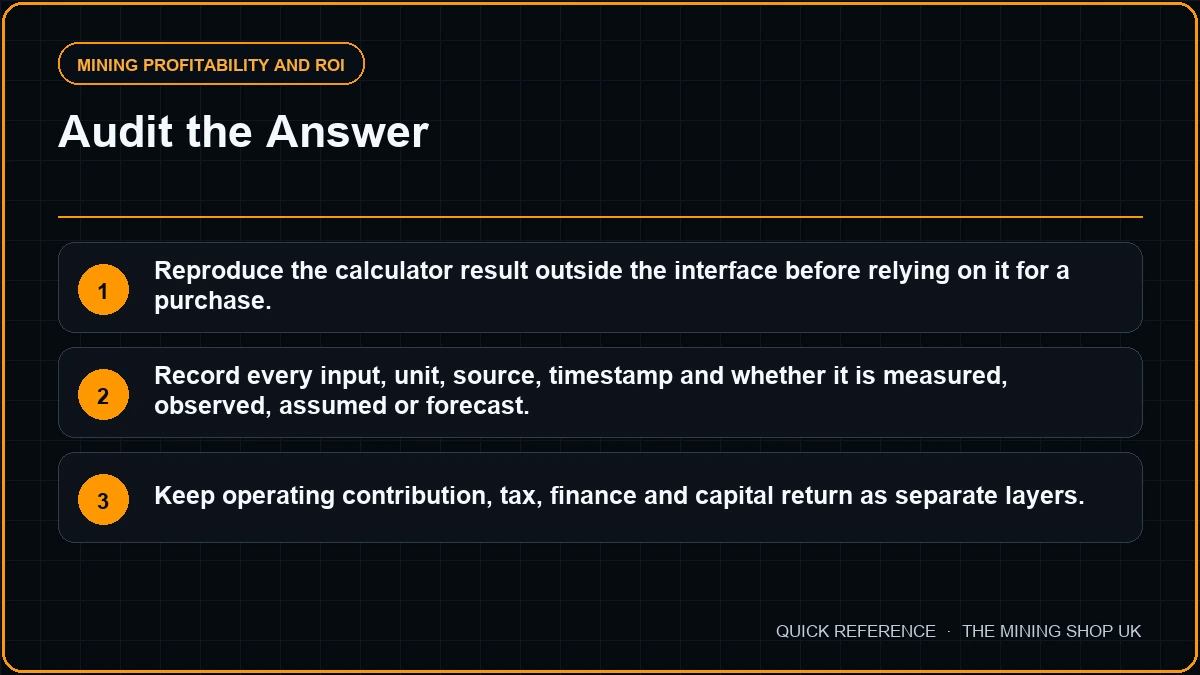
Compare the exact hashrate and unit, power, electricity rate, pool fee, uptime, Bitcoin price, network difficulty and reward assumptions. Check the update time and whether each figure is before or after costs. A different pool payment method can also change credited income.
They open the Bitcoin calculator with the selected miner’s current listed hashrate and power. You still need to set your own electricity price, pool fee, uptime and other daily costs. Check the linked product page for availability and equipment details.
Enter 0.25 in a field labelled £/kWh. Entering 25 means £25/kWh, which is one hundred times larger. Use the complete rate you actually pay and include additional charges in the appropriate cost field.
Use productive hashrate while the miner is running, then enter uptime separately. If your hashrate average already includes offline periods, do not deduct that downtime again. Include standby energy and fixed daily charges separately where they continue during downtime.
No. Check which costs the daily figure includes. The Bitcoin calculator’s operating estimate does not repay hardware, installation, financing, repairs or tax automatically. Add the relevant costs and consider the ownership period before evaluating payback.
The entered operating costs exceed expected income under those assumptions. Check the inputs and the complete costs before deciding what the result means for your proposed setup. Future prices, network conditions, downtime and repairs can change the outcome.
No. They repeat the entered assumptions over that period. Bitcoin price, difficulty, reward, uptime and costs can change. Review a lower-income and higher-cost case alongside the current estimate; no future payout is guaranteed.
No. Solo block discovery is highly variable, especially at small hashrates. Use the solo mining calculator to understand block odds and runtime assumptions. Accepted shares do not mean a Bitcoin block has been found.
Choose the exact model, check the units and enter the costs that apply to your setup. Compare like-for-like operating results, then assess the wider purchase and ownership costs separately.
Calculate with your own assumptions, then review the current miner range or hosting eligibility and complete quote requirements. Verify the exact product, condition, included equipment and current order terms before buying.
A useful estimate makes its inputs and exclusions clear. Check the current figures, test the costs you actually expect to pay, and resolve unknown requirements before committing to equipment or a hosting agreement.


Build a five-year ASIC replacement calendar from efficiency gap, tariff, failure rate, parts, firmware, resale, network scenarios and capital gates.

Build ASIC profit forecast ranges using base, downside and severe cases for accepted hashrate, energy, uptime, difficulty, reward, fees, price and repairs.
Compare European ASIC mining energy costs using the correct tariff band, taxes, grid connection, curtailment, cooling, contracts and location risks.
Join the ASIC Mining Discussion
Members can read and join the discussion
Log in to read comments from other miners. Create a free account if you would like to ask a question or share your experience.
Membership helps us protect the discussion from spam and keep answers useful.