

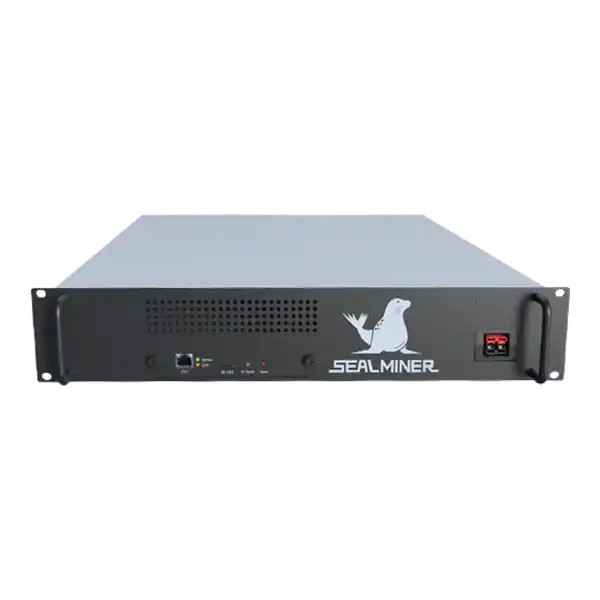
Sealminer DL1 Hydro
Litecoin & Dogecoin ASIC Miner

52.5GH
HASHRATE
149W/GH
EFFICIENCY
7823W
POWER
£774.73
EST. MONTHLY
NO PAYBACK
EST. ROI
Understand multi-ASIC deployment planning through continuous loads, circuits and PDUs. Check costs, limits and risks before making an ASIC decision.
Multi-ASIC deployment planning must treat circuits, PDUs, racks, airflow and heat rejection as one engineered system. A safe ASIC miner electrical setup treats the miners, circuits, PDUs, racks, airflow and heat rejection as one engineered system.
A multi-miner build is an electrical and thermal system, not a row of spare sockets. This guide starts from manufacturer maximums, turns the fleet into circuit and rack loads, sizes the ventilation problem, and sets out the measurements needed before extra miners are commissioned.
Multi-ASIC deployment planning: Planning more than a couple of full-size miners? Speak to The Mining Shop's consultancy team about the load schedule, distribution, rack layout, cooling and heat reuse before committing to hardware.
A site operator is checking multi-ASIC deployment planning. If local power or noise is the constraint, compare managed hosting locations . Create one row per model before choosing a breaker or PDU.
Create one row per model before choosing a breaker or PDU. Record permitted voltage, phase, manufacturer input current, typical and maximum power, connector, cooling method and temperature range from the current manual.
BITMAIN lists the S19 XP 234TH at 3,510 W typical wall power with ±5% variation, 220 to 277 V AC, 20 A single-phase input and a 4,000 W adapted supply requirement. Ten outlets cannot be designed from the 35.1 kW headline alone.
| Fleet example | Calculation | Result before margin |
|---|---|---|
| 10 × S19 XP | 10 × 3.510 kW | 35.1 kW |
| Daily energy | 35.1 × 24 h | 842.4 kWh |
| Approximate heat | 35.1 × 3,412 | 119,761 BTU/h |
| Supply requirement | 10 × 4.0 kW | 40 kW |
A competent design must also cover ambient conditions, cable installation, protection and ancillary loads.

Full-size ASICs are continuous industrial loads. Electrical Safety First says most domestic extension leads are rated at 13 A and warns against exceeding their marking or daisy-chaining. A miner specified at 20 A needs a dedicated, correctly designed connection.
In the UK, a competent designer must assess the installation under BS 7671 and, at work, the Electricity at Work Regulations. HSE requires planned work, suitable equipment and competent people. Verify supply capacity, earthing, fault protection, disconnection, cable capacity and voltage drop.
Do not import a blanket US '80%'. Rule or assume diversity: miners intended to run together are simultaneous loads. Balance single-phase circuits across a three-phase supply and prove the result with metering. Label isolation and plan shutdown so extraction or pumps are not left unsafe.
A PDU rating cannot override its inlet, upstream breaker, cable, branch protection or outlets. Match the complete path to voltage, phase and current. Reject loose, discoloured or improvised terminations and never daisy-chain PDUs.
Specify branch protection, voltage/current/kW/kWh metering, phase visibility, alarm thresholds, outlet retention, strain relief, hot-side temperature rating, accessible isolation and clear labels. An unused outlet is not proof of spare capacity.
Schneider Electric describes metering, phase balancing and overload alarms as rack-PDU capacity tools. They matter because miner software is not the safety measurement. Trend real PDU data and investigate rising current or connector temperature early.
Plan a rack in kW per shelf, PDU and exhaust path. Six 3.5 kW miners are about 21 kW typical before tolerances and auxiliaries. Verify rack and shelf loads, centre of gravity, cable bend radius, service clearance and removal access.
Map each miner to its circuit and outlet. Keep cables clear of fan inlets, protect network leads from exhaust heat and preserve inspection access. Empty space is useful when it prevents recirculation or enables maintenance.
Distribute heat as well as current: one dense rack may overwhelm an extraction point that two rows could share. The Mining Shop consultancy can model power and cooling together.
Almost every kilowatt entering an air-cooled miner becomes room heat. Ten typical S19 XP units create about 35.1 kW before ancillary loads. A rough calculation is:
`air volume (m³/s) = heat (kW) ÷ [1.2 × 1.005 × allowed rise (K)]`
At a 10°C rise, 35.1 kW needs roughly 2.9 m³/s or 10,500 m³/h. This is only a starting point: filters, ducts, bends, altitude and recirculation add resistance. Select fans from pressure/flow curves and test at the hottest ambient condition.
Separate intake and exhaust with sealed baffles or ducts. Monitor face temperature, exhaust, pressure and fan speed. Service filters before they starve airflow. Hydro and immersion move heat into liquid but still require manufacturer-specified flow, heat exchangers and failure interlocks.
Commission the installation before filling outlets, then energise one miner, branch and rack at a time. Record phase voltage/current, real kW and power factor. PDU branch current. Connection temperatures. Miner inlet, exhaust and chip temperatures. Fan RPM. Accepted hashrate. Rejects. Room pressure. Airflow. Alarms and isolation.
Thermal imaging is an inspection tool, not permission to open live equipment. Stop for hot connectors, smell, discolouration, unstable voltage, trips or rising inlets, and correct the cause before expanding.
Leave headroom for hot weather, blocked filters and fan failure. Set warnings below shutdown limits and assign a responder. A rack proven on a cool night is not proven for an August afternoon.
The reliable way to scale ASICs is to plan the full energy path: supply, protective device, cable, PDU, outlet, miner and heat rejection. Use manufacturer maximums, meter the real load, balance phases, separate intake from exhaust and add machines only after each stage is thermally and electrically stable. If the building cannot support the load cleanly, managed ASIC hosting may be the lower-risk answer.
Multi-ASIC deployment planning: Planning more than a couple of full-size miners? Speak to The Mining Shop's consultancy team about the load schedule, distribution, rack layout, cooling and heat reuse before committing to hardware.
Create one row per model before choosing a breaker or PDU. Record permitted voltage, phase, manufacturer input current, typical and maximum power, connector, cooling method and temperature range from the current manual.
Full-size ASICs are continuous industrial loads. Electrical Safety First says most domestic extension leads are rated at 13 A and warns against exceeding their marking or daisy-chaining.
A PDU rating cannot override its inlet, upstream breaker, cable, branch protection or outlets.
Planning more than a couple of full-size miners? Speak to The Mining Shop's consultancy team about the load schedule, distribution, rack layout, cooling and heat reuse before committing to hardware. If local power or noise is the constraint, compare managed hosting locations.
Inventory every miner by voltage, phase, manufacturer input current, maximum power, connector and cooling method. Design circuits and PDUs for simultaneous continuous operation with a competent electrician. Do not borrow the US 80% rule or assume diversity.
Treat almost all miner power as room heat, separate intake from exhaust, meter each branch and commission in stages. Ten 3.51 kW S19 XP units represent about 35.1 kW of typical IT load and roughly 120,000 BTU/h before design margin or ancillary cooling.
Check the exact hardware, electricity, network, pool and operating assumptions before making a decision.

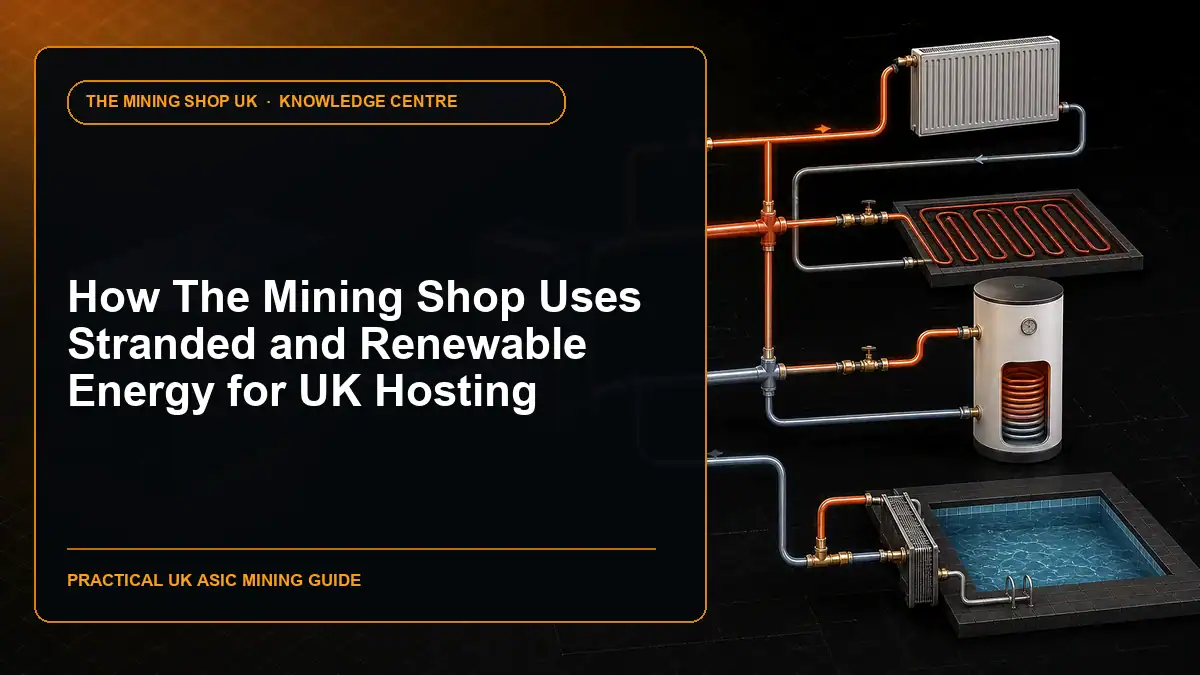
Renewable energy Bitcoin mining UK: UK guidance on contracts, cost, ownership, risk, records and practical checks to complete before committing equipment.
Use this Bitcoin mining handbook after commissioning to manage daily checks, maintenance, pools, security, cost reviews, records, incidents and end-of-life.
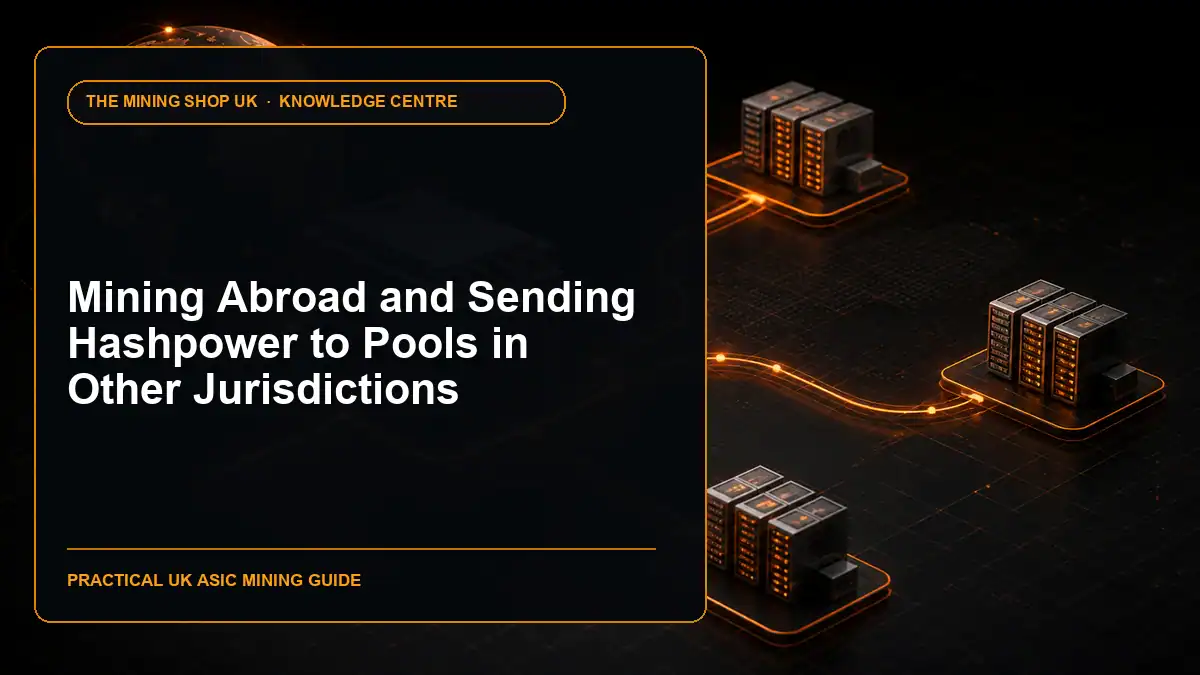
Cross border hashpower: Record where the hardware is located, who owns it, who operates it, who buys electricity, which entity contracts with the pool.
Join the ASIC Mining Discussion
Members can read and join the discussion
Log in to read comments from other miners. Create a free account if you would like to ask a question or share your experience.
Membership helps us protect the discussion from spam and keep answers useful.