

Sealminer A4 Ultra Hydro
Bitcoin & Bitcoin Cash ASIC Miner

886TH
HASHRATE
9.45W/TH
EFFICIENCY
8373W
POWER
£856.08
EST. MONTHLY
NO PAYBACK
EST. ROI
Understand ASIC heat-recovery system through heat capture, airflow and controls. Check usable demand, complete costs and safety before building the system.
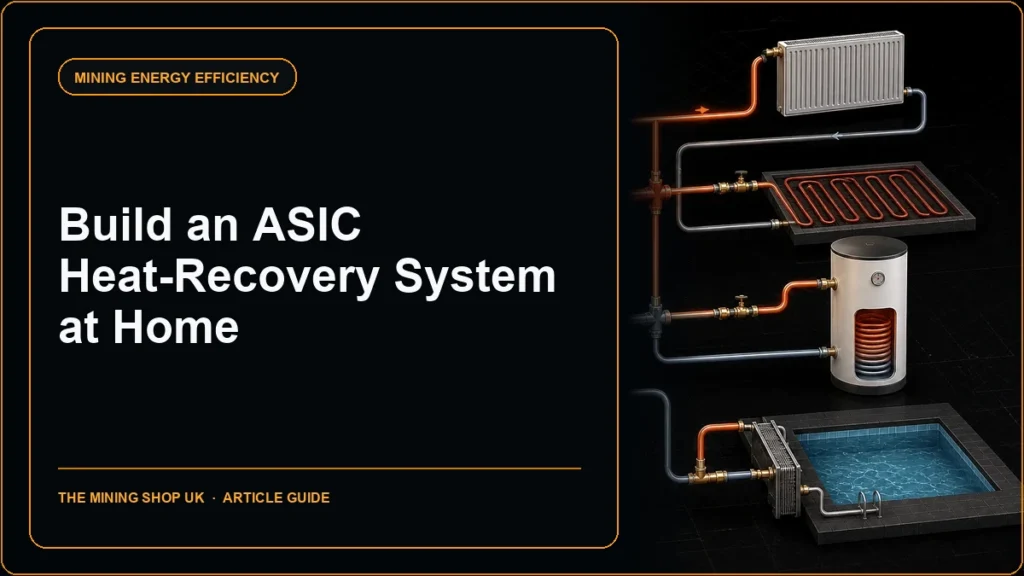
An ASIC heat-recovery system only creates a useful saving when recovered heat replaces energy that the building would otherwise buy. You can reuse ASIC miner heat when the installation moves warm air safely and the recovered energy replaces heating you would otherwise buy.
An ASIC miner is a continuous electrical heat source as well as a mining machine. This guide shows how to convert wall power into heat output, estimate the portion a building can genuinely use, choose a practical airflow layout and value recovered heat without flattering the economics.
ASIC heat-recovery system: We often hear home miners ask whether they can add a heat-recovery unit to an ASIC. The useful answer is that the heat is already there.
A site operator is checking ASIC heat-recovery system. If 3 kW of exhaust goes outdoors, the miner produced 3 kW of heat but the building recovered almost none.
We often hear home miners ask whether they can add a heat-recovery unit to an ASIC. The useful answer is that the heat is already there.
The chips, power supply and fans take electrical energy from the wall. After the tiny amount carried away as network signals or stored temporarily in moving air and components is ignored, almost all of that input ends up as heat in or immediately around the installation.
That does not make every watt useful to the house.
If 3 kW of exhaust goes outdoors, the miner produced 3 kW of heat but the building recovered almost none. Separate total output from useful delivered heat or the project economics will be overstated. This is also why a miner cannot be treated like a small computer.
Industrial air-cooled ASICs move a large volume of air continuously, and their heat, noise and electrical load all arrive together. Read our home Bitcoin mining setup guide before choosing the room or circuit.

Start with measured wall power, not the marketing hashrate. The practical steady-state calculation is: heat output in kW is about wall power in kW. Daily heat energy is wall power in kW multiplied by running hours. NIST’s conversion table states that one BTU per hour is 0.2930711 watts.
So watts multiplied by about 3.412 gives BTU per hour. Useful heat needs one more assumption: the capture factor.
This is the share delivered to the space that needs heating after duct leakage, outdoor exhaust, plant-room losses and periods of excess heat are removed. Useful heat energy equals wall power multiplied by runtime multiplied by the capture factor. Do not choose 100% merely because the equation looks neat.
Measure room temperatures and airflow, and use a deliberately conservative factor until the installation proves otherwise.
| Quantity | Calculation | 3.00 kW example |
|---|---|---|
| Heat rate | Wall power in kW | About 3.00 kW |
| Heat rate in BTU/h | Watts × 3.412 | About 10,236 BTU/h |
| Heat energy over 24 hours | kW × 24 | 72 kWh of heat |
| Useful heat at 80% capture | kW × hours × 0.80 | 57.6 kWh per day |
Bitmain specifies a typical wall draw of 3,510 W for the 234 TH/s S19 XP at 25°C, with actual wall power allowed to vary by ±5%. At the typical figure, it is therefore a roughly 3.51 kW heat source, equivalent to about 11,975 BTU/h.
Run continuously and it consumes 84.24 kWh and releases roughly the same quantity as heat every 24 hours.
Suppose an engineered duct arrangement delivers 80% of that heat into a workshop during a cold day. Useful heat is 3.51 × 24 × 0.80, or about 67.4 kWh. The other 16.8 kWh has not disappeared. It was simply lost or delivered where it had no heating value.
Bitmain’s permitted power variation also means a design should not assume exactly 3.51 kW. Measure the actual miner and size the airflow and electrical installation for the manufacturer’s requirements, not just our example.
Direct space heating is simplest: discharge into a secure, dry workshop with clean inlet air. Fan noise remains, and the room still needs a route for surplus heat. Ducted transfer separates the miner from the occupied room. Use a short, smooth, correctly sized route and divert exhaust outdoors when heat is unwanted.
Long flexible hose, tight bends and undersized filters can turn a noise solution into an overheating problem. Air-to-water, hydro and immersion recovery can serve a buffer tank or heating loop. But need heat exchangers, pumps, controls, compatible fluids and independent heat rejection. Domestic hot water adds hygiene, pressure and temperature requirements.
Treat it as specialist engineering.
Never let a thermostat close a damper against a running miner. Divert exhaust between heating and rejection routes, or use an approved shutdown or lower-power method. Failure must leave free exhaust or stop the miner safely. After any change, record inlet and board temperatures, fan speed, hashrate and thermal events. Test at the warmest expected ambient temperature and prevent exhaust recirculation.
Value heat against the marginal heating cost it actually displaces. If 67.4 kWh replaces resistive electric heating priced at an illustrative £0.25/kWh, the gross heat credit is £16.85 for that day.
If it replaces a heat pump delivering an illustrative three units of heat per unit of electricity, the avoided electricity is closer to 22.5 kWh, worth about £5.62 at the same tariff. Those examples are arithmetic, not tariff or performance promises.
Do not subtract the heat credit twice. The miner still used 84.24 kWh of electricity. Mining revenue and avoided heating cost are two separate benefits against that same input cost. The credit also falls to zero whenever doors are open, the space is already warm or the exhaust has to go outside.
Use our live ASIC profitability table for mining income, then add only a defensible seasonal heat credit.
Heat reuse works best where there is a long, predictable demand: a workshop, warehouse, greenhouse or process that would otherwise buy heat. It works less well in a well-insulated home that needs short bursts of heating and silence overnight. Summer rejection is not optional. So every system needs a plan for the months when useful heat is worth nothing.
The miner still requires a suitable continuous-load electrical installation, safe isolation, fire precautions, clear access and manufacturer-compliant air conditions. Do not run an industrial miner in a bedroom or line an improvised enclosure with combustible acoustic foam. If heat and noise are difficult to manage, compare the real home cost with professional ASIC hosting.
Sometimes the most efficient home heat-recovery decision is not to put the machine in the house.
A miner's wall draw gives a sound first estimate of its heat output. But useful heat is the smaller number that reaches a space at the time it is wanted. Measure wall power, apply a conservative capture factor and value only the heating purchase genuinely avoided.
Build the airflow around the miner's cooling requirement first. Heat recovery comes second. Done properly, an ASIC can offset a meaningful winter load. Done badly, it becomes an expensive way to recirculate hot air and shorten hardware life.
ASIC heat-recovery system: We often hear home miners ask whether they can add a heat-recovery unit to an ASIC.
We often hear home miners ask whether they can add a heat-recovery unit to an ASIC.
Start with measured wall power, not the marketing hashrate. The practical steady-state calculation is: heat output in kW is about wall power in kW.
Bitmain specifies a typical wall draw of 3,510 W for the 234 TH/s S19 XP at 25°C, with actual wall power allowed to vary by ±5%.
[object Object]
In steady operation, nearly all of an ASIC miner's wall power ultimately appears as heat in or around the installation. A 3.51 kW miner produces roughly 3.51 kW of heat, about 12,000 BTU per hour. But the building may capture much less.

Compare the most efficient Bitcoin ASICs by J/TH, wall power, operating mode and cooling before choosing hardware for purchase or hosting.
Run an accepted J per terahash comparison using matched wall power, pool work, ambient conditions, firmware fees, rejects and stable operating modes.
Plan Bitcoin mining intermittent energy controls around minimum load, start and stop cycles, pool recovery, uptime, fixed costs and safe curtailment.
Join the ASIC Mining Discussion
Members can read and join the discussion
Log in to read comments from other miners. Create a free account if you would like to ask a question or share your experience.
Membership helps us protect the discussion from spam and keep answers useful.