Avalon Nano 3S: What a Compact Bitcoin Miner Can Do
Avalon Nano 3S guide: Treat 6TH/s and 140W as a compact learning and heat-use profile, not industrial production. Read the practical UK guide before deciding.
Avalon Nano 3S guide depends on a clear operating boundary and evidence that can be checked before money or equipment is committed. The Avalon Nano 3S is a compact SHA-256 home miner and heater, not a replacement for an industrial ASIC.
Canaan lists 6TH/s, 140W maximum and an efficiency class around 29J/TH, with a low-voltage 28V input and stated sound range. Its modest total load makes it useful for learning, a desk or small heat application. At the same time, its accepted output and expected solo probability remain far below full-size machines.
Buyers should verify the supplied adaptor, operating mode, pool route and heat use, then value education and displaced heating separately from mining receipts.
Avalon Nano 3S guide in simple English
Avalon Nano 3S guide: The Nano 3S makes Bitcoin mining tangible at a manageable total load. It is best judged as a compact ASIC, learning tool and modest heater, with honest expectations for output.
Simple example
A miner is checking Avalon Nano 3S guide. Write the intended outcome before looking at a headline hashrate. The correct comparison changes when the available circuit, sound limit, heat demand, pool route or expected ownership period changes.
Key terms in plain English
ASIC:
A computer built to do one specialised job. A mining ASIC is designed for a particular proof-of-work algorithm.
Hashrate:
The amount of mining work a machine attempts each second. More hashrate does not guarantee more profit.
Efficiency:
How much electricity a miner uses for a set amount of work. Lower joules per terahash usually means better efficiency.
Wall power:
The electricity measured at the socket or supply. It includes losses that a headline chip figure may leave out.
Mining pool:
A service that combines work from many miners and shares rewards using stated rules.
Define the exact model and buying purpose
Confirm Nano 3S rather than Nano 3, Mini 3 or Avalon Q. Record regional power adaptor, included cable, firmware and modes.
Define the purpose as pool mining, solo learning, desk display or room heat. The best mode and value change with that purpose.
Compare total watts as well as J/TH. A full-size miner may be more efficient but create far more heat and sound than a room can use.
Write the intended outcome before looking at a headline hashrate. A learning device, a useful room heater, a quiet home miner and a commercially productive machine are different purchases. The correct comparison changes when the available circuit, sound limit, heat demand, pool route or expected ownership period changes.
Use a dated decision sheet and keep manufacturer claims separate from measured results. Record the exact model, variant, power supply, firmware and operating mode. Similar product names do not make accessories, voltage, firmware or thermal limits interchangeable.
Quick reference for Avalon Nano 3S guide.
Verify condition, specification and seller evidence
Use Canaan’s current product and support route, verify the seller and included certified power equipment, and inspect the unit and adaptor on arrival.
Confirm current pool compatibility and worker format. Use a receive-only address and never enter wallet secrets.
Check screen, network, fan or thermal behaviour and whether firmware recovery is available for the exact revision.
Prefer the manufacturer specification, manual and firmware portal for identity and limits. But treat them as the starting point rather than a promise of site performance. Keep a copy of the pages and files used because support pages, downloads and product revisions can change.
Ask the seller for a serial photograph, condition statement, included accessories and a recent operating record for the actual unit. A generic product image cannot prove board revision, power supply condition, repair history or whether the miner reaches stable accepted work.
Plan safe power, cooling, network and pool access
Use only the specified low-voltage supply and keep the adaptor ventilated. Protect the cable from damage and do not substitute another connector-compatible voltage.
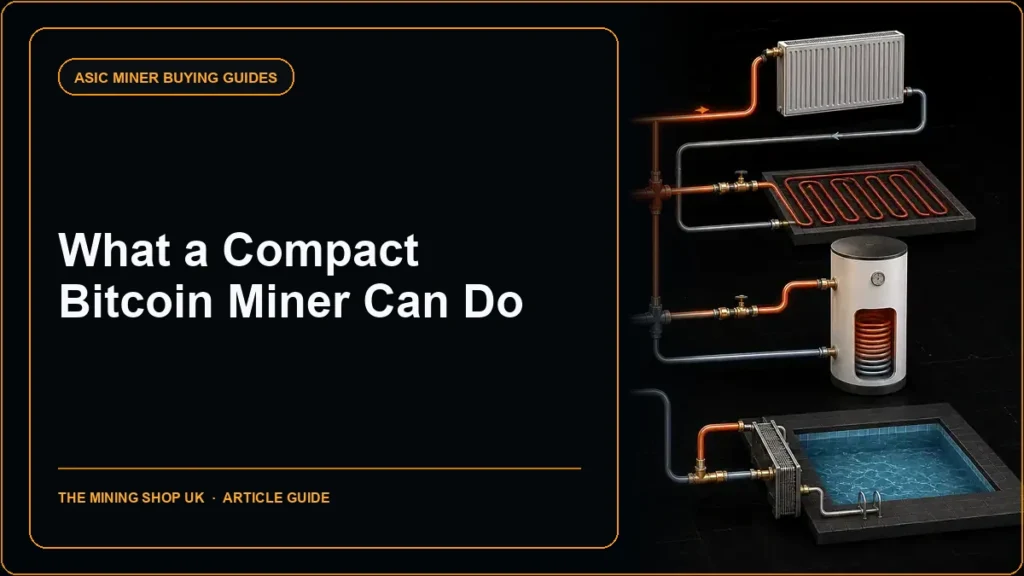
Place the unit where its roughly 140W heat is useful without blocking airflow or creating sound nuisance.
Use a separate IoT or guest network, strong Wi-Fi settings and no public port forwarding.
A competent person should confirm the electrical route for the real continuous load. Check voltage, protective device, earthing, cable, connector, socket, isolation and ventilation together. Do not assume that a plug physically fitting a socket proves that the circuit is suitable for sustained operation.
Place the miner on a trusted network segment with no unnecessary inbound exposure. Change supplied credentials, use a documented wallet and pool account, set approved backup endpoints and confirm that every endpoint belongs to the intended operator before power is applied.
Measure accepted work and complete ownership cost
At 140W, nominal daily energy is 3.36kWh. Multiply measured input by the tariff and include adaptor loss.
Compare local and pool-accepted work, rejects, temperature and reconnects over a representative run.
Value heat only against heating otherwise purchased. For mining economics, include price, pool fee, difficulty, downtime and the small output class.
Measure power at the wall and compare local hashrate with accepted pool work over a representative period. Local display figures can look healthy while stale shares, invalid work, reconnects or a wrong payout address reduce useful output.
Calculate revenue and cost over a range, not one favourable day. Include electricity, pool fees, auxiliary cooling, maintenance, downtime, conversion costs and hardware value. For a heat-use case, credit only heat that replaces a cost the owner would otherwise incur.
Control model-specific purchase risk
Hardware decision risk register
Risk
Evidence to get
Control
Wrong power adaptor
Official voltage and supplied equipment
Use exact approved supply
Pool rejects low output
Accepted-share test
Use a compatible route
Heat value overstated
Room heating baseline
Credit only displaced energy
Solo odds presented as income
Dated probability model
Explain randomness
Marketplace unit differs
Model and firmware identity
Verify the shipped revision
Rank each risk by consequence and by the practical ability to detect it before purchase. A low-priced machine with uncertain firmware, exhausted cooling or a weak algorithm market can require more working capital and attention than a newer unit with a higher invoice price.
Set written stop conditions. Examples include an unsafe supply, unavailable official firmware, rejected work above the approved limit, repeated thermal shutdown, no lawful payout route or an energy break-even price below the contracted rate. A stop condition prevents sunk cost from becoming the reason to continue.
Run a controlled acceptance test
Commission at the standard mode, measure complete input, confirm network and pool-accepted work, then test any heat or quiet mode separately.
Observe the room, adaptor and device through a full heating period and verify restart and configuration recovery.
Begin with one unit or the smallest sensible batch. Photograph labels and connections, export the original configuration, note ambient conditions and record the start time. Watch the kernel or system log, board detection, fan behaviour, temperatures, local hashrate, pool connection and accepted work.
Do not declare acceptance from a short dashboard snapshot. Run long enough to expose heat soak, intermittent network faults and pool variance. Retain the test record with the invoice, serial number, firmware file and any seller correspondence so a later repair or warranty question has a clear baseline.
Final model buying checklist
Confirm the exact model, variant, condition and included power equipment.
Verify official specifications, instructions and the correct firmware route.
Approve the continuous electrical load, airflow, heat and sound plan.
Test network isolation, credentials, pool endpoints and payout ownership.
Compare wall power with accepted work over a representative run.
Model downside revenue, electricity, downtime, maintenance and resale.
Record acceptance limits and a safe stop or return route.
Reassess whenever firmware, network economics or site conditions change.
The checklist is deliberately evidence based. Marketing language such as home friendly, efficient or profitable has no fixed meaning without a measured operating mode and a real site boundary. The record should make it possible for another competent person to reproduce the decision.
Frequently asked questions
What is the main point of Avalon Nano 3S guide?
Avalon Nano 3S guide: The Nano 3S makes Bitcoin mining tangible at a manageable total load.
For Avalon Nano 3S guide, what should a beginner know about defining the exact model and buying purpose?
Confirm Nano 3S rather than Nano 3, Mini 3 or Avalon Q.
For Avalon Nano 3S guide, what should a beginner know about verifying condition, specification and seller evidence?
Use Canaan's current product and support route, verify the seller and included certified power equipment, and inspect the unit and adaptor on arrival.
For Avalon Nano 3S guide, what should a beginner know about planning safe power, cooling, network and pool access?
Use only the specified low-voltage supply and keep the adaptor ventilated.
Key points to remember
The Nano 3S makes Bitcoin mining tangible at a manageable total load. It is best judged as a compact ASIC, learning tool and modest heater, with honest expectations for output. Verify the supply and pool, measure accepted work and energy, and choose it because its 140W-class footprint fits the room, not because a lottery outcome is promised.
Next steps
Use The Mining Shop UK tools and support pages to compare the exact hardware against your real electricity, installation, pool and operating constraints before ordering or commissioning it.
Treat 6TH/s and 140W as a compact learning and heat-use profile, not industrial production. Verify the official 28V supply, adaptor, firmware, pool and measured accepted work for the exact unit.
Darren Waggott is the visionary Founder and CEO of The Mining Shop UK, with over a decade of leadership in the cryptocurrency mining sector. Renowned for driving innovation, Darren has built a company dedicated to providing high-quality ASIC miners and comprehensive hosting services. His forward-thinking approach places The Mining Shop UK at the forefront of the industry.
Membership helps us protect the discussion from spam and keep answers useful.
ASIC MINING SUPPORT
Need Help Choosing an ASIC Miner?
Tell us what you want to mine, your electricity cost and where the machine will run. We can help you compare hardware, power requirements, hosting and repairs.
We use necessary cookies to run the shop and optional analytics cookies to understand how visitors use the site and improve shopping and checkout. You can accept analytics, use only necessary cookies, or choose settings. You can change your choice at any time.
Functional
Always active
The technical storage or access is strictly necessary for the legitimate purpose of enabling the use of a specific service explicitly requested by the subscriber or user, or for the sole purpose of carrying out the transmission of a communication over an electronic communications network.
Preferences
The technical storage or access is necessary for the legitimate purpose of storing preferences that are not requested by the subscriber or user.
Statistics
The technical storage or access that is used exclusively for statistical purposes.The technical storage or access that is used exclusively for anonymous statistical purposes. Without a subpoena, voluntary compliance on the part of your Internet Service Provider, or additional records from a third party, information stored or retrieved for this purpose alone cannot usually be used to identify you.
Marketing
The technical storage or access is required to create user profiles to send advertising, or to track the user on a website or across several websites for similar marketing purposes.





Join the ASIC Mining Discussion
Members can read and join the discussion
Log in to read comments from other miners. Create a free account if you would like to ask a question or share your experience.
Membership helps us protect the discussion from spam and keep answers useful.