Learn how ASIC mining thermal imaging works, what it changes for miners, the money and safety risks, and the checks to make before using it.
TL;DR
ASIC mining thermal imaging matters only when it improves a measured operating, security or financial result.
Trend images taken under comparable load can prioritise inspection without treating every warm component as a fault.
Emissivity, reflections, changing load and unsafe access can produce misleading readings; thermography does not replace competent electrical testing.
Test one controlled change, use net figures and keep a documented recovery route.
ASIC mining thermal imaging in simple English
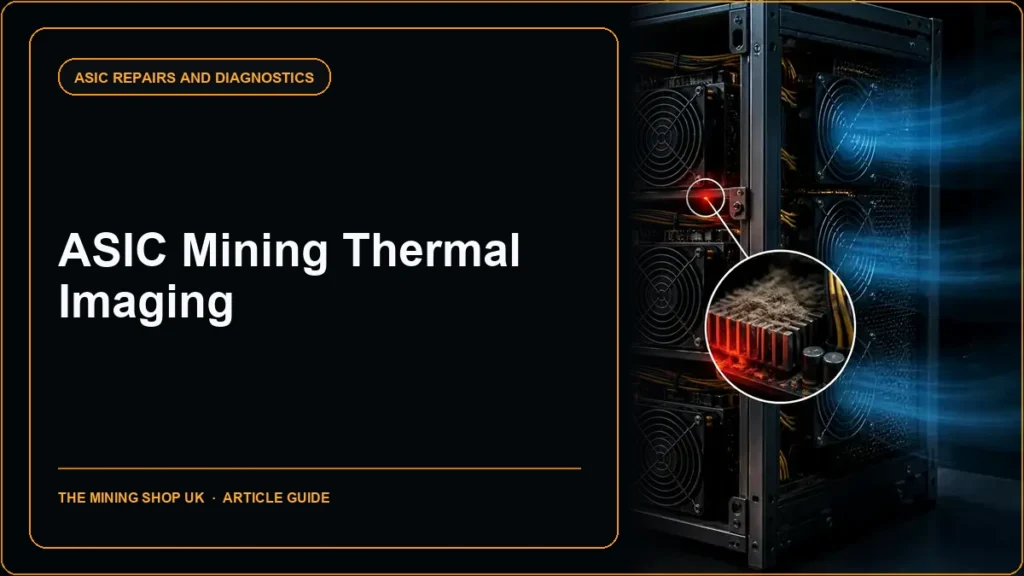
ASIC mining thermal imaging: A thermal camera shows surface temperature patterns that may reveal a loose termination, overloaded component, blocked airflow or failing fan.
Simple example
A trained inspector records load, camera settings and matching visible images, then isolates equipment before physical investigation.
Key terms in plain English
Preventive maintenance:
Planned inspection and servicing intended to reduce unexpected failures.
Baseline:
A recorded healthy condition used for later comparison.
Thermal throttling:
Automatic performance reduction when temperature approaches a protective limit.
Isolation:
Safely disconnecting all relevant energy sources before physical work.
Trend:
A change observed across comparable measurements rather than one isolated reading.
What ASIC mining thermal imaging mean
A thermal camera shows surface temperature patterns that may reveal a loose termination, overloaded component, blocked airflow or failing fan. Put simply, ASIC mining thermal imaging is a decision about evidence and control rather than a magic setting. The useful question is not whether the idea sounds advanced.
It is whether the change produces more accepted work, lower measured cost, stronger security or faster recovery under the conditions at the site.
Trend images taken under comparable load can prioritise inspection without treating every warm component as a fault. That benefit should be written as a testable claim. Identify the worker, circuit, endpoint, wallet or accounting period involved, then decide which measurement would prove the result. A local dashboard is helpful, but pool records, wall meters, node logs and wallet receipts usually provide stronger evidence.
How thermal inspection works
A useful review begins with the operating path. A miner receives work, performs hashes, submits results and depends on supporting power, cooling, networking and accounting. A thermal camera shows surface temperature patterns that may reveal a loose termination, overloaded component, blocked airflow or failing fan. The subject may sit in only one part of that path, but a change there can affect everything downstream.
Draw the path before changing it. Mark who controls each setting, where credentials are stored, what happens after a restart and which record confirms success. For ASIC mining thermal imaging, this prevents a common error: improving one headline number while accepted hashrate, reliability or custody quietly becomes worse.
What changes the financial result
Trend images taken under comparable load can prioritise inspection without treating every warm component as a fault. Convert that into pounds only after separating technical output from price. For mining, useful output means accepted hashrate, valid blocks or credited shares. Gross coin value is not profit, and a favourable coin-price move can hide wasted electricity or downtime.
Use like-for-like equipment and time windows for the baseline. Include electricity at the delivered rate, pool or service fees, cooling, restart losses, staff time and any capital cost created by the change. Where the outcome is mainly security or independence, say so plainly rather than inventing a precise financial return.
Measurements that matter
For ASIC mining thermal imaging, collect timestamps, accepted work, rejected work, uptime and the measurement closest to the real cost. Add temperature, voltage, bandwidth or wallet receipts where they are relevant. Use the same time zone and preserve raw records so an unusual result can be investigated later.
A brief success still needs repeat measurements. Compare ordinary load, a busy period and a controlled fault or restart where that can be done safely. Look for differences between the miner display and the receiving pool or node. If the two disagree, reconcile the definitions before calculating a percentage gain.
A practical decision path for thermal inspection in a mining operation.
A safe trial plan
Keep the first test small, reversible and separated from wallets or production administration. Record the original configuration so a failed trial can be undone without guesswork. Confirm current official documentation, supported versions and the exact model or service before committing. Do not paste secrets into screenshots, logs or support requests.
If a wallet address or payout rule is involved, verify it independently and begin with a small amount.
A sensible thermal inspection trial has a written starting state, one deliberate change, a monitoring window and a stop condition. Test restart and recovery as well as normal operation. Expand only when the evidence shows that the expected benefit occurred without new rejects, overheating, unsafe conditions or loss of administrative control.
Common mistakes
Emissivity, reflections, changing load and unsafe access can produce misleading readings; thermography does not replace competent electrical testing. This is the main reason ASIC mining thermal imaging should not be judged from a single screenshot or copied configuration. Similar equipment can behave differently because of firmware, component condition, electrical supply, network route, pool policy and ambient temperature.
Changing several variables at once creates another problem. If firmware, pool, power target and network route all change at once, a good or bad result cannot be attributed confidently. Change one layer at a time, keep dated notes and retain a tested way back. Treat unexplained improvement with the same caution as unexplained failure.
Simple worked example
A trained inspector records load, camera settings and matching visible images, then isolates equipment before physical investigation. The example is deliberately narrow. It establishes what changed, which evidence was collected and what would cause the operator to stop. It does not assume the same result for every site or promise a particular income.
Review the completed test with net rather than gross figures. Record any excluded cost and uncertainty. If the difference is smaller than normal daily variation, continue measuring rather than claiming a win. If the change affects safety, security or custody, require the relevant technical review even when the short test looks profitable.
Why 2019 matters
By 2019, mature mining sites increasingly used condition monitoring to find electrical and cooling problems before a forced outage. This date anchors the article to the period when the issue became relevant. It does not mean that present software, tariffs, rewards or hardware match that historical point.
Read the history as context for ASIC mining thermal imaging. Check today’s official release and commercial terms before acting. Mining equipment can remain physically capable while protocol support, electricity cost or pool availability changes around it. A dated guide is useful only when those differences are made explicit.
Decision checklist
Define the exact problem and the evidence that would prove improvement.
Record the current software, configuration, cost and accepted-work baseline.
Use official documentation and confirm model, network and service compatibility.
Protect wallet, management and administrator access throughout the trial.
Change one controlled variable and test restart or recovery.
Calculate the result with net figures and record uncertainty.
Frequently asked questions
What is the main point of ASIC mining thermal imaging?
ASIC mining thermal imaging: A thermal camera shows surface temperature patterns that may reveal a loose termination, overloaded component, blocked airflow or failing fan.
For ASIC mining thermal imaging, what should a beginner know about what ASIC mining thermal imaging means?
A thermal camera shows surface temperature patterns that may reveal a loose termination, overloaded component, blocked airflow or failing fan.
For ASIC mining thermal imaging, what should a beginner know about how thermal inspection works?
A useful review begins with the operating path. A miner receives work, performs hashes, submits results and depends on supporting power, cooling, networking and accounting.
For ASIC mining thermal imaging, what should a beginner know about what changes the financial result?
Trend images taken under comparable load can prioritise inspection without treating every warm component as a fault.
Conclusion
ASIC mining thermal imaging deserves a measured decision, not a copied setting or a promised percentage. Use current official information, begin with a small reversible test and judge the result through accepted work, net cost, security and recovery evidence. Where electrical or specialist work is involved, use someone competent for the installation.
This guide is historically placed on 18 June 2019. By 2019, mature mining sites increasingly used condition monitoring to find electrical and cooling problems before a forced outage. The archive date gives context and is not a claim that present prices, software or rewards match that period.
Mining software, tariffs, hardware support and network rules can change. Confirm current official documentation before committing equipment, electricity, credentials or funds.
About the Author:
Darren Waggott is the visionary Founder and CEO of The Mining Shop UK, with over a decade of leadership in the cryptocurrency mining sector. Renowned for driving innovation, Darren has built a company dedicated to providing high-quality ASIC miners and comprehensive hosting services. His forward-thinking approach places The Mining Shop UK at the forefront of the industry.
Membership helps us protect the discussion from spam and keep answers useful.
ASIC MINING SUPPORT
Need Help Choosing an ASIC Miner?
Tell us what you want to mine, your electricity cost and where the machine will run. We can help you compare hardware, power requirements, hosting and repairs.
We use necessary cookies to run the shop and optional analytics cookies to understand how visitors use the site and improve shopping and checkout. You can accept analytics, use only necessary cookies, or choose settings. You can change your choice at any time.
Functional
Always active
The technical storage or access is strictly necessary for the legitimate purpose of enabling the use of a specific service explicitly requested by the subscriber or user, or for the sole purpose of carrying out the transmission of a communication over an electronic communications network.
Preferences
The technical storage or access is necessary for the legitimate purpose of storing preferences that are not requested by the subscriber or user.
Statistics
The technical storage or access that is used exclusively for statistical purposes.The technical storage or access that is used exclusively for anonymous statistical purposes. Without a subpoena, voluntary compliance on the part of your Internet Service Provider, or additional records from a third party, information stored or retrieved for this purpose alone cannot usually be used to identify you.
Marketing
The technical storage or access is required to create user profiles to send advertising, or to track the user on a website or across several websites for similar marketing purposes.





Join the ASIC Mining Discussion
Members can read and join the discussion
Log in to read comments from other miners. Create a free account if you would like to ask a question or share your experience.
Membership helps us protect the discussion from spam and keep answers useful.