

Sealminer A4 Ultra Hydro
Bitcoin & Bitcoin Cash ASIC Miner
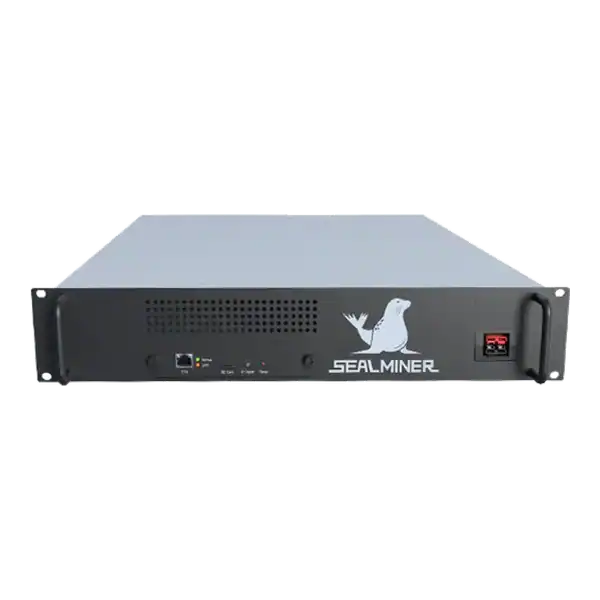

886TH
HASHRATE
9.45W/TH
EFFICIENCY
8373W
POWER
£830.22
EST. MONTHLY
NO PAYBACK
EST. ROI
Plan Bitcoin mining district heating through heat grade, seasonal demand, hydraulic separation, backup, metering, contracts and mining economics.
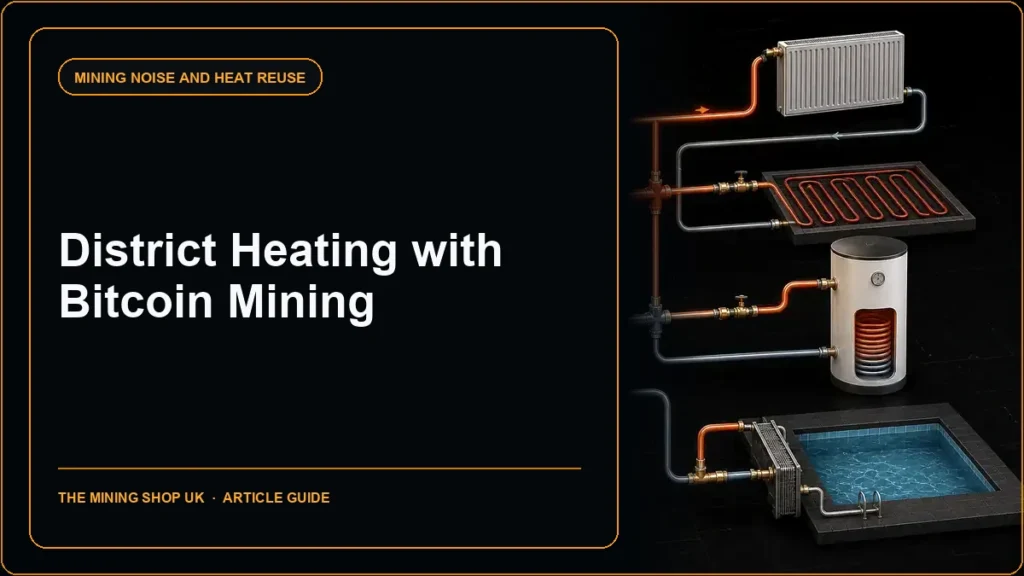
Bitcoin mining district heating can reuse most of an ASIC fleet's electrical input as continuous low-grade heat. But useful delivery depends on temperature, hydraulic design and coincident demand.
A commercial project must separate miner and heat-network circuits, protect equipment, provide backup and rejection when heat is not wanted, meter both energy and accepted work and assign service obligations. Recovered heat improves a project only when it displaces a real alternative at an evidenced value.
Bitcoin mining district heating is viable only when the heat grade, timing and contract fit the network. Measure useful delivered heat, separate circuits, provide backup and rejection and value displacement honestly.
A miner wants to understand Bitcoin mining district heating. Before investment approval, issue an interface schedule naming every temperature, flow, pressure, meter, alarm and service owner at the miner-to-network boundary.
Nearly all ASIC electrical input becomes heat. A measured 1MW miner load therefore creates roughly 1MW of heat before considering where auxiliaries and distribution losses occur.
Use circuit and site meters rather than nameplates. Separate miner heat that reaches the recovery loop from heat rejected by power supplies, fans, dry coolers or the building.
Convert power to energy over the matched period. One megawatt delivered for one hour is 1MWh thermal. Availability and demand determine how much is useful.
Do not call rejected summer heat recovered. Meter heat supplied to the customer boundary and state the calculation method.

Liquid-cooled ASIC outlet temperature depends on model, flow, inlet and control. Compare the supported range with district supply and return requirements under worst ordinary conditions.
Modern low-temperature networks, underfloor systems and preheat loads can accept lower-grade heat more readily than legacy radiators designed for high flow temperature.
A heat pump can raise temperature but adds electricity, capital, maintenance and performance variation. Model seasonal coefficient of performance and backup, not one laboratory value.
Protect miner warranty and chip temperature. Raising outlet temperature to serve a network cannot override manufacturer coolant and operating limits.
| Control | Purpose | Evidence |
|---|---|---|
| Heat exchanger | Separate miner and network fluids | Duty, approach and pressure rating |
| Buffer vessel | Decouple short demand changes | Volume and temperature strategy |
| Pumps | Maintain required flow | Duty, standby and head calculation |
| Water treatment | Control corrosion and fouling | Specification and monitoring |
| Backup heat | Meet heat obligation during mining outage | Capacity and fuel |
| Heat rejection | Protect miners when demand is low | Summer design duty |
Use competent mechanical design for pressure, expansion, air removal, isolation, leak detection and safe maintenance. Do not connect miner cooling directly to a public heat loop merely because both contain water.
Meter temperature and flow across the customer boundary with agreed accuracy. Dashboard chip temperature is not a heat invoice.
Build hourly or half-hourly heat-demand and mining-availability profiles. District demand is often highest in winter. At the same time, maintenance, curtailment and mining economics can interrupt supply.
Define whether mining follows heat demand, operates continuously with surplus rejection or stops when heat is unwanted. Each choice changes hardware utilisation and heat value.
Use thermal storage for short mismatch only after calculating volume, losses and temperature. It does not turn a summer surplus into winter energy.
Provide a plan for a mining shutdown, pool or market curtailment and heat-network fault. A heat customer should know which source maintains service.
Value heat against the marginal alternative actually displaced, including boiler or heat-pump efficiency, fuel, tax and network losses. Retail heat prices are not automatically the value at the miner boundary.
Allocate capital for liquid-cooled ASICs, exchangers, pumps, pipework, storage, heat pump, controls, metering, backup and planning. Avoid crediting the same infrastructure solely to both mining and heat.
Keep mining revenue, heat revenue or saving and environmental attributes separate. Stress-test low bitcoin revenue, high difficulty, warm weather, equipment failure and a lower heat price together.
Set title, funding, maintenance and end-of-life. A heat network may outlive one ASIC generation, so replacement compatibility and residual infrastructure value matter.
Heat networks can have metering, billing, consumer-protection and technical duties depending on structure and jurisdiction. Get current UK legal and regulatory advice before supply.
Complete planning, building, pressure, electrical, water, fire, noise and environmental reviews. Commercial heat obligations should never require unsafe miner operation.
Describe carbon impact against a defined counterfactual and evidence boundary. Recovered heat can displace another source. But the mining electricity source and heat-pump input remain relevant.
Do not label heat free. State price, losses, backup and who pays when the fleet is curtailed.
Bitcoin mining district heating is viable only when the heat grade, timing and contract fit the network.
Nearly all ASIC electrical input becomes heat. A measured 1MW miner load therefore creates roughly 1MW of heat before considering where auxiliaries and distribution losses occur.
Liquid-cooled ASIC outlet temperature depends on model, flow, inlet and control.
Use competent mechanical design for pressure, expansion, air removal, isolation, leak detection and safe maintenance.
Bitcoin mining district heating is viable only when the heat grade, timing and contract fit the network. Measure useful delivered heat, separate circuits, provide backup and rejection and value displacement honestly. The strongest design lets heating remain reliable while the fleet can still be maintained, curtailed or replaced without breaking an undefined dependency.
Commission through a full demand cycle, reconcile meter uncertainty and publish service availability separately from miner uptime.
A technically recoverable megawatt is not a sold or useful megawatt until the receiving network accepts it at the required temperature. Before investment approval, issue an interface schedule naming every temperature, flow, pressure, meter, alarm and service owner at the miner-to-network boundary.
This prevents a gap between the mining contractor, mechanical designer and heat supplier and gives commissioning teams one agreed basis for acceptance, maintenance, seasonal review and dispute evidence.
Use The Mining Shop UK consultancy, efficiency and profitability resources to screen the miner side before detailed heat-network engineering.
Calculate recoverable heat from measured miner and auxiliary power, then derate for exchanger, distribution and availability losses. Match supply and return temperature with the network. Low-grade ASIC heat may suit low-temperature systems directly or require a heat pump.


Bathhouse says it began a pool-heating mining pilot in 2022. Its technical explanation describes immersion-cooled ASICs, a dielectric-fluid circuit and heat exchangers that transfer heat into pool plumbing. The comparison is with its previous electric resistance heaters.
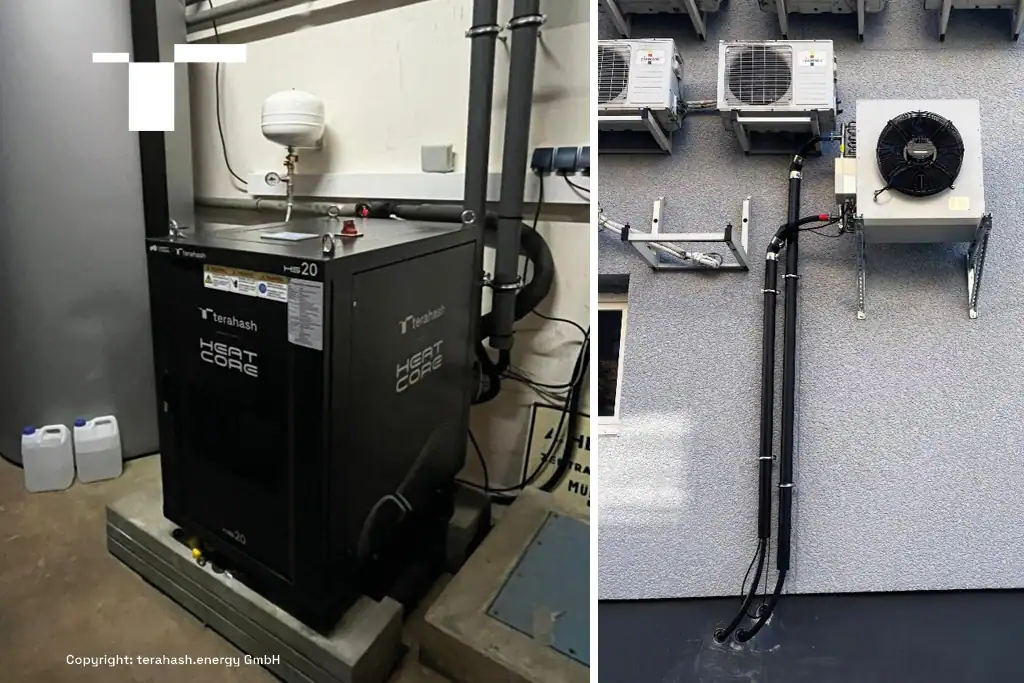
Terahash describes a commissioned system at Nebona’s spice factory: a Heatcore HS20 with two Whatsminer M63 units uses surplus rooftop solar power and supplies hot water to a buffer tank. The existing heating system remains available.

SunBit reports fitting a Bitcoin Boiler alongside the oil boiler in a 200 m² Kotka home. An outdoor unit rejects unwanted summer heat and allows additional use of solar surplus.
Join the ASIC Mining Discussion
Members can read and join the discussion
Log in to read comments from other miners. Create a free account if you would like to ask a question or share your experience.
Membership helps us protect the discussion from spam and keep answers useful.