

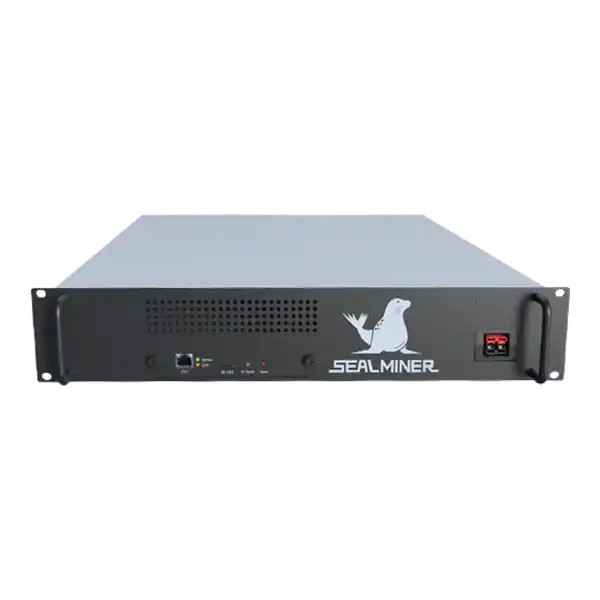
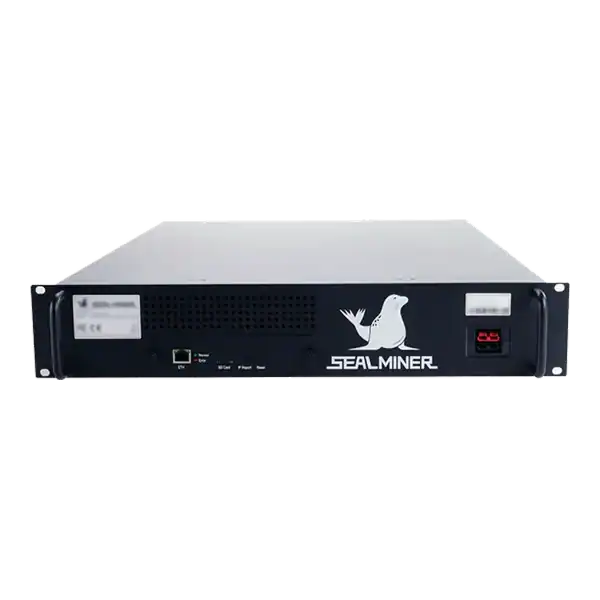
Sealminer A4 Ultra Hydro
Bitcoin & Bitcoin Cash ASIC Miner
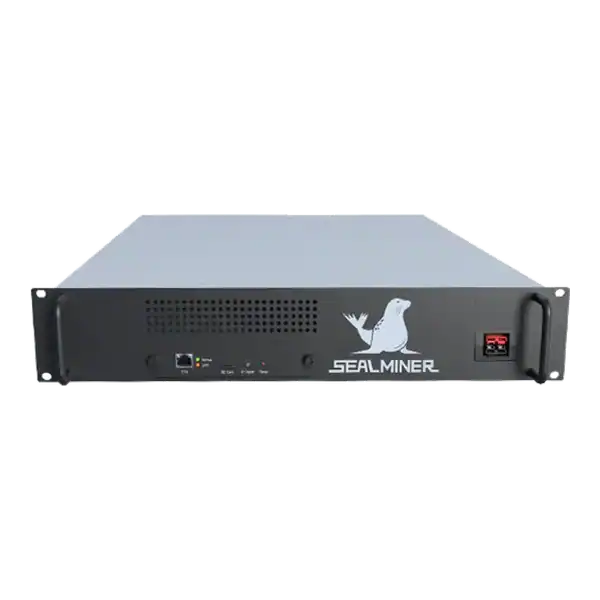

886TH
HASHRATE
9.45W/TH
EFFICIENCY
8373W
POWER
£853.81
EST. MONTHLY
NO PAYBACK
EST. ROI
BIP 351 Private Payments made simple. See what the proposal changes, its current status and what it means for Bitcoin users and operators.
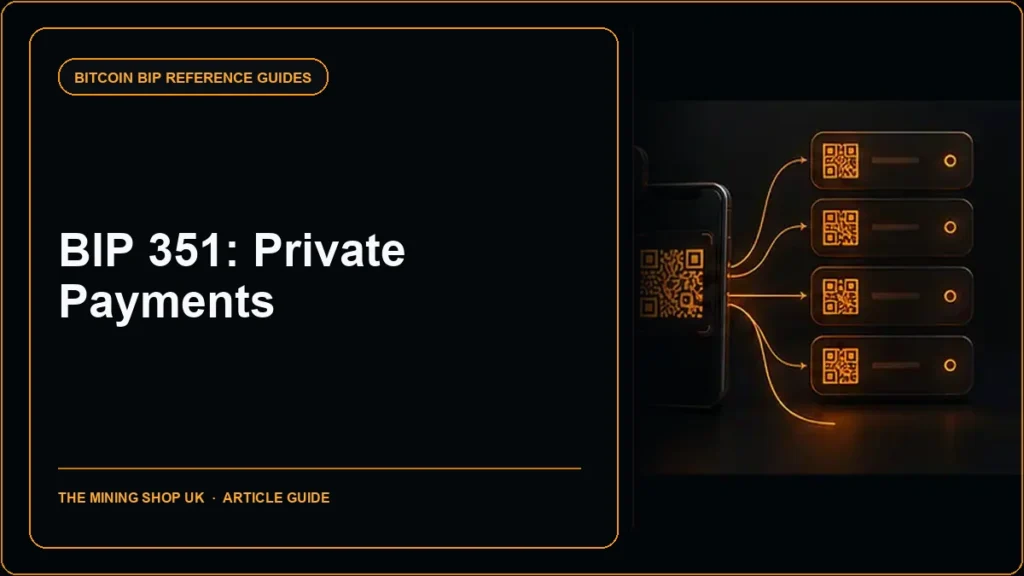
This guide explains BIP 351 Private Payments in plain English. It covers the problem behind the BIP, why it matters and whether the proposal is part of Bitcoin today.
BIP 351 Private Payments: BIP 351 remains Draft and Informational. It is incompatible with earlier static payment-code standards such as BIP 47, so support and backup semantics must be negotiated explicitly.
A node operator is checking BIP 351 Private Payments. The notification code is truncated to four bytes, allowing roughly one false match in 2^32.
BIP 351 remains Draft and Informational. It is incompatible with earlier static payment-code standards such as BIP 47, so support and backup semantics must be negotiated explicitly.
The code uses purpose 351, carries two address-type flag bytes plus a 33-byte compressed public key, and uses Bech32m HRP pay on mainnet or payt on testnet.
A 40-byte OP_RETURN begins with PP, followed by a four-byte ECDH-derived notification code, the sender’s 33-byte per-recipient public key and one address-type ordinal.

The notification code is truncated to four bytes, allowing roughly one false match in 2^32. A recipient must tolerate spurious watch entries without treating them as payments.
Sender and recipient compute the same ECDH point, hash it with a big-endian 64-bit counter and add the scalar to the recipient key to derive each ephemeral payment key.
Recipients must scan full block OP_RETURN data; BIP 158 filters do not cover those payloads. Out-of-band notifications need separate durable backup because chain restoration cannot rediscover them.
Developers test the proposal with made-up data on an isolated test network. They check normal cases and deliberately invalid cases. Different implementations should reach the same result before anyone relies on the proposal.
BIP 351 Private Payments: BIP 351 remains Draft and Informational. It is incompatible with earlier static payment-code standards such as BIP 47, so support and backup semantics must be negotiated explicitly.
BIP 351 remains Draft and Informational. It is incompatible with earlier static payment-code standards such as BIP 47, so support and backup semantics must be negotiated explicitly.
The code uses purpose 351, carries two address-type flag bytes plus a 33-byte compressed public key, and uses Bech32m HRP pay on mainnet or payt on testnet.
A 40-byte OP_RETURN begins with PP, followed by a four-byte ECDH-derived notification code, the sender’s 33-byte per-recipient public key and one address-type ordinal.
BIP 351 reduces recurring-address reuse but adds notification, scanning and state burdens. Until interoperability matures, wallets should label it Draft, preserve counters and notification history and test privacy assumptions under realistic coin selection.
Check the current specification status and the documentation for the exact implementation you operate before moving production funds or changing a mining node.

BIP 128 guide to Draft timelock-recovery plan storage, presigned transaction pairs, relative delay, checksums, monitoring, cancellation and reorg safety.
BIP 433 guide to Draft keyless Pay to Anchor outputs, CPFP fee bumping, standardness, ephemeral dust, TRUC anti-pinning and wallet safety.

What is BIP-110? Learn what Bitcoin’s reduced-data soft-fork proposal restricted, why it was controversial and why it later closed.
Join the ASIC Mining Discussion
Members can read and join the discussion
Log in to read comments from other miners. Create a free account if you would like to ask a question or share your experience.
Membership helps us protect the discussion from spam and keep answers useful.