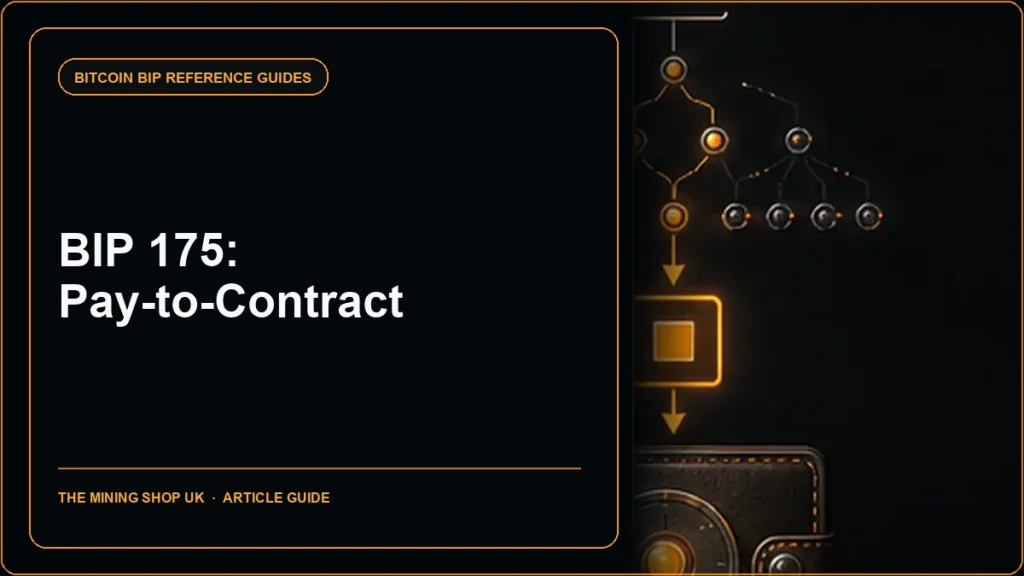
This guide explains BIP 175 pay to contract in plain English. It covers the problem behind the BIP, why it matters and whether the proposal is part of Bitcoin today.
TL;DR
What it is: BIP 175 proposed a multiparty pay-to-contract derivation scheme based on BIP 32 and BIP 43. A merchant supplied contract terms and a payment-base extended public key; the payer derived a destination cryptographically linked to that contract.
Why it matters: BIP 175 was a closed scheme for private on-chain contract commitments through HD derivation. Its security depends on canonical terms, scoped keys, authenticated invoices and recovery data beyond the wallet seed.
Current position: The informational BIP is Closed and is not a universal wallet protocol.
BIP 175 pay to contract in simple English
BIP 175 pay to contract: BIP 175 is Closed, and standard wallet recovery may not scan its custom derivation. A seed backup without the contract set, payment-base path and canonicalisation rules may miss funds.
Simple example
A node operator is checking BIP 175 pay to contract. The address derivation commits to agreed invoice data without putting the contract directly on-chain.
Key terms in plain English
BIP:
Bitcoin Improvement Proposal: a document describing a proposed rule, standard or process. Its status must be checked separately.
Node:
A computer running Bitcoin software that checks data and communicates with other peers.
Contract commitment goal
The address derivation commits to agreed invoice data without putting the contract directly on-chain. Payer and merchant can reproduce the destination from the same canonical contract and payment base. Any difference in bytes, ordering, encoding or normalisation yields a different destination.
Payment-base key
The merchant exposes an extended public key from which contract-specific keys can be derived while retaining the corresponding private derivation capability. Key scope, network, account and reuse must be documented. An over-broad extended key can reveal links or enable unintended derivations.
Canonical contract representation
Human documents permit harmless formatting differences, but cryptographic commitments do not. Implementations need a canonical byte representation, version and hash domain. Displayed terms must match committed bytes exactly, and both parties should retain the signed or authenticated invoice.
Canonical contract representation: the fields, validation boundary and operational evidence that implementations need to agree.
Multiparty proof
The scheme aimed to give cryptographic evidence of payee and purpose without public chain metadata. A proof’s legal or commercial meaning still depends on identity verification, invoice authenticity and custody of records. Cryptography does not establish that goods were delivered.
Privacy properties
Derived outputs resemble ordinary P2PKH or witness destinations and avoid an obvious public contract marker. Reusing payment-base branches, network metadata, amount patterns and later disclosure can still link payments. Proof sharing should reveal only what the dispute requires.
Closed status and wallet support
BIP 175 is Closed, and standard wallet recovery may not scan its custom derivation. A seed backup without the contract set, payment-base path and canonicalisation rules may miss funds. Do not accept real payment until independent derivation and restoration have been tested.
How specialists test it
Developers test the proposal with made-up data on an isolated test network. They check normal cases and deliberately invalid cases. Different implementations should reach the same result before anyone relies on the proposal.
Frequently asked questions
What is the main point of BIP 175 pay to contract?
BIP 175 pay to contract: BIP 175 is Closed, and standard wallet recovery may not scan its custom derivation.
For BIP 175 pay to contract, what should a beginner know about contract commitment goal?
The address derivation commits to agreed invoice data without putting the contract directly on-chain.
For BIP 175 pay to contract, what should a beginner know about payment-base key?
The merchant exposes an extended public key from which contract-specific keys can be derived while retaining the corresponding private derivation capability.
For BIP 175 pay to contract, what should a beginner know about canonical contract representation?
Human documents permit harmless formatting differences, but cryptographic commitments do not. Implementations need a canonical byte representation, version and hash domain.
Conclusion
BIP 175 was a closed scheme for private on-chain contract commitments through HD derivation. Its security depends on canonical terms, scoped keys, authenticated invoices and recovery data beyond the wallet seed.
Check the current specification status and the documentation for the exact implementation you operate before moving production funds or changing a mining node.
About the Author:
Darren Waggott is the visionary Founder and CEO of The Mining Shop UK, with over a decade of leadership in the cryptocurrency mining sector. Renowned for driving innovation, Darren has built a company dedicated to providing high-quality ASIC miners and comprehensive hosting services. His forward-thinking approach places The Mining Shop UK at the forefront of the industry.
Membership helps us protect the discussion from spam and keep answers useful.
ASIC MINING SUPPORT
Need Help Choosing an ASIC Miner?
Tell us what you want to mine, your electricity cost and where the machine will run. We can help you compare hardware, power requirements, hosting and repairs.
We use necessary cookies to run the shop and optional analytics cookies to understand how visitors use the site and improve shopping and checkout. You can accept analytics, use only necessary cookies, or choose settings. You can change your choice at any time.
Functional
Always active
The technical storage or access is strictly necessary for the legitimate purpose of enabling the use of a specific service explicitly requested by the subscriber or user, or for the sole purpose of carrying out the transmission of a communication over an electronic communications network.
Preferences
The technical storage or access is necessary for the legitimate purpose of storing preferences that are not requested by the subscriber or user.
Statistics
The technical storage or access that is used exclusively for statistical purposes.The technical storage or access that is used exclusively for anonymous statistical purposes. Without a subpoena, voluntary compliance on the part of your Internet Service Provider, or additional records from a third party, information stored or retrieved for this purpose alone cannot usually be used to identify you.
Marketing
The technical storage or access is required to create user profiles to send advertising, or to track the user on a website or across several websites for similar marketing purposes.









Join the ASIC Mining Discussion
Members can read and join the discussion
Log in to read comments from other miners. Create a free account if you would like to ask a question or share your experience.
Membership helps us protect the discussion from spam and keep answers useful.