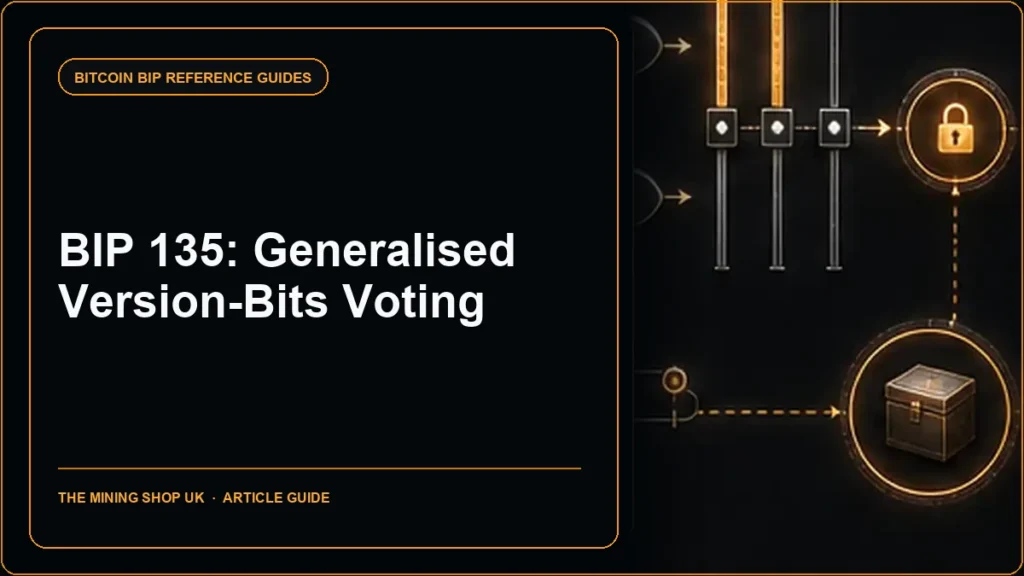
This guide explains BIP 135 version bits in plain English. It covers the problem behind the BIP, why it matters and whether the proposal is part of Bitcoin today.
TL;DR
What it is: BIP 135 proposed generalising BIP 9 version-bit signalling so each deployment could configure its threshold, window size, minimum locked blocks and minimum locked time. It retained the familiar state machine while extending it to arbitrary consensus changes.
Why it matters: BIP 135 explored a flexible activation state machine but is a closed proposal. Its main lesson is that configurable thresholds demand explicit parameters, independent state verification and careful language about what signalling represents.
Current position: The informational BIP is Closed and did not replace BIP 9 in Bitcoin consensus.
BIP 135 version bits in simple English
BIP 135 version bits: Miner version bits reveal block-production signals under defined rules. They do not measure users, economic nodes or moral legitimacy.
Simple example
A node operator is checking BIP 135 version bits. Flexible values could model faster or slower coordination. Calling the mechanism voting can overstate what a hash-power threshold decides.
Key terms in plain English
BIP:
Bitcoin Improvement Proposal: a document describing a proposed rule, standard or process. Its status must be checked separately.
Bitcoin Core:
Widely used software that validates Bitcoin and can provide wallet, network and operator tools.
Consensus:
The shared rules full nodes use to decide whether blocks and transactions are valid.
Soft fork:
A proposed tightening of Bitcoin rules that old nodes may not enforce themselves.
Node:
A computer running Bitcoin software that checks data and communicates with other peers.
Parameters added
Beyond name, bit, start time and timeout, the proposal added deployment-specific threshold, window size, minimum locked blocks and minimum locked time. Flexible values could model faster or slower coordination. Every node would need identical parameters to calculate the same activation state.
State-machine continuity
DEFINED, STARTED, LOCKED_IN, ACTIVE and FAILED concepts were retained with extended transition conditions. Boundary calculations depend on prior-window state, median-time-past and block counts. Tests need genesis-adjacent cases, delayed starts, exact thresholds and reorganisations.
Signalling is not voting authority
Miner version bits reveal block-production signals under defined rules; they do not measure users, economic nodes or moral legitimacy. Calling the mechanism voting can overstate what a hash-power threshold decides. Deployment design must specify enforcement and compatibility separately.
Signalling is not voting authority: the fields, validation boundary and operational evidence that implementations need to agree.
Arbitrary fork scope
The proposal discussed signalling beyond backwards-compatible soft forks. A hard fork cannot become compatible merely because a bit threshold is reached; old validators still reject new rules. Interfaces must state the rule change and consequences, not show one generic approval percentage.
Lock-in grace controls
Minimum locked blocks and time could provide a deployment grace period independent of the signalling window. More flexibility also creates more parameter combinations, operator confusion and implementation divergence. A small configuration error can shift activation height across nodes.
Closed status
BIP 135 is not current Bitcoin activation policy. Historical clients or alternative chains may have implemented variants, but that does not alter Bitcoin Core consensus. Research environments should pin chain parameters and prevent accidental connection to production networks.
Simulation and monitoring
Generate signalling patterns just below, at and above threshold across variable windows, then reorganise around every transition. Compare two independent implementations and expose the complete parameter set in monitoring. A status label without the calculation inputs is inadequate evidence.
Frequently asked questions
What is the main point of BIP 135 version bits?
BIP 135 version bits: Miner version bits reveal block-production signals under defined rules. They do not measure users, economic nodes or moral legitimacy.
For BIP 135 version bits, what should a beginner know about parameters added?
Beyond name, bit, start time and timeout, the proposal added deployment-specific threshold, window size, minimum locked blocks and minimum locked time.
For BIP 135 version bits, what should a beginner know about state-machine continuity?
DEFINED, STARTED, LOCKED_IN, ACTIVE and FAILED concepts were retained with extended transition conditions.
For BIP 135 version bits, what should a beginner know about signalling is not voting authority?
Miner version bits reveal block-production signals under defined rules. They do not measure users, economic nodes or moral legitimacy.
Conclusion
BIP 135 explored a flexible activation state machine but is a closed proposal. Its main lesson is that configurable thresholds demand explicit parameters, independent state verification and careful language about what signalling represents.
Check the current specification status and the documentation for the exact implementation you operate before moving production funds or changing a mining node.
About the Author:
Darren Waggott is the visionary Founder and CEO of The Mining Shop UK, with over a decade of leadership in the cryptocurrency mining sector. Renowned for driving innovation, Darren has built a company dedicated to providing high-quality ASIC miners and comprehensive hosting services. His forward-thinking approach places The Mining Shop UK at the forefront of the industry.
Membership helps us protect the discussion from spam and keep answers useful.
ASIC MINING SUPPORT
Need Help Choosing an ASIC Miner?
Tell us what you want to mine, your electricity cost and where the machine will run. We can help you compare hardware, power requirements, hosting and repairs.
We use necessary cookies to run the shop and optional analytics cookies to understand how visitors use the site and improve shopping and checkout. You can accept analytics, use only necessary cookies, or choose settings. You can change your choice at any time.
Functional
Always active
The technical storage or access is strictly necessary for the legitimate purpose of enabling the use of a specific service explicitly requested by the subscriber or user, or for the sole purpose of carrying out the transmission of a communication over an electronic communications network.
Preferences
The technical storage or access is necessary for the legitimate purpose of storing preferences that are not requested by the subscriber or user.
Statistics
The technical storage or access that is used exclusively for statistical purposes.The technical storage or access that is used exclusively for anonymous statistical purposes. Without a subpoena, voluntary compliance on the part of your Internet Service Provider, or additional records from a third party, information stored or retrieved for this purpose alone cannot usually be used to identify you.
Marketing
The technical storage or access is required to create user profiles to send advertising, or to track the user on a website or across several websites for similar marketing purposes.








Join the ASIC Mining Discussion
Members can read and join the discussion
Log in to read comments from other miners. Create a free account if you would like to ask a question or share your experience.
Membership helps us protect the discussion from spam and keep answers useful.