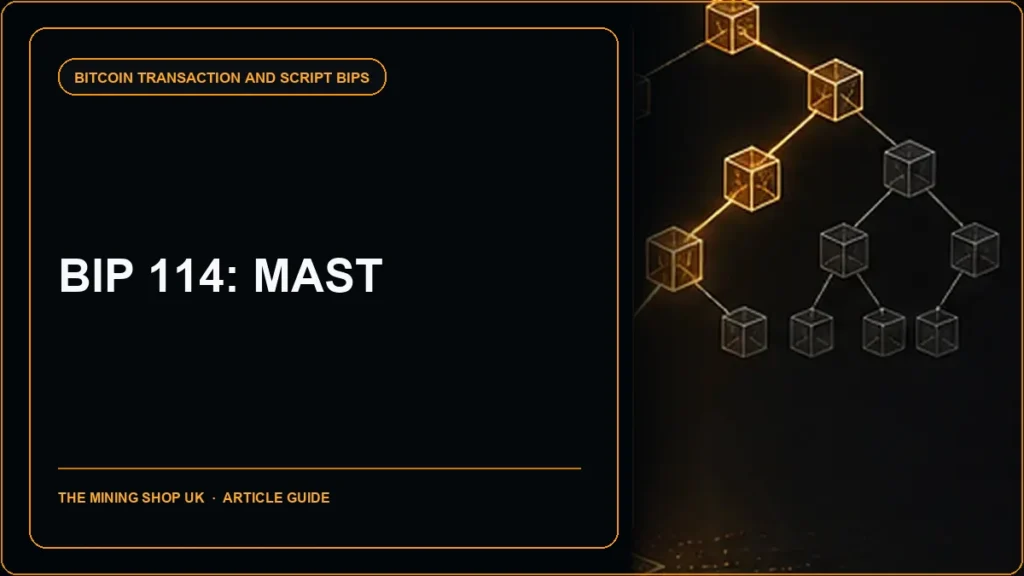
This guide explains BIP 114 MAST in plain English. It covers the problem behind the BIP, why it matters and whether the proposal is part of Bitcoin today.
TL;DR
What it is: BIP 114 proposed a new SegWit witness-program version for Merkelized Abstract Syntax Trees, allowing a spend to reveal only the executed script branch plus a Merkle proof. The goal was smaller complex spends, improved privacy and more flexible conditions.
Why it matters: BIP 114 captured the core value of revealing one committed script branch, but its specific consensus design is closed. Modern implementations must follow deployed Taproot rules rather than reuse BIP 114 encodings.
Current position: The proposal is Closed and was not deployed; later Taproot and Tapscript designs use different commitments and validation rules.
BIP 114 MAST in simple English
BIP 114 MAST: P2SH and P2WSH require revealing an entire redeem or witness script even when only one conditional branch executes.
Simple example
A node operator is checking BIP 114 MAST. Software implementing the draft alone could not safely create spendable mainnet outputs without network-wide activation. BIP 114 assigned meaning to a new witness version and defined how the Merkle root, script and proof would be interpreted.
Key terms in plain English
BIP:
Bitcoin Improvement Proposal: a document describing a proposed rule, standard or process. Its status must be checked separately.
Consensus:
The shared rules full nodes use to decide whether blocks and transactions are valid.
Taproot:
A Bitcoin upgrade that added new signature and script options for spending outputs.
Node:
A computer running Bitcoin software that checks data and communicates with other peers.
Why script trees were proposed
P2SH and P2WSH require revealing an entire redeem or witness script even when only one conditional branch executes. Large policies consume block space and disclose unused recovery paths. A Merkle tree commits to alternatives while opening only the selected leaf and authentication path.
Commitment structure
Leaves represent scripts and internal hashes combine them into a fixed root. The witness supplies the executed script and sibling hashes needed to reconstruct that root. Ordering, hash domain, leaf encoding and duplicate handling are consensus-critical; a visually identical tree can have a different commitment.
Witness programme design
BIP 114 assigned meaning to a new witness version and defined how the Merkle root, script and proof would be interpreted. That would have required consensus deployment. Software implementing the draft alone could not safely create spendable mainnet outputs without network-wide activation.
Witness programme design: the fields, validation boundary and operational evidence that implementations need to agree.
Privacy and its limits
Unexecuted branches remain hidden during a spend, reducing direct policy disclosure. The revealed branch, proof depth, output pattern and later recovery behaviour can still fingerprint a wallet. Privacy depends on tree design and common conventions, not merely using a Merkle root.
Resource accounting
Logarithmic proofs can make large sets of alternatives practical, but script execution, hashing and witness sizes still need limits. Consensus designs must bound worst-case validation and prevent hidden branches from bypassing opcode or stack rules. Test adversarial depth and malformed proofs.
Closed status
BIP 114 did not become Bitcoin consensus. Wallets must not generate funds under its witness semantics. Historical libraries may expose experimental code, but compatibility between two implementations does not establish network deployment or recovery support.
Comparison with Taproot
BIP 341 commits script paths alongside a key-spend path using Taproot’s tagged hashes, internal key and tweak construction. Tapscript rules are defined separately. The shared MAST idea does not make BIP 114 proofs or addresses interchangeable with Taproot.
Frequently asked questions
What is the main point of BIP 114 MAST?
BIP 114 MAST: P2SH and P2WSH require revealing an entire redeem or witness script even when only one conditional branch executes.
For BIP 114 MAST, why script trees were proposed?
P2SH and P2WSH require revealing an entire redeem or witness script even when only one conditional branch executes.
For BIP 114 MAST, what should a beginner know about commitment structure?
Leaves represent scripts and internal hashes combine them into a fixed root.
For BIP 114 MAST, what should a beginner know about witness programme design?
BIP 114 assigned meaning to a new witness version and defined how the Merkle root, script and proof would be interpreted.
Conclusion
BIP 114 captured the core value of revealing one committed script branch, but its specific consensus design is closed. Modern implementations must follow deployed Taproot rules rather than reuse BIP 114 encodings.
Check the current specification status and the documentation for the exact implementation you operate before moving production funds or changing a mining node.
About the Author:
Darren Waggott is the visionary Founder and CEO of The Mining Shop UK, with over a decade of leadership in the cryptocurrency mining sector. Renowned for driving innovation, Darren has built a company dedicated to providing high-quality ASIC miners and comprehensive hosting services. His forward-thinking approach places The Mining Shop UK at the forefront of the industry.
Membership helps us protect the discussion from spam and keep answers useful.
ASIC MINING SUPPORT
Need Help Choosing an ASIC Miner?
Tell us what you want to mine, your electricity cost and where the machine will run. We can help you compare hardware, power requirements, hosting and repairs.
We use necessary cookies to run the shop and optional analytics cookies to understand how visitors use the site and improve shopping and checkout. You can accept analytics, use only necessary cookies, or choose settings. You can change your choice at any time.
Functional
Always active
The technical storage or access is strictly necessary for the legitimate purpose of enabling the use of a specific service explicitly requested by the subscriber or user, or for the sole purpose of carrying out the transmission of a communication over an electronic communications network.
Preferences
The technical storage or access is necessary for the legitimate purpose of storing preferences that are not requested by the subscriber or user.
Statistics
The technical storage or access that is used exclusively for statistical purposes.The technical storage or access that is used exclusively for anonymous statistical purposes. Without a subpoena, voluntary compliance on the part of your Internet Service Provider, or additional records from a third party, information stored or retrieved for this purpose alone cannot usually be used to identify you.
Marketing
The technical storage or access is required to create user profiles to send advertising, or to track the user on a website or across several websites for similar marketing purposes.







Join the ASIC Mining Discussion
Members can read and join the discussion
Log in to read comments from other miners. Create a free account if you would like to ask a question or share your experience.
Membership helps us protect the discussion from spam and keep answers useful.