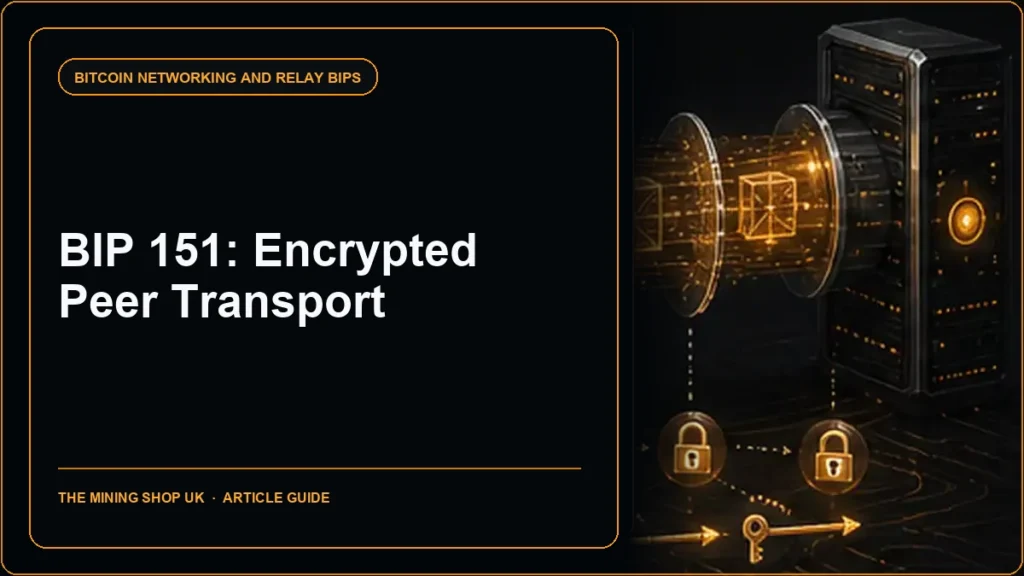
This guide explains BIP 151 peer encryption in plain English. It covers the problem behind the BIP, why it matters and whether the proposal is part of Bitcoin today.
TL;DR
What it is: BIP 151 proposed encrypted Bitcoin peer-to-peer communication using an unauthenticated key exchange, authenticated encryption and periodic rekeying. It aimed to make passive surveillance and undetected message manipulation harder while supplying the encrypted session required by BIP 150 peer authentication.
Why it matters: BIP 151 is a closed encrypted-transport proposal whose ideas informed later work. It should be studied for threat modelling, not presented as a supported switch or proof of anonymity in current Bitcoin Core.
Current position: The proposal is Closed, names BIP 324 as its proposed replacement and is not a current Bitcoin Core configuration interface.
BIP 151 peer encryption in simple English
BIP 151 peer encryption: Peers needed to negotiate the encrypted transport while preserving compatibility. Any fallback path is security-critical because an attacker may try to force plaintext.
Simple example
A node operator is checking BIP 151 peer encryption. The design addressed network observers and active intermediaries who could read, suppress or alter plaintext P2P traffic.
Key terms in plain English
BIP:
Bitcoin Improvement Proposal: a document describing a proposed rule, standard or process. Its status must be checked separately.
Bitcoin Core:
Widely used software that validates Bitcoin and can provide wallet, network and operator tools.
Node:
A computer running Bitcoin software that checks data and communicates with other peers.
Threat model
The design addressed network observers and active intermediaries who could read, suppress or alter plaintext P2P traffic. Encryption could conceal message content and detect tampering, but connection timing, packet sizes and endpoints remained observable. It did not by itself authenticate the peer operator.
Negotiation and fallback
Peers needed to negotiate the encrypted transport while preserving compatibility. Any fallback path is security-critical because an attacker may try to force plaintext. A deployment test must prove how unsupported, malformed and downgrade attempts are handled rather than assume encryption from a successful TCP connection.
Key agreement and session binding
The proposal derived shared session material through an elliptic-curve exchange and used transcript-related values for channel state. Fresh ephemeral material limited reuse. Cryptographic implementation quality, randomness, parsing and side channels would be as important as the written construction.
Key agreement and session binding: the fields, validation boundary and operational evidence that implementations need to agree.
Authenticated encryption and rekeying
Encrypted records included integrity protection so altered data should fail verification. Rekeying limited material processed under one key. Boundary tests need truncated frames, replay, reordered records, invalid tags and rekey transitions, with bounded disconnect behaviour and no secret-bearing debug output.
Relationship to BIP 150
BIP 150 required an established BIP 151 channel and bound peer-identity proof to its session identifier. BIP 151 alone therefore offered encryption without operator identity, while BIP 150 layered mutual authentication using pre-shared public keys. Both proposals are Closed.
Traffic analysis limits
Encrypted P2P traffic still exposes IP addresses, session duration, direction, volume and packet timing. Padding and decoy strategies were limited and operational correlation could remain strong. Do not market transport encryption as anonymity or a replacement for Tor and network-layer isolation.
Modern replacement context
BIP 324 defines the modern v2 transport design with different wire details and deployment status. Operators must use current Bitcoin Core documentation and observed negotiation, not translate BIP 151 settings that never became a stable interface. Historical comparison should preserve the different goals and cryptographic transcripts.
Frequently asked questions
What is the main point of BIP 151 peer encryption?
BIP 151 peer encryption: Peers needed to negotiate the encrypted transport while preserving compatibility. Any fallback path is security-critical because an attacker may try to force plaintext.
For BIP 151 peer encryption, what should a beginner know about threat model?
The design addressed network observers and active intermediaries who could read, suppress or alter plaintext P2P traffic.
For BIP 151 peer encryption, what should a beginner know about negotiation and fallback?
Peers needed to negotiate the encrypted transport while preserving compatibility. Any fallback path is security-critical because an attacker may try to force plaintext.
For BIP 151 peer encryption, what should a beginner know about key agreement and session binding?
The proposal derived shared session material through an elliptic-curve exchange and used transcript-related values for channel state.
Conclusion
BIP 151 is a closed encrypted-transport proposal whose ideas informed later work. It should be studied for threat modelling, not presented as a supported switch or proof of anonymity in current Bitcoin Core.
Check the current specification status and the documentation for the exact implementation you operate before moving production funds or changing a mining node.
About the Author:
Darren Waggott is the visionary Founder and CEO of The Mining Shop UK, with over a decade of leadership in the cryptocurrency mining sector. Renowned for driving innovation, Darren has built a company dedicated to providing high-quality ASIC miners and comprehensive hosting services. His forward-thinking approach places The Mining Shop UK at the forefront of the industry.
Membership helps us protect the discussion from spam and keep answers useful.
ASIC MINING SUPPORT
Need Help Choosing an ASIC Miner?
Tell us what you want to mine, your electricity cost and where the machine will run. We can help you compare hardware, power requirements, hosting and repairs.
We use necessary cookies to run the shop and optional analytics cookies to understand how visitors use the site and improve shopping and checkout. You can accept analytics, use only necessary cookies, or choose settings. You can change your choice at any time.
Functional
Always active
The technical storage or access is strictly necessary for the legitimate purpose of enabling the use of a specific service explicitly requested by the subscriber or user, or for the sole purpose of carrying out the transmission of a communication over an electronic communications network.
Preferences
The technical storage or access is necessary for the legitimate purpose of storing preferences that are not requested by the subscriber or user.
Statistics
The technical storage or access that is used exclusively for statistical purposes.The technical storage or access that is used exclusively for anonymous statistical purposes. Without a subpoena, voluntary compliance on the part of your Internet Service Provider, or additional records from a third party, information stored or retrieved for this purpose alone cannot usually be used to identify you.
Marketing
The technical storage or access is required to create user profiles to send advertising, or to track the user on a website or across several websites for similar marketing purposes.







Join the ASIC Mining Discussion
Members can read and join the discussion
Log in to read comments from other miners. Create a free account if you would like to ask a question or share your experience.
Membership helps us protect the discussion from spam and keep answers useful.