What Is a Bitcoin Wallet? Keys, Addresses and Backups
A Bitcoin wallet manages keys, addresses and payments rather than storing coins. Learn wallet types, recovery, fees, privacy and safe setup in simple English.
A Bitcoin wallet manages the keys and information needed to receive, view and spend bitcoin. It does not contain digital coins in the way a leather wallet contains notes. Bitcoin remains represented by transactions and unspent outputs on the network.
Wallets range from phone apps to full-node software and hardware signing devices. The important questions are who controls the keys, how transactions are checked, how recovery works and what happens if a device or service disappears.
Estimated reading time: 7 minutes
TL;DR
A wallet manages signing keys and transaction information rather than storing coins.
Custody, validation, backup and privacy can differ greatly between wallets.
Test recovery and payment checks with a small amount before relying on a setup.
What This Means in Simple English
A Bitcoin wallet is a tool for managing the secret keys that approve payments. It also creates receiving details, finds relevant blockchain records and builds transactions. The balance shown is the wallet's view of outputs it can control.
Simple Example
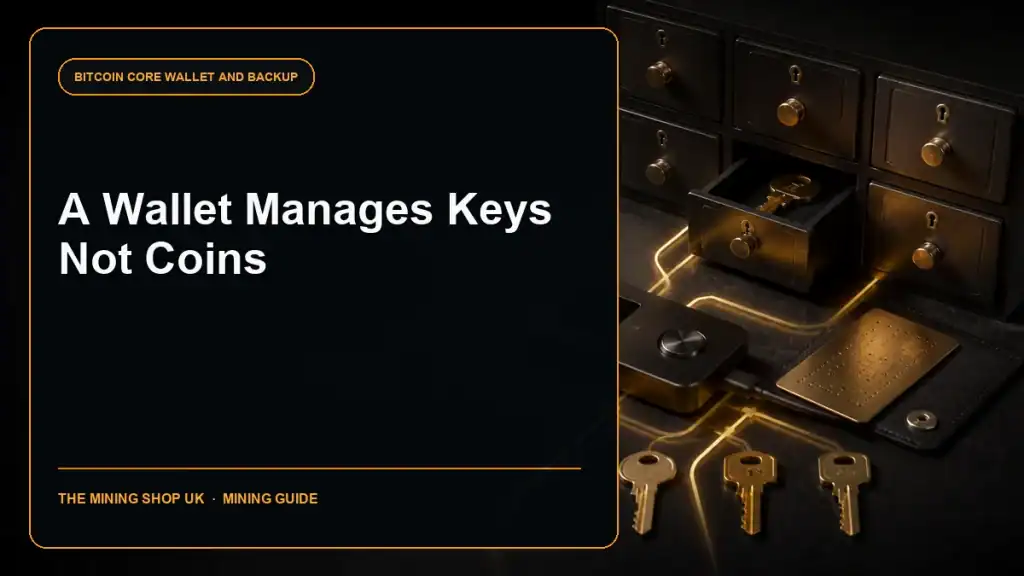
A key cabinet does not contain the rooms in a building. It organises keys that open particular doors and records which staff may use them. A Bitcoin wallet similarly manages access, while the network keeps the shared transaction record.
Key Terms in Plain English
Private Key:
Secret data used to authorise a spend.
Public Key:
Data derived from a private key and used in spending conditions.
Address:
A human-facing encoding used to request payment to a script condition.
Descriptor:
Structured information describing how a wallet finds and spends outputs.
Seed Backup:
Secret source material from which some deterministic wallets derive many keys.
What a Bitcoin Wallet Does
The wallet creates or imports key material, produces receiving information and watches the network for relevant transactions. When spending, it selects available outputs, creates new recipient and change outputs, estimates a fee and signs where it holds the required keys.
Different wallets divide these jobs differently. A watch-only wallet can monitor and build unsigned transactions. A hardware signer may hold keys but depend on companion software for network data. A custodial app may show only the provider's internal account.
Keys, Addresses and Coins
A private key is secret authority, while an address is a convenient way to communicate a receiving condition. One wallet can manage many addresses and should normally create fresh ones. Sending to an address creates an output; it does not fill a permanent account box.
Never publish private keys or recovery words. An address and transaction identifier are intended for public network use, although they can still reveal financial relationships. Keep internal labels separate from anything broadcast.
Wallet Balance and UTXOs
The displayed balance is usually the sum of unspent outputs the wallet believes it can spend, plus categories such as unconfirmed or watch-only funds. Those outputs remain separate even when the interface shows one total.
Input selection affects fees and privacy. Spending several small outputs can create a larger transaction than spending one suitable output. A good wallet explains enough detail without requiring a beginner to edit raw transactions.
Quick reference for Bitcoin wallet decisions.
Custodial and Self-custody Wallets
A self-custody wallet lets the user or organisation control signing keys. A custodial provider controls withdrawal systems and may offer password recovery, limits and account checks. The account balance may not correspond to individually controlled on-chain outputs.
Self-custody removes some provider dependence but makes backup and transaction mistakes the user's responsibility. Custody can simplify access but adds counterparty and account risk. Ask who can sign, freeze or recover funds before choosing.
Mobile, Desktop, Hardware and Full-node Wallets
Mobile wallets favour portability and code scanning. Desktop wallets can offer larger displays, coin control and hardware support. Hardware devices isolate signing. A full-node wallet validates blocks and transactions using the user's own node but requires more resources.
These are capabilities, not quality guarantees. Check current maintenance, source transparency, backup method, fee controls, address support and recovery documentation. Avoid choosing only from an advert or a stranger's download link.
How Wallet Recovery Works
Many deterministic wallets derive numerous keys from one secret backup. Others need descriptors, files, additional passphrases or policy information. Record what the actual wallet requires rather than assuming every list of words is interchangeable.
Test recovery with a small balance on safe equipment. Confirm wallet identity and expected receiving history before signing. Store secret material offline and never give it to support staff or enter it into a web form.
Fees, Change and Confirmation
A wallet spends complete earlier outputs and usually returns surplus as change. The transaction fee is the input value not assigned to new outputs. Fee rate and transaction virtual size matter more than the sterling value being sent.
A wallet can estimate a rate from current network conditions, but confirmation timing is not guaranteed. Check the total fee, destination and change before signing. Use replacement features only when supported and understood.
Choosing and Setting Up Safely
Start from the project's genuine website or reproducible source, use supported equipment and check recent maintenance. Decide whether you need everyday access, hardware signing, your own node, multi-signature or only a modest mobile balance.
Create the wallet privately, record the recovery route without cameras or cloud notes, receive a small test and practise a payment. Then prove recovery before increasing the value. Write down the process for anyone legitimately expected to use it later.
What the Current Data Can and Cannot Tell You
Wallet software, supported address types and backup formats change. Use current documentation for the chosen release.
The word wallet can also describe a custodial account, so confirm who controls signing keys rather than relying on the label.
A wallet protects access to bitcoin but does not remove price, legal, tax or counterparty risk.
Decision Table
Wallet Capability
Question To Ask
Custody
Who can sign or freeze a withdrawal?
Validation
Does it use my node or a third party?
Recovery
What exact information rebuilds access?
Fees
Can I review rate, size and total before signing?
A table is a starting point, not a promise. Verify current official sources and apply each detail to the decision you are actually making.
Frequently Asked Questions
Does a Bitcoin Wallet Store Coins?
No. It manages access to outputs recorded by the Bitcoin network.
Is an Address the Same as a Private Key?
No. An address can be shared to receive; a private key must remain secret.
Can One Wallet Have Many Addresses?
Yes. Modern wallets commonly derive many receiving and change addresses.
What Happens If I Lose the Device?
A correct tested backup may restore access; without it, funds can be lost.
Must a Wallet Run a Full Node?
No. Some wallets use external servers, while full-node wallets validate with their own node.
Conclusion
A Bitcoin wallet is a key and transaction manager. Choose one by custody, validation, recovery and everyday needs, then install it from a genuine source. Protect the backup, verify payment details and prove the complete recovery process with a small amount.
Darren Waggott is the visionary Founder and CEO of The Mining Shop UK, with over a decade of leadership in the cryptocurrency mining sector. Renowned for driving innovation, Darren has built a company dedicated to providing high-quality ASIC miners and comprehensive hosting services. His forward-thinking approach places The Mining Shop UK at the forefront of the industry.
Membership helps us protect the discussion from spam and keep answers useful.
ASIC MINING SUPPORT
Need Help Choosing an ASIC Miner?
Tell us what you want to mine, your electricity cost and where the machine will run. We can help you compare hardware, power requirements, hosting and repairs.
We use necessary cookies to run the shop and optional analytics cookies to understand how visitors use the site and improve shopping and checkout. You can accept analytics, use only necessary cookies, or choose settings. You can change your choice at any time.
Functional
Always active
The technical storage or access is strictly necessary for the legitimate purpose of enabling the use of a specific service explicitly requested by the subscriber or user, or for the sole purpose of carrying out the transmission of a communication over an electronic communications network.
Preferences
The technical storage or access is necessary for the legitimate purpose of storing preferences that are not requested by the subscriber or user.
Statistics
The technical storage or access that is used exclusively for statistical purposes.The technical storage or access that is used exclusively for anonymous statistical purposes. Without a subpoena, voluntary compliance on the part of your Internet Service Provider, or additional records from a third party, information stored or retrieved for this purpose alone cannot usually be used to identify you.
Marketing
The technical storage or access is required to create user profiles to send advertising, or to track the user on a website or across several websites for similar marketing purposes.





Join the ASIC Mining Discussion
Members can read and join the discussion
Log in to read comments from other miners. Create a free account if you would like to ask a question or share your experience.
Membership helps us protect the discussion from spam and keep answers useful.