Bitcoin Transaction Fees Explained: Fee Rate, Size and Confirmation
Bitcoin transaction fees depend on virtual size and fee-rate competition, not the amount sent. Learn estimates, confirmation targets, RBF, CPFP and fee risks.
Bitcoin transaction fees pay miners for including transactions in blocks. A fee is not a percentage of the amount sent. It is the value left when inputs exceed outputs, and wallets normally choose it by multiplying the transaction's virtual size by a fee rate.
That is why moving a small balance made from many inputs can cost more than sending a larger amount from one input. Current mempool demand, confirmation target, script type, replacement options and wallet estimation all affect the sensible choice.
Estimated reading time: 7 minutes
TL;DR
Bitcoin transaction fees are usually judged in satoshis per virtual byte.
More or heavier inputs increase size even when the payment amount is small.
A fee estimate is a probability-based choice, not a guaranteed confirmation appointment.
What This Means in Simple English
A Bitcoin fee pays for space in a block. The wallet measures how much data the payment will use and chooses a rate based on how busy the waiting area is. The amount of bitcoin being transferred is not the main size factor.
Simple Example
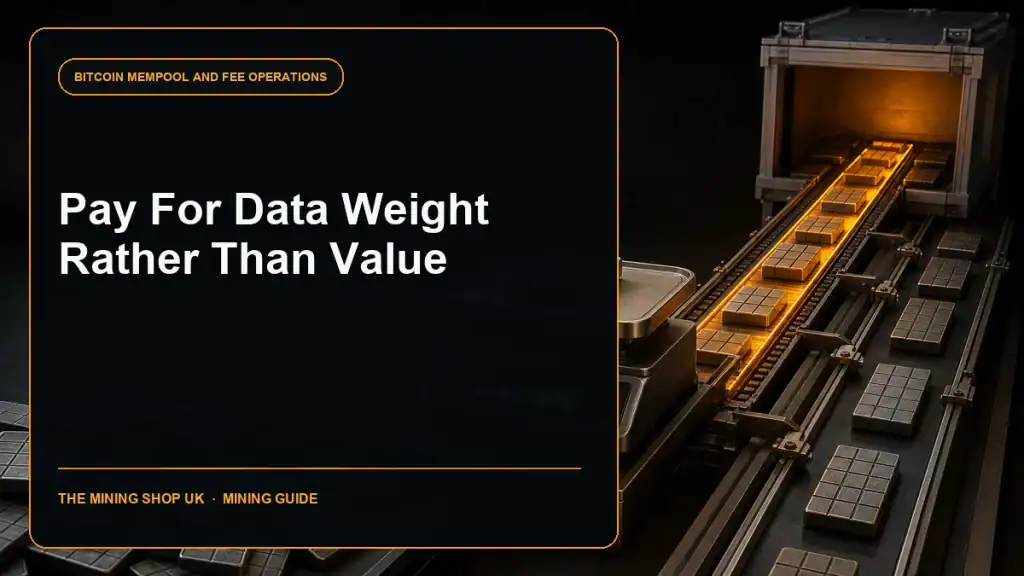
A delivery firm charges for parcel space and urgency, not the value inside the box. Ten small boxes can cost more to carry than one valuable compact box. Paying express improves the chance of an early journey but cannot control traffic.
Key Terms in Plain English
Fee:
Input value minus output value.
Fee Rate:
Fee per virtual byte of transaction size.
Virtual Size:
A weight-based size used for fee comparison.
Confirmation Target:
How many blocks a wallet aims to wait.
CPFP:
A child transaction whose fee helps make a related parent package attractive.
How Bitcoin Transaction Fees Are Created
A normal transaction spends complete earlier outputs. It assigns value to recipients and usually to a change output. Any input value left unassigned becomes the transaction fee claimable by the miner.
A misplaced decimal or missing change output can create an excessive fee. Reviewed wallets calculate change automatically, but the user should still check payment, fee and destination before signing.
Why Virtual Size Matters
SegWit introduced transaction weight, which discounts witness data relative to base data. Virtual size converts weight into a practical fee unit. Wallets and mempool tools commonly show satoshis per virtual byte.
Script type, number of inputs and outputs and signature structure affect weight. The BTC amount inside an output does not make its data record proportionally larger.
How Fee Competition Works
Nodes store acceptable unconfirmed transactions locally. Miners assemble block templates under weight limits and usually favour transactions or packages offering stronger fee revenue.
There is no central auctioneer and not every miner has the same mempool. A rate that confirmed quickly yesterday can wait today if demand changes before the next blocks.
Quick reference for Bitcoin transaction fees decisions.
Choose a Confirmation Target
A wallet can estimate rates based on recent transactions and blocks. A shorter target normally suggests a stronger rate; a non-urgent payment can accept more waiting risk.
Estimates need enough current data and remain probabilistic. Check whether the wallet is using economical or conservative behaviour and whether fee bumping is available.
Use RBF without Guessing
Replace by fee can create a replacement transaction with a higher rate when the original signalled replaceability and policy conditions are met. The replacement spends the same inputs and must pay sufficient additional fee.
Use the wallet's documented bump function. Manually creating a conflicting transaction can make accounting confusing and risks sending change incorrectly.
When CPFP Can Help
Child pays for parent spends an output from an unconfirmed parent and adds enough fee that miners find the combined package attractive. It is useful only when the user controls a spendable output and package policy accepts it.
The child pays for its own size and helps cover the parent, so the required fee may be larger than expected. Calculate the combined package rather than looking only at the child rate.
Avoid Overpayment and Underpayment
Overpayment wastes funds and cannot normally be reclaimed after confirmation. Underpayment can leave an urgent transaction waiting or vulnerable to eviction.
Set a maximum absolute fee guard in automated systems, verify units and distinguish BTC per kilobyte from satoshis per virtual byte. Unit mistakes can be far larger than ordinary estimation error.
Keep a Fee Evidence Record
For a material transfer, store transaction identifier, virtual size, fee, fee rate, replaceability, broadcast time and confirmation height. This makes support and accounting easier.
If a service claims a fixed network fee, ask whether it is a withdrawal charge added by the business. Service charges and the actual on-chain miner fee are different amounts.
Reading a Wallet Fee Quote
A useful wallet quote shows a fee rate, an estimated transaction size and a target rather than one unexplained number. Check whether the wallet selected many inputs, whether it created change and whether the quoted unit is satoshis per virtual byte. Confusing total satoshis with a fee rate can produce a serious overpayment.
Treat the confirmation target as an estimate, not a promise. Compare it with the wallet's current node data and confirm that the chosen rate remains sensible before signing. For a business payout, record the quote, total fee, transaction identifier and approval. This evidence helps explain cost without pretending that a miner or wallet controlled the next block.
What the Current Data Can and Cannot Tell You
Fee conditions can change between signing and broadcast. Refresh estimates for a transaction that has sat unsigned for a long time.
Bitcoin Core interfaces evolve; current releases favour explicit fee-rate arguments and current estimation RPCs over removed static-fee settings.
A block explorer's suggested rates are advice from that service, not a consensus rule or guarantee.
Decision Table
Factor
Effect
More Inputs
Usually increases transaction weight
More Outputs
Adds data and weight
Higher Fee Rate
Usually improves miner attractiveness
Busy Mempools
Raise competition for limited space
A table is a starting point, not a promise. Verify current official sources and apply each detail to the decision you are actually making.
Frequently Asked Questions
Are Bitcoin Fees a Percentage?
No. They mainly depend on transaction virtual size and fee rate.
Does a Higher Fee Guarantee the Next Block?
No. It changes competitiveness but miners and demand can vary.
Can I Recover an Overpaid Confirmed Fee?
Normally no. It is claimed by the block miner.
What Does RBF Do?
It replaces a signalling unconfirmed transaction under policy with a higher-fee version.
What Does CPFP Do?
It adds a fee-paying child so miners can value the related package together.
Conclusion
Bitcoin transaction fees are a price for scarce block weight, not a transfer tax. Check virtual size, fee rate, current demand and the wallet's replacement choices before signing. Use unit and absolute-fee guards, then keep the evidence needed to explain what was paid and when it confirmed.
Darren Waggott is the visionary Founder and CEO of The Mining Shop UK, with over a decade of leadership in the cryptocurrency mining sector. Renowned for driving innovation, Darren has built a company dedicated to providing high-quality ASIC miners and comprehensive hosting services. His forward-thinking approach places The Mining Shop UK at the forefront of the industry.
Membership helps us protect the discussion from spam and keep answers useful.
ASIC MINING SUPPORT
Need Help Choosing an ASIC Miner?
Tell us what you want to mine, your electricity cost and where the machine will run. We can help you compare hardware, power requirements, hosting and repairs.
We use necessary cookies to run the shop and optional analytics cookies to understand how visitors use the site and improve shopping and checkout. You can accept analytics, use only necessary cookies, or choose settings. You can change your choice at any time.
Functional
Always active
The technical storage or access is strictly necessary for the legitimate purpose of enabling the use of a specific service explicitly requested by the subscriber or user, or for the sole purpose of carrying out the transmission of a communication over an electronic communications network.
Preferences
The technical storage or access is necessary for the legitimate purpose of storing preferences that are not requested by the subscriber or user.
Statistics
The technical storage or access that is used exclusively for statistical purposes.The technical storage or access that is used exclusively for anonymous statistical purposes. Without a subpoena, voluntary compliance on the part of your Internet Service Provider, or additional records from a third party, information stored or retrieved for this purpose alone cannot usually be used to identify you.
Marketing
The technical storage or access is required to create user profiles to send advertising, or to track the user on a website or across several websites for similar marketing purposes.





Join the ASIC Mining Discussion
Members can read and join the discussion
Log in to read comments from other miners. Create a free account if you would like to ask a question or share your experience.
Membership helps us protect the discussion from spam and keep answers useful.