What Is a Bitcoin UTXO? the Transaction Output Model Explained
A Bitcoin UTXO is an unspent transaction output available as a future input. Learn wallet balances, change, fees, consolidation, privacy and node validation simply.
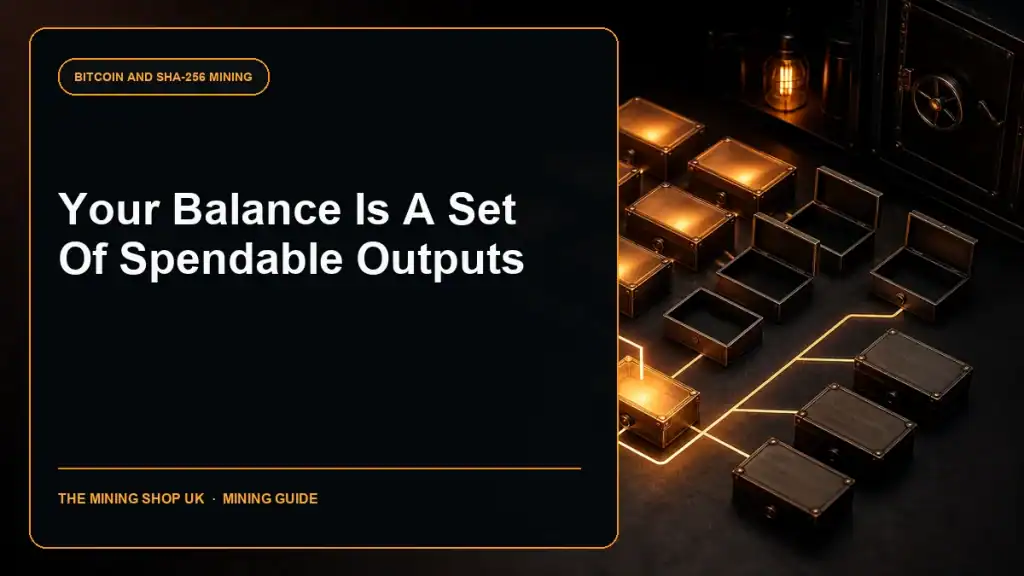
A Bitcoin UTXO is an unspent transaction output. It is a specific amount created by an earlier transaction that has not yet been used as an input. A wallet balance is usually the sum of the UTXOs the wallet can spend, not one editable account number.
When a UTXO is spent, it is consumed completely. The new transaction creates fresh outputs for recipients and often change. This model explains why input count affects fees, why wallets label coins and why one payment can reveal links between earlier receipts.
Estimated reading time: 7 minutes
TL;DR
A UTXO is a particular spendable output, not a fraction taken from an account balance.
Transactions consume complete UTXOs and create new outputs for payments and change.
UTXO size, script type, labels and history affect future fees, privacy and coin control.
What This Means in Simple English
A Bitcoin wallet can hold several separate chunks created by earlier payments. Each chunk is a UTXO. To pay, the wallet opens enough complete chunks, creates a new chunk for the recipient and normally creates another for change.
Simple Example
A purse containing £5, £10 and £20 notes shows £35, but the notes remain separate. Paying £12 may use the £20 note and return £8 change. The total looked like one balance, while the pieces decided the payment shape.
Key Terms in Plain English
Unspent:
Not yet referenced by a valid accepted input.
Outpoint:
The transaction identifier and output index naming a UTXO.
Chainstate:
A node database including the current unspent-output set.
Coin Control:
Manual or automated choice of which outputs to spend.
Dust:
An output whose value is too small relative to spending cost under policy measures.
What a Bitcoin UTXO Contains
An output records a value in satoshis and a locking script that defines the conditions for spending it. The outpoint, made from transaction identifier and output index, uniquely references that output.
The output does not store a person's legal name or a live sterling value. Ownership is inferred from the ability to satisfy the script and from outside context.
How Wallets Show One Balance
Wallet software scans relevant transactions and adds the UTXOs whose spending conditions it can satisfy. It may separate confirmed, unconfirmed, immature, locked or watch-only values.
The displayed total hides the number and type of pieces. Two wallets showing the same BTC balance can face very different fees and privacy choices when they spend.
Why a UTXO Is Spent Completely
An input references the whole earlier output. The new transaction then assigns value to one or more outputs. Surplus normally returns to the sender as change, and any unassigned difference becomes fee.
There is no remaining half of the old UTXO after the transaction. Nodes mark it spent and track the new outputs instead.
Quick reference for Bitcoin UTXO decisions.
How Full Nodes Use the UTXO Set
To validate a new transaction, a node checks whether each referenced output exists, is unspent and can be unlocked correctly. It also checks that values do not appear from nowhere.
The current UTXO set allows efficient lookups without replaying the whole chain for every new payment. Nodes still validated the history that produced the set.
Why UTXOs Affect Fees
Each input adds transaction data. Spending many small UTXOs can require more virtual bytes than spending one larger output, even if the recipient receives the same amount.
Script type matters too. Wallet fee estimates should inspect the actual selected inputs and outputs. A simple percentage of balance cannot price the transaction.
Privacy and Coin Selection
Combining inputs can suggest that one entity controls them. Change can also be identified through patterns. Wallet algorithms try to balance fee efficiency, privacy, labels and avoiding unnecessary change.
Keep business, customer and personal contexts separated. Use labels and coin control where appropriate, but do not improvise with valuable funds before understanding the wallet's behaviour.
Consolidation and Output Planning
A consolidation spends several outputs into fewer new ones, usually during lower fee rates. It may reduce future input weight but costs a fee and links history now.
One large output is not ideal for every user. Plan sizes around expected payments and accounting while avoiding tiny outputs likely to cost more to spend than their practical value.
How to Inspect Your UTXOs Safely
Use a maintained wallet or your own node to list value, confirmations, address or descriptor, label and outpoint. Watch-only tools can inspect without holding spending keys.
Never upload a seed phrase to a UTXO checker. Public outpoints are enough for chain inspection, and private recovery material gives control of funds rather than extra public information.
A Practical Wallet Review
Open the coin-control or output view in a maintained wallet and compare the displayed balance with the individual outputs beneath it. Look at value, confirmations, labels and script type. This simple review explains why two wallets with the same balance may build transactions of different sizes.
For business funds, label receipts when they arrive and keep customer contexts apart where practical. Review small outputs before a busy fee period, but do not consolidate automatically. The fee saving must justify today's cost and the privacy link created by combining them. Back up wallet descriptors and recovery material through a separate, tested process.
What the Current Data Can and Cannot Tell You
The UTXO set changes with every accepted block. Counts and total database size must be tied to a height and node version.
Wallet coin-selection algorithms evolve. A description of one release should not be assumed for every wallet or later version.
Dust policy and fee economics can change without rewriting old outputs. Spendability under consensus and economical relay are related but different questions.
Decision Table
Item
Meaning
UTXO
An available output from an earlier transaction
Input
A transaction field spending a UTXO
Change
A new output returning surplus value
Wallet Balance
The wallet's view of spendable and related outputs
A table is a starting point, not a promise. Verify current official sources and apply each detail to the decision you are actually making.
Frequently Asked Questions
Is a UTXO the Same as an Address?
No. An address helps define a spending condition; one address can receive several separate outputs.
Can I Spend Part of a UTXO?
The input consumes it completely and creates new outputs for payment and change.
Why Do Many UTXOs Raise Fees?
Each input adds data that uses block weight.
Does a UTXO Have a Sterling Price?
It has a satoshi value. Sterling value depends on an outside market and time.
Can I Inspect UTXOs without a Seed Phrase?
Yes. Public outpoints and watch-only tools can be used without revealing private recovery data.
Conclusion
A Bitcoin UTXO is a specific unspent output that can become a future input. Wallets make many pieces look like one balance, but those pieces determine transaction size, change and privacy. Inspect and label them with maintained tools, and never reveal a seed phrase merely to view public output data.
Darren Waggott is the visionary Founder and CEO of The Mining Shop UK, with over a decade of leadership in the cryptocurrency mining sector. Renowned for driving innovation, Darren has built a company dedicated to providing high-quality ASIC miners and comprehensive hosting services. His forward-thinking approach places The Mining Shop UK at the forefront of the industry.
Membership helps us protect the discussion from spam and keep answers useful.
ASIC MINING SUPPORT
Need Help Choosing an ASIC Miner?
Tell us what you want to mine, your electricity cost and where the machine will run. We can help you compare hardware, power requirements, hosting and repairs.
We use necessary cookies to run the shop and optional analytics cookies to understand how visitors use the site and improve shopping and checkout. You can accept analytics, use only necessary cookies, or choose settings. You can change your choice at any time.
Functional
Always active
The technical storage or access is strictly necessary for the legitimate purpose of enabling the use of a specific service explicitly requested by the subscriber or user, or for the sole purpose of carrying out the transmission of a communication over an electronic communications network.
Preferences
The technical storage or access is necessary for the legitimate purpose of storing preferences that are not requested by the subscriber or user.
Statistics
The technical storage or access that is used exclusively for statistical purposes.The technical storage or access that is used exclusively for anonymous statistical purposes. Without a subpoena, voluntary compliance on the part of your Internet Service Provider, or additional records from a third party, information stored or retrieved for this purpose alone cannot usually be used to identify you.
Marketing
The technical storage or access is required to create user profiles to send advertising, or to track the user on a website or across several websites for similar marketing purposes.








Join the ASIC Mining Discussion
Members can read and join the discussion
Log in to read comments from other miners. Create a free account if you would like to ask a question or share your experience.
Membership helps us protect the discussion from spam and keep answers useful.