Hot Wallet versus Cold Wallet: Which Bitcoin Setup Fits?
Compare a hot wallet versus cold wallet for Bitcoin security, access, backups and recovery. Learn why many users separate spending funds from reserves.
The hot wallet versus cold wallet choice is about access and exposure. A hot wallet can sign on a connected device. A cold setup keeps signing keys away from normal internet-connected systems. Both still depend on sound backups and careful users.
Many people do not need to choose only one. A small hot operating balance can cover routine payments while a separate cold reserve protects funds that rarely move. The right split depends on value, frequency, recovery ability and business duties.
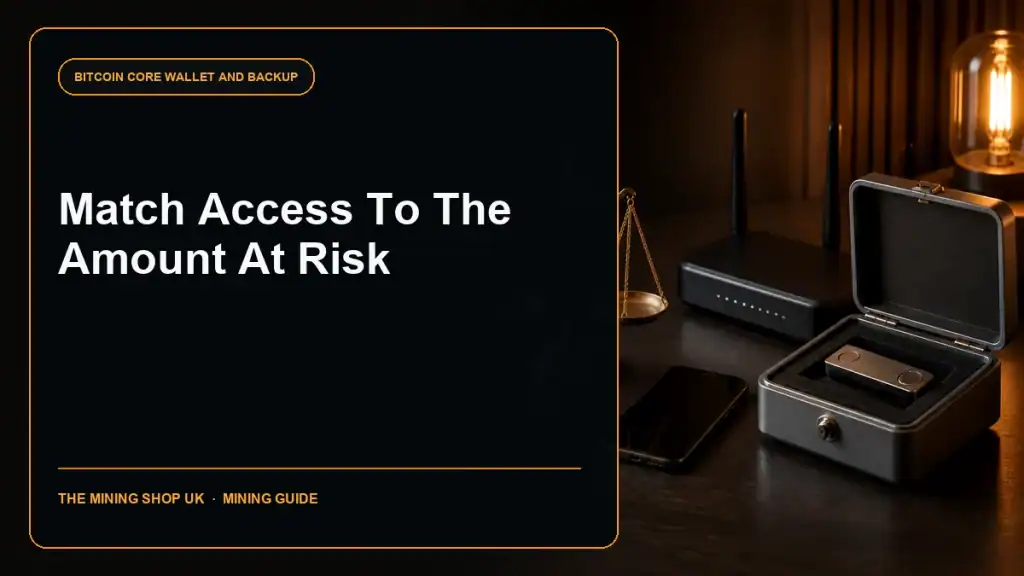
Separate spending funds from reserves when that makes loss easier to contain.
What This Means in Simple English
A hot wallet is ready to spend online, while a cold wallet signs away from everyday network exposure. The useful question is not which label wins. It is which risks matter for this amount of money and how often it needs to move.
Simple Example
A café uses a till for today's change and a safe for money kept overnight. Emptying the safe for every small sale would be awkward, while leaving all takings in the till would be exposed. Separate wallet roles follow the same practical idea.
Key Terms in Plain English
Attack Surface:
The devices, software and processes an attacker could target.
Operating Balance:
Funds deliberately available for near-term use.
Reserve:
Funds not expected to move routinely.
Recovery Test:
A controlled proof that backup instructions rebuild access.
Multi-signature:
A policy requiring more than one key approval for spending.
Hot Wallet versus Cold Wallet: the Core Difference
A hot wallet's signing keys are available in a connected environment. A cold process isolates signing from ordinary internet use. The blockchain and UTXOs do not move between hot and cold places; only the method for authorising a spend changes.
Cold storage can narrow remote exposure, but it creates more steps and physical responsibilities. Hot access reduces friction, but a compromised device can be dangerous. Compare the complete workflows rather than the appearance of two devices.
Access and Payment Speed
Hot wallets suit frequent receiving, fee estimation and quick broadcasting. Cold wallets may require moving unsigned and signed transaction data between systems. That delay can be useful for review but inconvenient for urgent operating payments.
A business should set expectations before an invoice becomes urgent. Keep enough operating value accessible for planned costs and define how reserves are approved. Emergency improvisation is when staff are most likely to bypass checks.
Online and Physical Exposure
Hot wallets face malware, fake apps, phishing and account takeover. Cold wallets face theft, fire, damaged backups, malicious supply chains and forgotten procedures. Both face coercion, social engineering and incorrect recipient details.
Count the realistic paths to loss. A cold device stored beside its complete backup is one physical target. A hot wallet backed up to the same compromised cloud account is one online target. Separation matters more than marketing labels.
Quick reference for hot wallet versus cold wallet decisions.
Backup and Recovery Differences
Both arrangements need a valid recovery route. A hot wallet backup should be kept offline where possible. A cold wallet backup must survive device failure and may need extra descriptor, passphrase or policy information.
Test on safe equipment with a small amount. Recovery should confirm expected addresses or wallet fingerprints before any payment. A list of recovery words that opens a different empty wallet is not a successful test.
Privacy and Records
Moving funds between a hot operating wallet and a cold reserve creates public transactions. Combining inputs can reveal links, while address reuse can make monitoring easier for outsiders. Wallet separation is an operational control, not automatic blockchain privacy.
Keep internal labels and accounting records without publishing personal details. For business reserves, record who approved a move, which wallet roles were involved and how the destination was independently checked.
When a Hot Wallet Makes Sense
Choose hot access for modest amounts that need routine movement and where rapid recovery of service matters. A maintained mobile or desktop wallet can be clearer and safer than repeatedly handling an offline reserve for every minor payment.
Limit the balance, secure the device, maintain software and keep a tested backup. Do not treat an exchange login as identical to a self-custody wallet; provider rules and counterparty risk remain separate.
When Cold Storage Makes Sense
Cold storage suits reserves that move rarely and values whose loss would be severe. It also suits policies where review and deliberate physical approval are useful. The additional steps must be documented and practised.
Cold is a poor fit when nobody can recover it, when the device screen is never checked or when staff routinely reveal backups to connected computers. Complexity should buy a measurable control rather than the appearance of sophistication.
Using Both without Confusion
Name each wallet by role, set a target operating balance and define when funds move. Use separate backups and access controls, while ensuring authorised people know which recovery procedure belongs to which wallet.
Review the split after staffing, software or payment patterns change. A monthly operating balance may become excessive when bills fall, while a reserve process may become too slow when a business begins paying suppliers more frequently.
What the Current Data Can and Cannot Tell You
Wallet capabilities evolve, and some hardware wallets are used in connected multi-device processes. Judge the signing and recovery workflow, not the product shape.
Custodial accounts add a separate provider-risk decision that hot and cold labels alone do not explain.
No storage method removes Bitcoin price risk or guarantees recovery after operator error.
Decision Table
Factor
Hot Wallet
Cold Wallet
Typical access
Fast and connected
Deliberate offline signing
Main strength
Convenience
Reduced routine online exposure
Main weakness
Connected attack surface
Physical and recovery complexity
Common role
Spending or operations
Longer-term reserve
A table is a starting point, not a promise. Verify current official sources and apply each detail to the decision you are actually making.
Frequently Asked Questions
Is a Cold Wallet Always Safer Than a Hot Wallet?
No. Poor backups, fake devices and untested procedures can defeat cold storage.
Can I Use Both Wallet Types?
Yes. Many users separate an operating balance from a reserve.
Does Moving to Cold Storage Hide My Bitcoin?
No. The transfer remains visible on the public blockchain.
Which Wallet Should Hold Mining Income?
That depends on payment frequency, value, accounting and recovery controls; separating operations and reserves can limit exposure.
Does a Hardware Wallet Remove the Need for a Backup?
No. Device failure or loss makes a tested recovery route essential.
Conclusion
The hot wallet versus cold wallet decision is a trade-off between access and exposure. Match the process to the amount, movement frequency and people involved. For many users, a controlled hot balance plus a tested cold reserve is clearer than forcing one wallet to do every job.
Darren Waggott is the visionary Founder and CEO of The Mining Shop UK, with over a decade of leadership in the cryptocurrency mining sector. Renowned for driving innovation, Darren has built a company dedicated to providing high-quality ASIC miners and comprehensive hosting services. His forward-thinking approach places The Mining Shop UK at the forefront of the industry.
Membership helps us protect the discussion from spam and keep answers useful.
ASIC MINING SUPPORT
Need Help Choosing an ASIC Miner?
Tell us what you want to mine, your electricity cost and where the machine will run. We can help you compare hardware, power requirements, hosting and repairs.
We use necessary cookies to run the shop and optional analytics cookies to understand how visitors use the site and improve shopping and checkout. You can accept analytics, use only necessary cookies, or choose settings. You can change your choice at any time.
Functional
Always active
The technical storage or access is strictly necessary for the legitimate purpose of enabling the use of a specific service explicitly requested by the subscriber or user, or for the sole purpose of carrying out the transmission of a communication over an electronic communications network.
Preferences
The technical storage or access is necessary for the legitimate purpose of storing preferences that are not requested by the subscriber or user.
Statistics
The technical storage or access that is used exclusively for statistical purposes.The technical storage or access that is used exclusively for anonymous statistical purposes. Without a subpoena, voluntary compliance on the part of your Internet Service Provider, or additional records from a third party, information stored or retrieved for this purpose alone cannot usually be used to identify you.
Marketing
The technical storage or access is required to create user profiles to send advertising, or to track the user on a website or across several websites for similar marketing purposes.





Join the ASIC Mining Discussion
Members can read and join the discussion
Log in to read comments from other miners. Create a free account if you would like to ask a question or share your experience.
Membership helps us protect the discussion from spam and keep answers useful.