

Sealminer A4 Ultra Hydro
Bitcoin & Bitcoin Cash ASIC Miner


886TH
HASHRATE
9.45W/TH
EFFICIENCY
8373W
POWER
£851.51
EST. MONTHLY
NO PAYBACK
EST. ROI
BIP 338 guide covering its Closed status, disabletx proposal, block-relay-only connections, version-message limits, negotiation, compatibility and successor context.
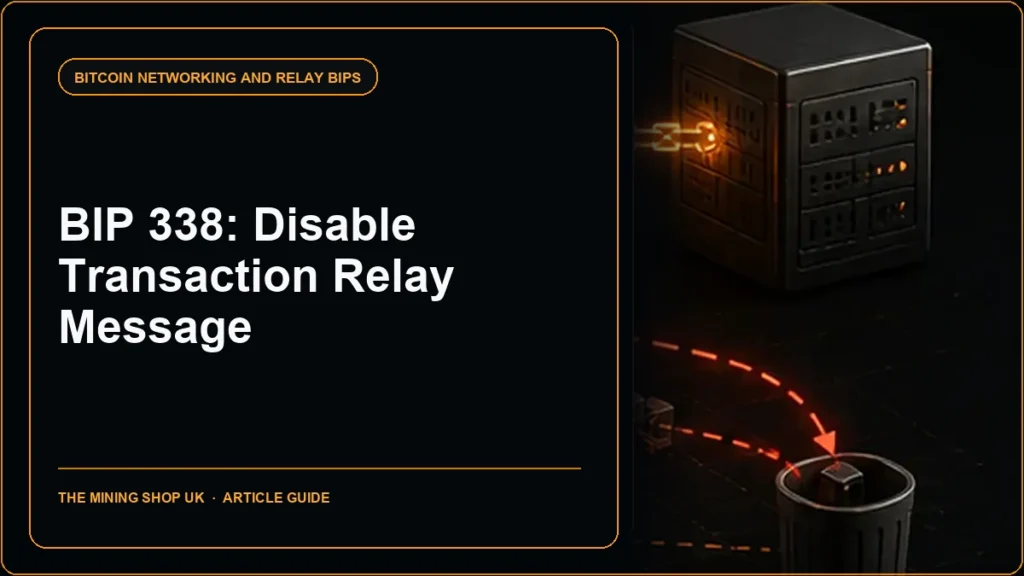
This guide explains BIP 338 Disable transaction relay message in plain English. It covers the problem behind the BIP, why it matters and whether the proposal is part of Bitcoin today.
BIP 338 Disable transaction relay message: The relay field in the version message indicated initial transaction relay preference but was not a permanent lifetime commitment, leaving an inbound peer unable to distinguish a permanent block-only link.
A node operator is checking BIP 338 Disable transaction relay message. The proposal added an explicit message after connection negotiation to declare that transaction relay would remain disabled.
The primary record labels BIP 338 Peer Services, Specification and Closed. Do not advertise disabletx as generally negotiated current behaviour solely because block-relay-only connections exist.
Low-bandwidth block-only connections can improve resistance to network partitions and reduce topology disclosure by avoiding transactions and address gossip.
The relay field in the version message indicated initial transaction relay preference but was not a permanent lifetime commitment, leaving an inbound peer unable to distinguish a permanent block-only link.

The proposal added an explicit message after connection negotiation to declare that transaction relay would remain disabled. Implementations needed ordering and one-time-state rules to avoid ambiguity.
A block-relay-only connection still exchanges the messages needed for blocks and chain maintenance. It must not be mistaken for a full transaction relay or address source.
Peers unaware of the new message would treat it according to existing unknown-message behaviour, but operators still needed feature negotiation and fallback logic.
Developers test the proposal with made-up data on an isolated test network. They check normal cases and deliberately invalid cases. Different implementations should reach the same result before anyone relies on the proposal.
BIP 338 Disable transaction relay message: The relay field in the version message indicated initial transaction relay preference but was not a permanent lifetime commitment, leaving an inbound peer unable to distinguish a permanent block-only link.
The primary record labels BIP 338 Peer Services, Specification and Closed. Do not advertise disabletx as generally negotiated current behaviour solely because block-relay-only connections exist.
Low-bandwidth block-only connections can improve resistance to network partitions and reduce topology disclosure by avoiding transactions and address gossip.
The relay field in the version message indicated initial transaction relay preference but was not a permanent lifetime commitment, leaving an inbound peer unable to distinguish a permanent block-only link.
BIP 338 captured a useful explicit-signalling idea for block-relay-only links, but its Closed status is decisive. Use it to understand the design problem, not as a current interoperability contract.
Check the current specification status and the documentation for the exact implementation you operate before moving production funds or changing a mining node.


BIP 331 package relay explained for mining nodes: understand ancestor packages, orphan handling, fee bumps, combined hashes and draft protocol limits.
BIP 339 wtxid relay explained: see why witness-aware transaction identifiers improve Bitcoin peer announcements, requests and rejection handling.
BIP 330 Erlay explained: see how transaction-set reconciliation, short IDs and sketches can reduce Bitcoin node announcement bandwidth.
Join the ASIC Mining Discussion
Members can read and join the discussion
Log in to read comments from other miners. Create a free account if you would like to ask a question or share your experience.
Membership helps us protect the discussion from spam and keep answers useful.