What Is a Merkle Tree? How Bitcoin Checks Transactions Efficiently
A Merkle tree combines transaction hashes into one root. Learn how Bitcoin builds it, proves inclusion, handles odd entries and protects block integrity simply.
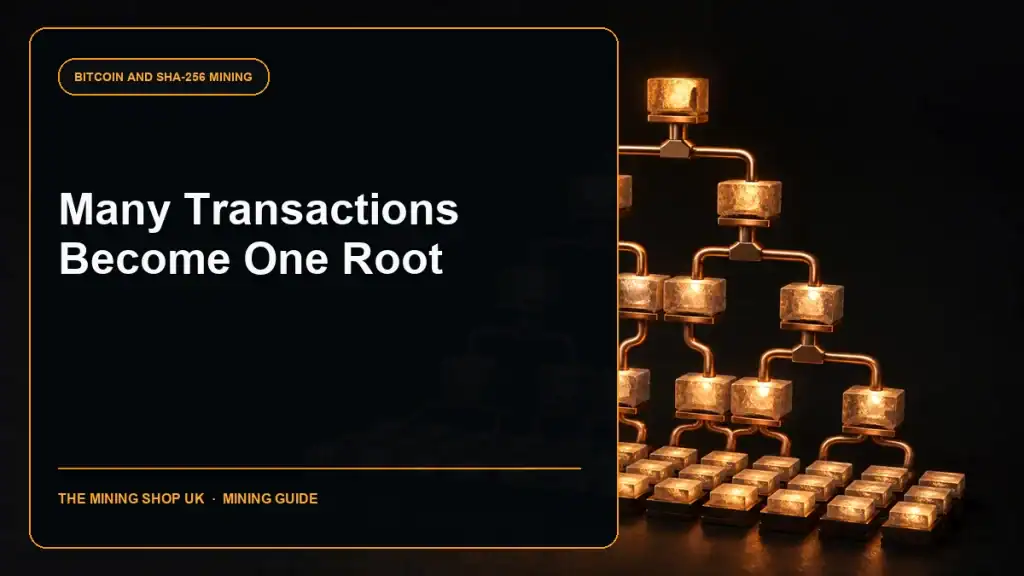
A Merkle tree is a way to combine many transaction hashes into one final hash called the Merkle root. Bitcoin stores that root in each block header. It lets software detect a changed transaction and can prove inclusion without sending the whole block.
The name sounds mathematical, but the job is practical. Hashes are paired, combined and hashed again level by level. A change at the bottom produces a new path and normally a different root at the top.
Estimated reading time: 7 minutes
TL;DR
Bitcoin builds a Merkle tree from transaction identifiers in a block.
The single Merkle root commits the header to the block's transaction set and order.
A Merkle proof can show inclusion with a small path rather than every transaction.
What This Means in Simple English
A Merkle tree turns a long list of transaction fingerprints into one summary fingerprint. It does this in pairs until only one remains. If one transaction changes, the fingerprints above it change and the final summary no longer matches.
Simple Example
A warehouse pairs receipt totals by aisle, then pairs those subtotals again until one building total remains. To check one receipt, an auditor needs its neighbouring subtotals along the route, not every receipt in the warehouse.
Key Terms in Plain English
Hash:
A fixed-length fingerprint calculated from data.
Leaf:
A transaction hash at the bottom of the tree.
Merkle Root:
The single hash at the top of the tree.
Merkle Proof:
The neighbouring hashes needed to verify one path.
SPV:
A lighter verification approach using headers and proofs rather than full blocks.
How a Merkle Tree Is Built
Bitcoin starts with transaction identifiers. It pairs two identifiers, hashes their combined binary values, then treats that result as a new entry on the next level. Pairing continues until one root remains.
The order matters. Swapping transactions changes the paired inputs and therefore the result. The calculation also follows exact byte-order and duplication rules, so a hand-drawn tree is an explanation rather than a safe implementation.
Why the Merkle Root Enters the Header
The Merkle root is one of the fields inside the block header. Miners hash the header repeatedly during proof of work. This makes the successful proof commit to that exact root.
If a transaction changes, its identifier and the path above it change. The old header no longer represents the altered body, so the proof cannot simply be reused for a different transaction set.
How a Merkle Proof Works
To prove one transaction is present, software supplies the transaction identifier and the sibling hash at each level. The verifier combines them in the correct left or right order until it calculates a root.
If the calculated root matches the header, the path is internally consistent. The verifier also needs confidence that the header belongs to the accepted proof-of-work chain. A root alone does not establish network acceptance.
Quick reference for Merkle tree decisions.
Why Proofs Can Be Much Smaller
A block can contain thousands of transactions, but a balanced binary tree grows in levels rather than one proof item per transaction. The path for one transaction therefore needs only a small number of neighbouring hashes.
This efficiency helped early simplified payment verification designs. It does not make full validation unnecessary: full nodes still check signatures, amounts, scripts and all block rules.
What Happens with an Odd Number
When a level has an odd number of hashes, Bitcoin duplicates the final hash so it has a partner. The pair is then processed like the others. This rule must be reproduced exactly.
Historical implementation details around duplicate transaction identifiers created a mutation concern. Modern validation checks relevant duplicate cases; beginners should use maintained libraries rather than inventing a tree routine from a diagram.
Merkle Root versus Block Hash
The Merkle root summarises the transactions. The block hash is calculated from the complete header, which also includes the previous block link, time, target representation, version and nonce.
The two hashes answer different questions. The root asks which transactions the header commits to. The block hash identifies the header and demonstrates whether its proof meets the target.
What a Merkle Tree Does Not Prove
A valid path does not prove that a transaction is morally legitimate, legally final or safe to accept with no confirmations. It shows membership in the block represented by a header.
It also does not validate the transaction's signature or prevent every software bug. Those jobs belong to transaction and block validation rules, maintained implementations and the wider chain context.
A Beginner Verification Exercise
Choose a known block through a node or developer example, record its header root and select one transaction. Follow a documented Merkle proof and note the sibling at each level.
Do not send funds or reveal wallet keys for this exercise. Merkle data is public. If a website requests a seed phrase to produce a proof, it is asking for information the calculation does not need.
What the Current Data Can and Cannot Tell You
Merkle-tree construction is a stable Bitcoin protocol detail, but developer APIs and proof formats can change. Use the documentation for the software version in use.
A block explorer can display a Merkle root, yet independent validation comes from checking the block and chain rules rather than trusting its page design.
Newer Bitcoin structures may use other trees or commitments for different jobs. Do not assume every structure called a tree follows the block transaction algorithm.
Decision Table
Layer
Contains
Leaves
Transaction identifiers
Middle Levels
Hashes of ordered child pairs
Root
One hash committing to the transaction tree
Header
The root plus other block and proof-of-work fields
A table is a starting point, not a promise. Verify current official sources and apply each detail to the decision you are actually making.
Frequently Asked Questions
Is a Merkle Tree a Real Tree?
No. It is a data structure shown as branches because hashes are combined in levels.
Does Bitcoin Store Every Transaction in the Root?
The root commits to them through hashes; the full transactions remain in the block body.
Can a Proof Work without a Block Header?
It can calculate a root, but the header and chain context are needed to relate that root to Bitcoin history.
Why Duplicate the Last Hash?
Bitcoin's defined construction pairs the final hash with itself when a level has an odd count.
Does a Merkle Proof Need a Private Key?
No. Inclusion proofs use public transaction and block data.
Conclusion
A Merkle tree gives Bitcoin a compact commitment to every transaction in a block. Pairing and hashing create one root, while short proofs can demonstrate an inclusion path. The root is powerful because it sits inside the mined header, but it is only one part of complete block and transaction validation.
Darren Waggott is the visionary Founder and CEO of The Mining Shop UK, with over a decade of leadership in the cryptocurrency mining sector. Renowned for driving innovation, Darren has built a company dedicated to providing high-quality ASIC miners and comprehensive hosting services. His forward-thinking approach places The Mining Shop UK at the forefront of the industry.
Membership helps us protect the discussion from spam and keep answers useful.
ASIC MINING SUPPORT
Need Help Choosing an ASIC Miner?
Tell us what you want to mine, your electricity cost and where the machine will run. We can help you compare hardware, power requirements, hosting and repairs.
We use necessary cookies to run the shop and optional analytics cookies to understand how visitors use the site and improve shopping and checkout. You can accept analytics, use only necessary cookies, or choose settings. You can change your choice at any time.
Functional
Always active
The technical storage or access is strictly necessary for the legitimate purpose of enabling the use of a specific service explicitly requested by the subscriber or user, or for the sole purpose of carrying out the transmission of a communication over an electronic communications network.
Preferences
The technical storage or access is necessary for the legitimate purpose of storing preferences that are not requested by the subscriber or user.
Statistics
The technical storage or access that is used exclusively for statistical purposes.The technical storage or access that is used exclusively for anonymous statistical purposes. Without a subpoena, voluntary compliance on the part of your Internet Service Provider, or additional records from a third party, information stored or retrieved for this purpose alone cannot usually be used to identify you.
Marketing
The technical storage or access is required to create user profiles to send advertising, or to track the user on a website or across several websites for similar marketing purposes.








Join the ASIC Mining Discussion
Members can read and join the discussion
Log in to read comments from other miners. Create a free account if you would like to ask a question or share your experience.
Membership helps us protect the discussion from spam and keep answers useful.