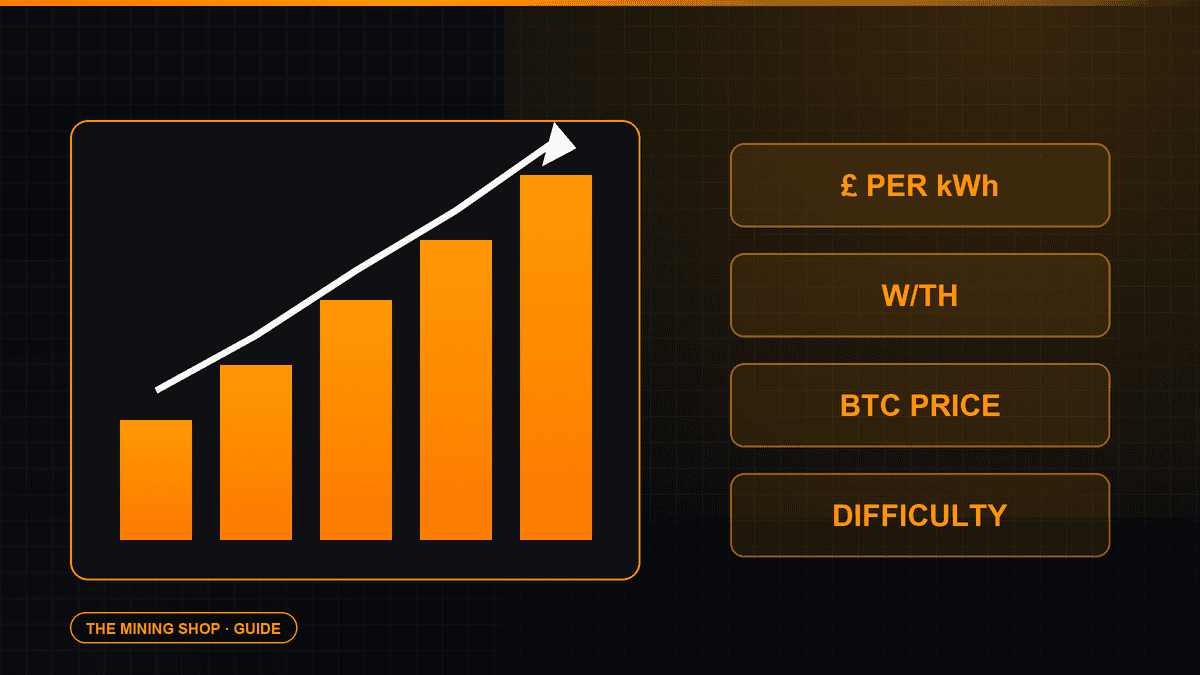
Understand Calculate ASIC Mining ROI. Model electricity, fees, uptime and hardware cost without treating returns as guaranteed before choosing equipment.
How to Calculate ASIC Mining ROI treats profitability as a changing operating model rather than a promised return. Revenue, electricity, pool fees, uptime and hardware cost all need to be tested together.
TL;DR
How to Calculate ASIC Mining ROI treats profitability as a changing operating model rather than a promised return. Revenue, electricity, pool fees, uptime and hardware cost all need to be tested together.
Gross mining revenue is not profit; electricity and every operating cost must be deducted.
Network difficulty, coin price, pool luck, fees and uptime can change the result after purchase.
Model several energy prices and downside cases instead of relying on one break-even date.
Use live comparison data and keep written records of every assumption used in the model.
Introduction: Why Calculating the ROI Matters
If you’re diving into crypto mining in 2025, knowing how to calculate the ROI of your crypto mining investment is crucial. Cryptocurrency mining continues to evolve rapidly, and staying profitable requires careful planning, tracking, and analysis. But how exactly can you measure if your crypto mining setup will generate a solid return on investment?
This guide, we’ll clearly break down how to calculate the ROI of your crypto mining investment step-by-step. You’ll discover exactly what metrics matter, how to factor in hidden costs, and how to predict long-term profitability. By the end, you’ll have all the tools and knowledge needed to accurately determine if your crypto mining endeavors will pay off in 2025.
Understanding ROI in Crypto Mining: Basics to Master
To calculate the ROI of your crypto mining investment effectively, you first need a solid understanding of what ROI means in the cryptocurrency mining world. ROI, or Return on Investment, is a financial metric used to evaluate the efficiency and profitability of an investment. It calculates the gain or loss generated relative to the initial investment amount.
In crypto mining, calculating ROI involves comparing your total mining income against your total setup and operating costs. With cryptocurrencies’ volatility and fluctuating mining difficulty, accurately predicting ROI becomes critical for long-term success.
Key Components to Calculate the ROI of Your Crypto Investment
When calculating the ROI of your crypto mining setup, consider these critical factors:
Hardware Costs: Initial equipment expenses, including GPUs, ASIC miners, and supporting hardware.
Operating Expenses: Ongoing costs like electricity, cooling solutions, maintenance, and internet services.
Crypto Mining Difficulty: Increasing difficulty levels can significantly impact profitability.
Crypto Price Volatility: Changes in cryptocurrency market prices directly influence your earnings.
Step-by-Step: How to Calculate the ROI of Your Crypto Mining
Here’s a simplified formula to calculate the ROI of your crypto investment:
For example, if your total revenue from mining is $15,000 and your combined setup and operational costs total $10,000, your ROI would be calculated as:
This means your crypto mining investment generated a 50% return, signifying a successful venture.
Important Considerations: maximise Your Crypto Mining ROI
To ensure accuracy when you calculate the ROI of your crypto investment, carefully consider these elements:
Hardware Selection and Costs
Your choice of mining hardware directly influences profitability. ASIC miners, while efficient, can be expensive initially. GPUs offer versatility but may require higher maintenance. Researching thoroughly before purchasing hardware will dramatically affect your long-term ROI calculations.
Operating Costs: Electricity and Cooling
Electricity remains the largest recurring cost for miners. To accurately calculate the ROI of your crypto investment, factor in local electricity rates and the efficiency of your mining hardware. Cooling costs, often underestimated, should also be accounted for, especially in warmer climates.
Crypto Mining Difficulty and Network Hash Rate
As more miners join a network, mining difficulty increases, decreasing the rewards for individual miners. To accurately calculate the ROI of your crypto mining, keep track of mining difficulty trends and anticipate their impact on profitability.
Market Volatility and Price Fluctuations
Crypto market volatility significantly affects mining profitability. Ensure your ROI calculations include scenarios with various cryptocurrency prices to understand potential risks and rewards better.
How to Calculate ASIC Mining ROI 4
Practical Example: Calculate the ROI of Your Crypto Mining Investment
Let’s go through a detailed example to illustrate precisely how to calculate the ROI of your crypto investment:
Step 1: Calculate Hardware Costs
Suppose your mining setup costs $5,000, including GPUs, motherboards, and accessories.
Step 2: Calculate Operating Costs
If your electricity cost is $0.10 per kWh, and your rig consumes 1000 watts, your daily electricity cost is approximately $2.40. Monthly, this equates to around $72. Add maintenance and internet costs, say $28, making monthly operating expenses roughly $100.
Step 3: Estimate Monthly Earnings
If mining rewards you with approximately 0.05 BTC per month, and Bitcoin’s current price is $40,000, your monthly revenue would be $2,000.
Step 4: Calculate Monthly and Annual Profit
Subtracting your monthly expenses ($100) from monthly revenue ($2,000), your net monthly profit is $1,900. Annually, this totals $22,800.
How to Calculate ASIC Mining ROI 5
Step 5: Final ROI Calculation
Using these figures:
How to Calculate ASIC Mining ROI 6
This indicates a highly profitable scenario, though this depends significantly on stable or rising cryptocurrency prices.
Tools and Resources to Calculate the ROI of Your Crypto Investment
Accurate calculations benefit from specialised tools:
Online ROI Calculators: Tools like CryptoCompare and WhatToMine offer real-time profitability estimates.
Mining Management Software: Software like NiceHash and HiveOS helps optimize mining operations, indirectly boosting ROI.
Regularly update firmware, maintain clean equipment, and ensure proper cooling to enhance hardware longevity and efficiency, improving ROI significantly.
Explore Alternative Cryptocurrencies
Mining less popular but profitable altcoins can be advantageous. Diversifying your crypto mining portfolio helps mitigate market volatility risks and can enhance ROI.
minimise Operational Costs
Reducing electricity costs through renewable energy sources, energy-efficient mining hardware, or location-specific electricity rebates can dramatically improve profitability.
Timely Equipment Upgrades
Regularly evaluating market trends and strategically upgrading your equipment ensures optimal performance, directly boosting your returns over time.
Conclusion: Making Smart Crypto Investments in 2025
Learning how to calculate the ROI of your crypto mining investment is fundamental to achieving financial success in cryptocurrency mining. By carefully analyzing hardware costs, operational expenses, mining difficulty, and market volatility, you ensure your investments remain profitable and sustainable long-term.
Check our in-depth guide on Building a Profitable Mining Rig for more detailed information. For additional market insights and analytics, consider reputable external resources like CoinDesk and Cointelegraph.
By continually refining your strategies, maintaining diligent tracking, and accurately calculating your ROI, you’ll be well-equipped to navigate the profitable, though sometimes volatile, world of crypto mining in 2025 and beyond.
Useful next steps
Use these pages to move from research to a product or operating decision:
We use necessary cookies to run the shop and optional analytics cookies to understand how visitors use the site and improve shopping and checkout. You can accept analytics, use only necessary cookies, or choose settings. You can change your choice at any time.
Functional
Always active
The technical storage or access is strictly necessary for the legitimate purpose of enabling the use of a specific service explicitly requested by the subscriber or user, or for the sole purpose of carrying out the transmission of a communication over an electronic communications network.
Preferences
The technical storage or access is necessary for the legitimate purpose of storing preferences that are not requested by the subscriber or user.
Statistics
The technical storage or access that is used exclusively for statistical purposes.The technical storage or access that is used exclusively for anonymous statistical purposes. Without a subpoena, voluntary compliance on the part of your Internet Service Provider, or additional records from a third party, information stored or retrieved for this purpose alone cannot usually be used to identify you.
Marketing
The technical storage or access is required to create user profiles to send advertising, or to track the user on a website or across several websites for similar marketing purposes.