This guide explains Bitcoin Core data directory in plain English. It focuses on what the subject is, why it matters and what a beginner should remember.
TL;DR
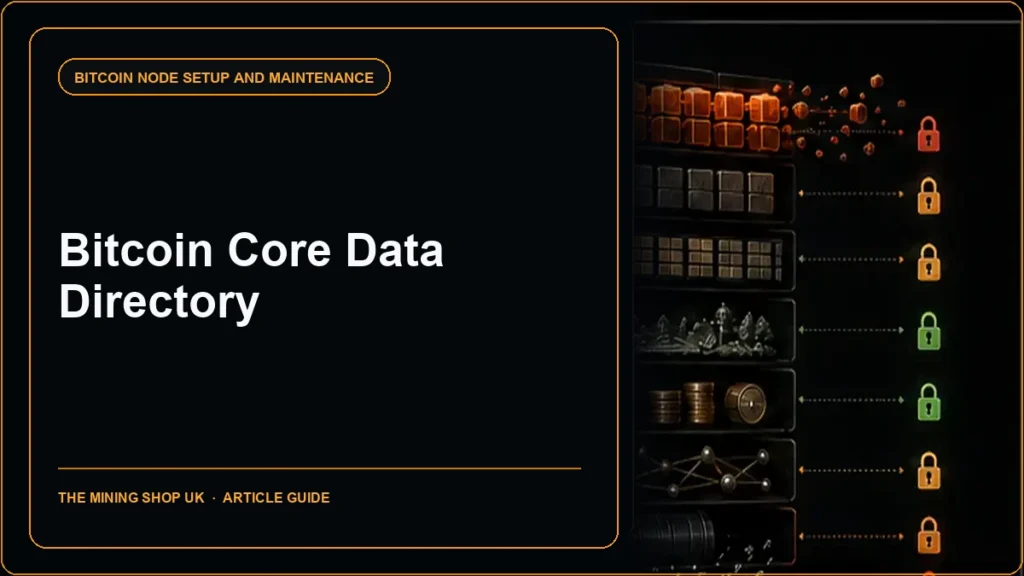
What it is: The Bitcoin Core data directory is not one interchangeable database. In Core 0.12 it held raw block and undo files, a block index, chainstate, wallet database environment, peers, fee estimates, banlist, logs, configuration, the RPC cookie and the Tor hidden-service key.
Why it matters: A Bitcoin Core data directory combines irreplaceable secrets with large reproducible state. Classify each file, snapshot consistently, protect permissions and rehearse restoration before moving a production node.
Current position: The Bitcoin Core data directory is not one interchangeable database.
Bitcoin Core data directory in simple English
Bitcoin Core data directory: The blocks directory stores blk files containing raw blocks, rev files with undo information and a LevelDB block index.
Simple example
A node operator is checking Bitcoin Core data directory. Classify and encrypt backups instead of copying the complete directory indiscriminately. Raw files are large and mostly reproducible from peers, but pruning may remove old material.
Key terms in plain English
Bitcoin Core:
Widely used software that validates Bitcoin and can provide wallet, network and operator tools.
RPC:
A command that software sends to a node to request information or a local action.
UTXO:
An unspent transaction output: a piece of bitcoin that can be used as an input to a later transaction.
Node:
A computer running Bitcoin software that checks data and communicates with other peers.
Blocks and undo data
The blocks directory stores blk files containing raw blocks, rev files with undo information and a LevelDB block index. Raw files are large and mostly reproducible from peers, but pruning may remove old material. Copying them during writes can create an inconsistent snapshot unless the node is stopped or the storage layer provides a coordinated snapshot.
Chainstate is derived but critical
Chainstate is the LevelDB representation of the current UTXO set. It can be rebuilt by reindexing available blocks or redownloading history, but that can take substantial time. Treat block files and chainstate as a consistent operational set for fast recovery while recognising that cryptographic validation, not backup trust, establishes correctness.
Wallet and secret-bearing files
The historical wallet.dat contains keys and transactions and is not replaceable by chain download. The.cookie and onion private key also carry authority or identity, although the cookie is ephemeral and should not be backed up. Configuration can contain RPC credentials. Classify and encrypt backups instead of copying the complete directory indiscriminately.
Wallet and secret-bearing files: the fields, validation boundary and operational evidence that implementations need to agree.
Peer, ban and fee state
peers.dat, banlist.dat and fee_estimates.dat improve continuity but can be regenerated or deliberately omitted from a clean recovery. Restoring stale peer or fee state has different consequences from restoring a wallet. Document which operational state is retained and how it is validated after migration.
Network-specific paths
Mainnet, testnet and regtest data must not be mixed. The node checked the expected genesis block, but an incorrect path can still delay startup or expose the wrong wallet and RPC cookie. Resolve datadir and network subdirectory from effective arguments and label mounts and backups with chain identity.
Capacity, pruning and media
Plan peak block, undo, index, chainstate, log and temporary reindex demand, not just current usage. Pruning lowers retained block storage but limits rescans and historical serving. Filesystem free space, inode availability, write latency, durability and snapshot semantics all affect a node even when nominal capacity looks enough.
Migration rehearsal
Stop an isolated node cleanly, hash a classified manifest, copy with ownership and sparse-file behaviour preserved, then start on the destination and verify chain, wallet mode, pruning, peers and RPC. Test an interrupted copy and rollback. Never use a live production wallet as the first migration rehearsal.
Frequently asked questions
What is the main point of Bitcoin Core data directory?
Bitcoin Core data directory: The blocks directory stores blk files containing raw blocks, rev files with undo information and a LevelDB block index.
For Bitcoin Core data directory, what should a beginner know about blocks and undo data?
The blocks directory stores blk files containing raw blocks, rev files with undo information and a LevelDB block index.
For Bitcoin Core data directory, what should a beginner know about chainstate is derived but critical?
Chainstate is the LevelDB representation of the current UTXO set. It can be rebuilt by reindexing available blocks or redownloading history, but that can take substantial time.
For Bitcoin Core data directory, what should a beginner know about wallet and secret-bearing files?
The historical wallet.dat contains keys and transactions and is not replaceable by chain download.
Conclusion
A Bitcoin Core combines irreplaceable secrets with large reproducible state. Classify each file, snapshot consistently, protect permissions and rehearse restoration before moving a production node.
Check the current specification status and the documentation for the exact implementation you operate before moving production funds or changing a mining node.
About the Author:
Darren Waggott is the visionary Founder and CEO of The Mining Shop UK, with over a decade of leadership in the cryptocurrency mining sector. Renowned for driving innovation, Darren has built a company dedicated to providing high-quality ASIC miners and comprehensive hosting services. His forward-thinking approach places The Mining Shop UK at the forefront of the industry.
Membership helps us protect the discussion from spam and keep answers useful.
ASIC MINING SUPPORT
Need Help Choosing an ASIC Miner?
Tell us what you want to mine, your electricity cost and where the machine will run. We can help you compare hardware, power requirements, hosting and repairs.
We use necessary cookies to run the shop and optional analytics cookies to understand how visitors use the site and improve shopping and checkout. You can accept analytics, use only necessary cookies, or choose settings. You can change your choice at any time.
Functional
Always active
The technical storage or access is strictly necessary for the legitimate purpose of enabling the use of a specific service explicitly requested by the subscriber or user, or for the sole purpose of carrying out the transmission of a communication over an electronic communications network.
Preferences
The technical storage or access is necessary for the legitimate purpose of storing preferences that are not requested by the subscriber or user.
Statistics
The technical storage or access that is used exclusively for statistical purposes.The technical storage or access that is used exclusively for anonymous statistical purposes. Without a subpoena, voluntary compliance on the part of your Internet Service Provider, or additional records from a third party, information stored or retrieved for this purpose alone cannot usually be used to identify you.
Marketing
The technical storage or access is required to create user profiles to send advertising, or to track the user on a website or across several websites for similar marketing purposes.





Join the ASIC Mining Discussion
Members can read and join the discussion
Log in to read comments from other miners. Create a free account if you would like to ask a question or share your experience.
Membership helps us protect the discussion from spam and keep answers useful.