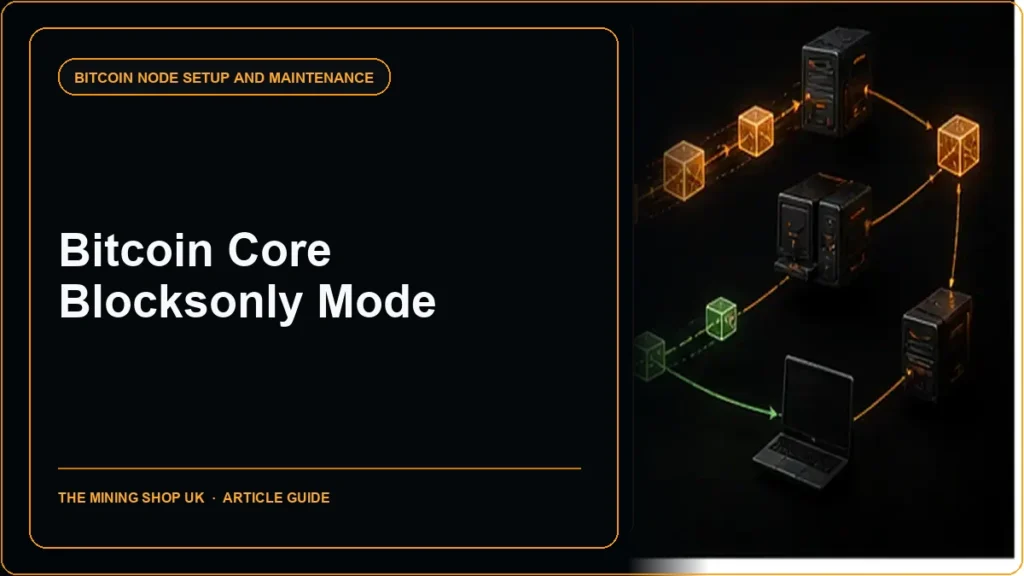
This guide explains Bitcoin Core blocksonly mode in plain English. It focuses on what the subject is, why it matters and what a beginner should remember.
TL;DR
What it is: Bitcoin Core 0.12.0 introduced blocks-only mode for operators who wanted to validate and relay blocks while avoiding ordinary transaction relay bandwidth. The node still participated in chain validation, but transaction announcements and wallet broadcasting changed, with specific whitelist interactions.
Why it matters: Blocks-only mode is valuable for constrained validation and specialised topology, but it deliberately removes ordinary transaction relay. Wallet and mining deployments need an explicit, tested transaction path and monitoring that understands the reduced-mempool design.
Current position: Bitcoin Core 0.12.0 introduced blocks-only mode for operators who wanted to validate and relay blocks while avoiding ordinary transaction relay bandwidth.
Bitcoin Core blocksonly mode in simple English
Bitcoin Core blocksonly mode: Run two isolated nodes with one in blocks-only mode. Broadcast transactions through ordinary and whitelisted paths, create a wallet spend, mine blocks and compare templates and fees.
Simple example
A node operator is checking Bitcoin Core blocksonly mode. An operator could not assume that creating and signing through the same node meant the transaction reached the network.
Key terms in plain English
Bitcoin Core:
Widely used software that validates Bitcoin and can provide wallet, network and operator tools.
Consensus:
The shared rules full nodes use to decide whether blocks and transactions are valid.
Mempool:
A node’s changing local collection of valid, unconfirmed transactions.
Node:
A computer running Bitcoin software that checks data and communicates with other peers.
What the option changes
With blocksonly enabled, the node avoids requesting and relaying ordinary transactions from normal peers. It remains connected for headers and blocks and validates the active chain. Dashboards must therefore distinguish a deliberately sparse mempool from a stalled node or broken peer connection.
Wallet broadcasting interaction
The 0.12 startup logic disabled walletbroadcast in blocks-only mode. A local wallet transaction needed an explicit alternative path or manual broadcast. An operator could not assume that creating and signing through the same node meant the transaction reached the network.
Whitelist relay
The historical implementation also changed whitelistrelay defaults in blocks-only mode, while explicitly whitelisted peers could have different relay treatment under configuration. A trusted peer path must be deliberate and narrow. Whitelisting is a policy exception, not authentication of every transaction or protection against resource abuse.
Whitelist relay: the fields, validation boundary and operational evidence that implementations need to agree.
Mining template consequences
A blocks-only node without a transaction feed builds templates from a thin or empty mempool and can lose fee revenue. A pool might pair it with a trusted transaction source, but the validating template node must still verify every candidate transaction. Failover must preserve both consensus validity and the intended mempool feed.
Bandwidth and privacy
Reducing transaction gossip lowers traffic and may reveal less about local transaction interests, but peer metadata and block downloads remain. A distinctive connectivity pattern can itself fingerprint the node. Maxuploadtarget and pruning solve different outbound and storage problems and should be evaluated separately.
Monitoring design
Expected mempool size and transaction rate depend on the chosen trusted-peer exceptions. Alert on chain lag, block propagation, peer loss and template fee deltas, not simply a zero mempool. Record whether the node is validation-only, wallet-facing, mining-primary or emergency failover because acceptable behaviour differs.
Operational rehearsal
Run two isolated nodes with one in blocks-only mode. Broadcast transactions through ordinary and whitelisted paths, create a wallet spend, mine blocks and compare templates and fees. Restart into failover, verify transaction-source restoration and prove the node never treats unvalidated external template content as trusted.
Frequently asked questions
What is the main point of Bitcoin Core blocksonly mode?
Bitcoin Core blocksonly mode: Run two isolated nodes with one in blocks-only mode. Broadcast transactions through ordinary and whitelisted paths, create a wallet spend, mine blocks and compare templates and fees.
For Bitcoin Core blocksonly mode, what should a beginner know about what the option changes?
With blocksonly enabled, the node avoids requesting and relaying ordinary transactions from normal peers.
For Bitcoin Core blocksonly mode, what should a beginner know about wallet broadcasting interaction?
The 0.12 startup logic disabled walletbroadcast in blocks-only mode. A local wallet transaction needed an explicit alternative path or manual broadcast.
For Bitcoin Core blocksonly mode, what should a beginner know about whitelist relay?
The historical implementation also changed whitelistrelay defaults in blocks-only mode, while explicitly whitelisted peers could have different relay treatment under configuration.
Conclusion
Blocks-only mode is valuable for constrained validation and specialised topology, but it deliberately removes ordinary transaction relay. Wallet and mining deployments need an explicit, tested transaction path and monitoring that understands the reduced-mempool design.
Check the current specification status and the documentation for the exact implementation you operate before moving production funds or changing a mining node.
About the Author:
Darren Waggott is the visionary Founder and CEO of The Mining Shop UK, with over a decade of leadership in the cryptocurrency mining sector. Renowned for driving innovation, Darren has built a company dedicated to providing high-quality ASIC miners and comprehensive hosting services. His forward-thinking approach places The Mining Shop UK at the forefront of the industry.
Membership helps us protect the discussion from spam and keep answers useful.
ASIC MINING SUPPORT
Need Help Choosing an ASIC Miner?
Tell us what you want to mine, your electricity cost and where the machine will run. We can help you compare hardware, power requirements, hosting and repairs.
We use necessary cookies to run the shop and optional analytics cookies to understand how visitors use the site and improve shopping and checkout. You can accept analytics, use only necessary cookies, or choose settings. You can change your choice at any time.
Functional
Always active
The technical storage or access is strictly necessary for the legitimate purpose of enabling the use of a specific service explicitly requested by the subscriber or user, or for the sole purpose of carrying out the transmission of a communication over an electronic communications network.
Preferences
The technical storage or access is necessary for the legitimate purpose of storing preferences that are not requested by the subscriber or user.
Statistics
The technical storage or access that is used exclusively for statistical purposes.The technical storage or access that is used exclusively for anonymous statistical purposes. Without a subpoena, voluntary compliance on the part of your Internet Service Provider, or additional records from a third party, information stored or retrieved for this purpose alone cannot usually be used to identify you.
Marketing
The technical storage or access is required to create user profiles to send advertising, or to track the user on a website or across several websites for similar marketing purposes.







Join the ASIC Mining Discussion
Members can read and join the discussion
Log in to read comments from other miners. Create a free account if you would like to ask a question or share your experience.
Membership helps us protect the discussion from spam and keep answers useful.