
Pre-order
Overall ranking

Equihash
·
ZEC
Overall rank#1of 163AvailableAll: #2 / 836


Pre-OrderFree Shipping
Hashrate
525KSOL
Efficiency
4.73W/KSOL
Power
2483W
Earns/kWh
39.4p
SHA-256 Bitcoin mining: This guide covers the practical hardware, compatibility and operating checks for ASIC miners. Check current pool and network details.
SHA-256 Bitcoin mining: This guide covers the practical hardware, compatibility and operating checks for ASIC miners. Check current pool and network details.
What Is SHA-256 and How Does Bitcoin Use It? Explains what the network or algorithm means for an ASIC buyer. A miner is normally tied to one algorithm family. So compatibility must be confirmed before purchase.
SHA-256 Bitcoin mining: The versatility and robustness of SHA-256 have paved the way for its diverse applications: Cryptocurrencies: Most famously, SHA-256 is the cryptographic backbone of Bitcoin, ensuring transaction and data security.
A miner wants to understand SHA-256 Bitcoin mining. Password Storage: Instead of storing actual passwords, systems store the SHA-256 hash of passwords, enhancing security.
Amidst the growth of cryptocurrencies and the changing landscape of the digital systems, cryptographic algorithms have gained significant attention. Central to many discussions is the question, “What is SHA-256?”
SHA-256 stands for Secure Hash Algorithm 256-bit. It’s a member of the SHA-2 (Secure Hash Algorithm 2) family. This was designed by the National Security Agency (NSA) in the USA. Introduced in 2001, SHA-256 has since become a cornerstone in cryptographic security.
At its core, SHA-256 is a cryptographic hash function. This means it takes an input and returns a fixed-size string of characters. This typically appears random. Here’s why SHA-256 stands out:
The versatility and robustness of SHA-256 have paved the way for its diverse applications:
Responding to “What is SHA-256?”, it is evident that this algorithm, with its deep-rooted security and versatility, plays a monumental role in our digital era. Its wide range of applications, from powering cryptocurrencies to safeguarding data, shows its significance in the current interconnected world.
Stay updated on cryptographic advancements and insights with The Mining Shop, where we dissect complex digital phenomena for our community.
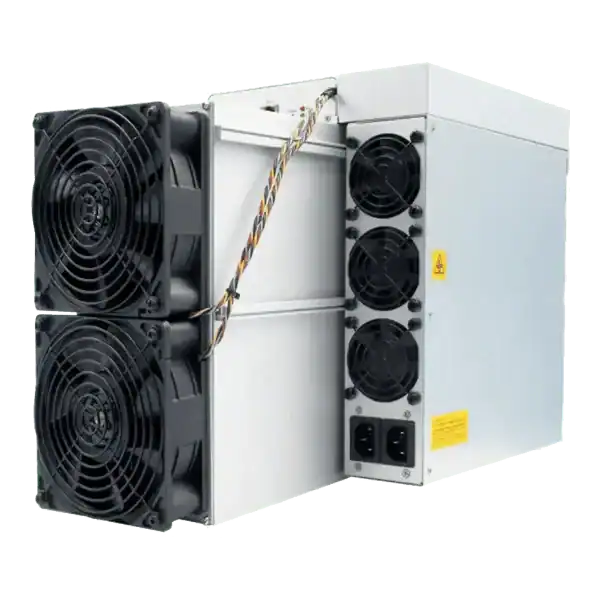
Start with the exact equipment, network or service described in this guide. Record the model, firmware, rated and measured wall power, supported algorithm, pool endpoint and the date on which each fact was checked. A product name or broad algorithm label is not enough to prove compatibility.
For bitcoin, coins and algorithms, calculate the position using the electricity tariff actually payable, pool fees, rejected shares, expected uptime, cooling load and maintenance. Keep gross revenue separate from operating cost. Repeat the calculation with lower revenue and higher difficulty so the downside is visible before money or equipment is committed.
Confirm that fixed wiring, protective devices, cabling, ventilation and access arrangements suit continuous operation. Use a competent electrician where fixed electrical work is involved. Keep firmware and wallet credentials secure, test with one worker first and retain a written baseline so later changes can be compared with evidence.
Before committing equipment, compare at least two operating cases. Use the expected case with measured power and current revenue, then an adverse case with higher difficulty, lower revenue, added downtime and repair cost. This shows whether SHA-256 remains workable when conditions move against the operator.
Retain the manufacturer specification, firmware checksum, photographs, serial number, pool test, meter reading and calculation date. Those records make warranty, resale, insurance and troubleshooting decisions easier. They also prevent an old dashboard estimate from being mistaken for current evidence.
SHA-256 Bitcoin mining: The versatility and robustness of SHA-256 have paved the way for its diverse applications: Cryptocurrencies: Most famously, SHA-256 is the cryptographic backbone of Bitcoin, ensuring transaction and data security.
SHA-256 stands for Secure Hash Algorithm 256-bit . It's a member of the SHA-2 (Secure Hash Algorithm 2) family.
At its core, SHA-256 is a cryptographic hash function. This means it takes an input and returns a fixed-size string of characters.
The versatility and robustness of SHA-256 have paved the way for its diverse applications: Cryptocurrencies: Most famously, SHA-256 is the cryptographic backbone of Bitcoin, ensuring transaction and data security.
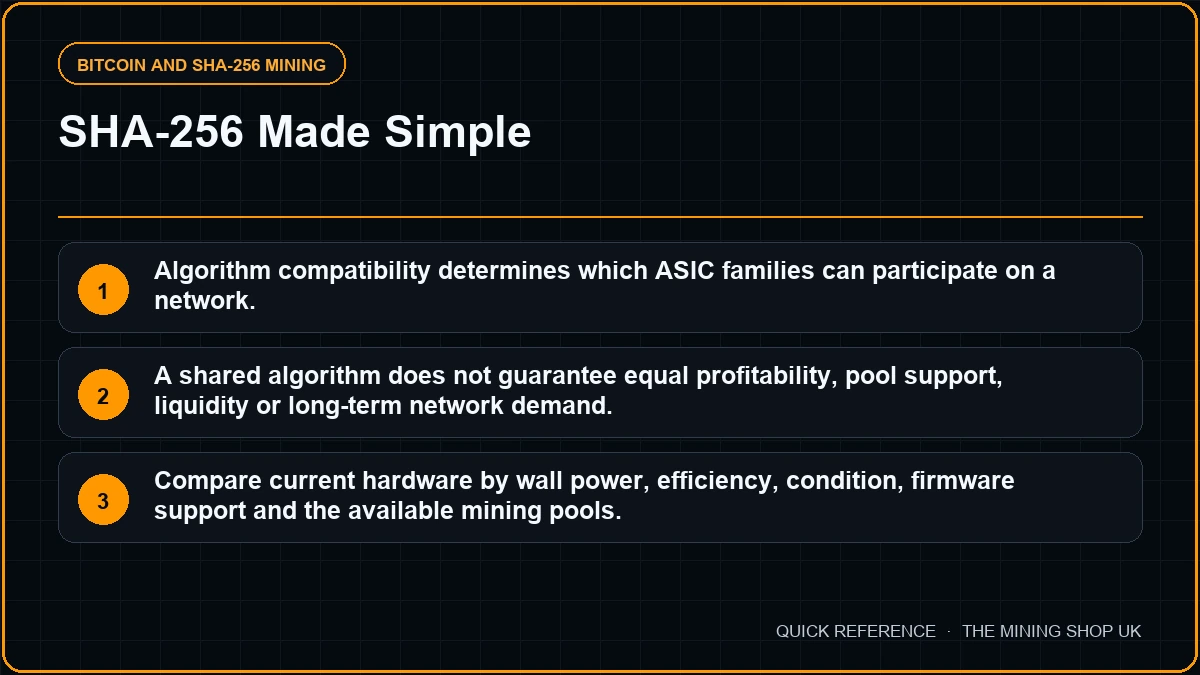
Algorithm compatibility determines which ASIC families can participate on a network. A shared algorithm does not guarantee equal profitability, pool support, liquidity or long-term network demand.
For SHA-256 Bitcoin mining, the following pages provide the most relevant practical next steps. Use these pages to move from research to a product or operating decision:
For SHA-256 Bitcoin mining, check current official guidance and retain the evidence used for the decision. Use current official guidance alongside this article because network rules, tax guidance and safety duties can change.

Understand why Bitcoin proof of work uses energy to create costly block proposals, easy verification, accumulated chain work and resistance to history changes.
Bitcoin Target Arithmetic made simple. See the main facts, costs, risks and practical checks before you make a decision.

Mining expansion and Bitcoin difficulty: ASIC guidance on compatibility, measurement, fees, reliability, security and checks before routing hashrate.

Join the ASIC Mining Discussion
Members can read and join the discussion
Log in to read comments from other miners. Create a free account if you would like to ask a question or share your experience.
Membership helps us protect the discussion from spam and keep answers useful.