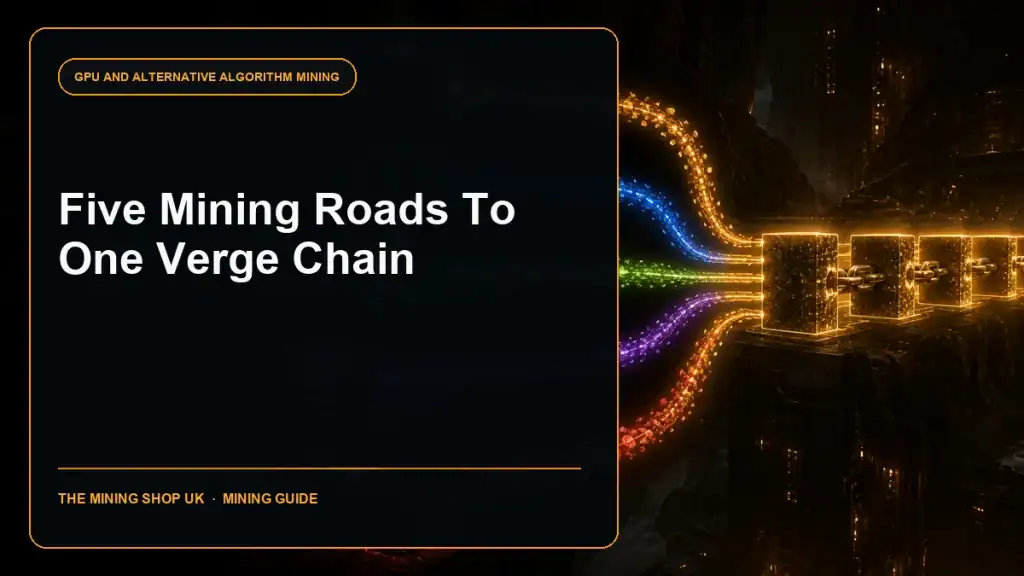
Verge mining cannot be explained by writing only 'Scrypt' beside the coin name. The live design supports five proof-of-work algorithms: Scrypt, X17, Lyra2rev2, Myr-Groestl and Blake2s. They all contribute blocks to one Verge blockchain.
That choice broadens hardware access, but it also makes profitability comparisons easy to misunderstand. A miner competes inside the chosen algorithm's difficulty and pool market. Hashrate figures from two different algorithms cannot be added or compared as if they were the same unit of work.
Estimated reading time: 7 minutes
TL;DR
Verge supports five mining algorithms, not Scrypt alone.
Choose hardware and software for one specific algorithm and compare results within that lane.
Use accepted pool hashrate, wall power, algorithm difficulty and actual payout for a fair test.
What This Means in Simple English
Verge has five doors into the same block race. Different types of mining hardware can use different doors. The network adjusts the work for each route so all five can contribute to the same history.
Simple Example
Think of five qualifying races feeding one final scoreboard. A fast cyclist and a fast runner use different measurements. You compare each person with competitors in the same race, then record who reaches the shared finish line.
Key Terms in Plain English
Multi-algorithm:
A network that accepts proof of work from more than one hashing method.
Scrypt:
A mining algorithm also used by Litecoin and Dogecoin hardware.
X17:
A chain of 17 hash functions used as one Verge mining route.
Myr-Groestl:
One of Verge's GPU-oriented proof-of-work choices.
Difficulty:
The target level applied to mining attempts for an algorithm.
The Five Verge Algorithms
The official Verge blackpaper names Scrypt, X17, Lyra2rev2, Myr-Groestl and Blake2s. A current pool may support all five, some of them or none. The coin symbol alone does not tell mining software which work to request.
Each algorithm has different hardware and software choices. Scrypt is dominated by specialist machines on large networks. Several other routes have historically been associated with GPUs, but current efficiency and software support must be checked rather than assumed.
Why One Network Uses Five
A multi-algorithm design aims to let a wider mix of equipment take part and reduce dependence on one hardware class. Blocks found through the supported routes still join the same chain and follow Verge's shared transaction rules.
Diversity does not remove concentration. One algorithm may have few pools or a large operator. Security depends on the actual distribution of work, software and reachable nodes, not merely the number five on a feature list.
Pick the Right Hardware Lane
Start with equipment you own and identify the algorithms it can run efficiently. A Scrypt ASIC cannot be treated as an X17 GPU. A hashrate of one gigahash on one function is not equal to the same number on another.
Use algorithm-specific benchmarks from the exact device, then verify them with a short live test. Record wall power, accepted work and temperature. Aggressive overclock settings that raise rejected shares or crashes can reduce paid output.
Quick reference for Verge mining decisions.
Choose Software and a Pool
Download mining software from a traceable project source and verify releases where checksums or signatures are supplied. Avoid bundles that disable security tools or ask for unrelated wallet secrets.
At the pool, choose Verge and the intended algorithm explicitly. Check server region, port, payout method, fee and minimum. A wrong port may submit unusable work or simply fail, while an old pool list may point to a closed service.
Compare Profit without Mixing Units
Calculate expected income separately for each algorithm. Use its network difficulty or pool estimate, your accepted hashrate and current reward. Then subtract the measured electricity and pool costs for that exact setup.
A switching service may move hardware between compatible coins, but it adds exchange, payout and timing rules. Check whether payment is made in XVG or another asset and record every conversion charge.
Network and Wallet Checks
Send the first payout to a wallet you control and confirm it appears as expected before scaling. Keep the recovery information offline. A pool account is not a substitute for a wallet backup.
Mining traffic should sit on a controlled network segment where practical. Do not expose miner dashboards to the public internet. Change default passwords, restrict management access and keep a record of firmware changes.
A Beginner Test Plan
Choose one algorithm, one machine and one pool. Run long enough to capture stable temperatures and ordinary pool variance. Note accepted shares, rejects, watts and XVG received in a simple dated log.
Repeat only when one variable changes. Testing five algorithms at once makes it hard to learn why a result improved or failed. The best route is the one that produces the strongest net result safely on your actual equipment.
What the Current Data Can and Cannot Tell You
The supplied snapshot lists Verge as Scrypt, which is incomplete. It is better to treat XVG as a multi-algorithm network and store the selected algorithm with every hashrate observation. Without that label, mining records from different routes become misleading.
Historical market data can help a reader see price volatility, but it does not identify the strongest mining lane. Algorithm difficulty, available pools and hardware efficiency can move independently, so each route needs its own dated trial and cost sheet.
Keep the algorithm name beside every pool payment in the test record. If a switching service converts another coin into XVG, label that separately from direct Verge mining. Otherwise a later review may credit the wrong network with the result and hide conversion charges, stale work or an unsuccessful route.
Decision Table
Algorithm
Typical equipment to investigate
Do not assume
Scrypt
Purpose-built Scrypt ASIC
That SHA-256 hardware is compatible
X17
Supported GPU software
That an old miner still works
Lyra2rev2
Supported GPU software
That headline hashrate equals profit
Myr-Groestl
Supported GPU software
That all pools offer it
Blake2s
Compatible hardware and miner
That other Blake variants match
A table is a starting point, not a promise. Verify every live input before spending money on Verge mining hardware, software or hosting.
Frequently Asked Questions
Is Verge Only a Scrypt Coin?
No. Official Verge material lists five algorithms: Scrypt, X17, Lyra2rev2, Myr-Groestl and Blake2s.
Can One Miner Use All Five Algorithms at Once?
Most hardware and software targets a particular algorithm. Some management tools can switch compatible routes, but compatibility must be verified.
Which Verge Algorithm Is Most Profitable?
There is no permanent winner. Hardware efficiency, algorithm difficulty, pool terms, price and electricity all change.
Can I Compare Hashrate Across Verge Algorithms?
Not directly. Each algorithm performs different work, so compare earnings and watts within the same route.
Does Five-algorithm Mining Remove Security Risk?
No. It diversifies proof of work, but pool concentration, software risk and weak node distribution can still matter.
Conclusion: Verge Mining
Verge mining deserves a measured trial, not a promise of easy money. Confirm the live network rules, use compatible hardware and official software, protect the wallet, and calculate profit from accepted work and wall power. Keep dated records because rewards, difficulty, prices and pool terms change.
Darren Waggott is the visionary Founder and CEO of The Mining Shop UK, with over a decade of leadership in the cryptocurrency mining sector. Renowned for driving innovation, Darren has built a company dedicated to providing high-quality ASIC miners and comprehensive hosting services. His forward-thinking approach places The Mining Shop UK at the forefront of the industry.
Membership helps us protect the discussion from spam and keep answers useful.
ASIC MINING SUPPORT
Need Help Choosing an ASIC Miner?
Tell us what you want to mine, your electricity cost and where the machine will run. We can help you compare hardware, power requirements, hosting and repairs.
We use necessary cookies to run the shop and optional analytics cookies to understand how visitors use the site and improve shopping and checkout. You can accept analytics, use only necessary cookies, or choose settings. You can change your choice at any time.
Functional
Always active
The technical storage or access is strictly necessary for the legitimate purpose of enabling the use of a specific service explicitly requested by the subscriber or user, or for the sole purpose of carrying out the transmission of a communication over an electronic communications network.
Preferences
The technical storage or access is necessary for the legitimate purpose of storing preferences that are not requested by the subscriber or user.
Statistics
The technical storage or access that is used exclusively for statistical purposes.The technical storage or access that is used exclusively for anonymous statistical purposes. Without a subpoena, voluntary compliance on the part of your Internet Service Provider, or additional records from a third party, information stored or retrieved for this purpose alone cannot usually be used to identify you.
Marketing
The technical storage or access is required to create user profiles to send advertising, or to track the user on a website or across several websites for similar marketing purposes.





Join the ASIC Mining Discussion
Members can read and join the discussion
Log in to read comments from other miners. Create a free account if you would like to ask a question or share your experience.
Membership helps us protect the discussion from spam and keep answers useful.