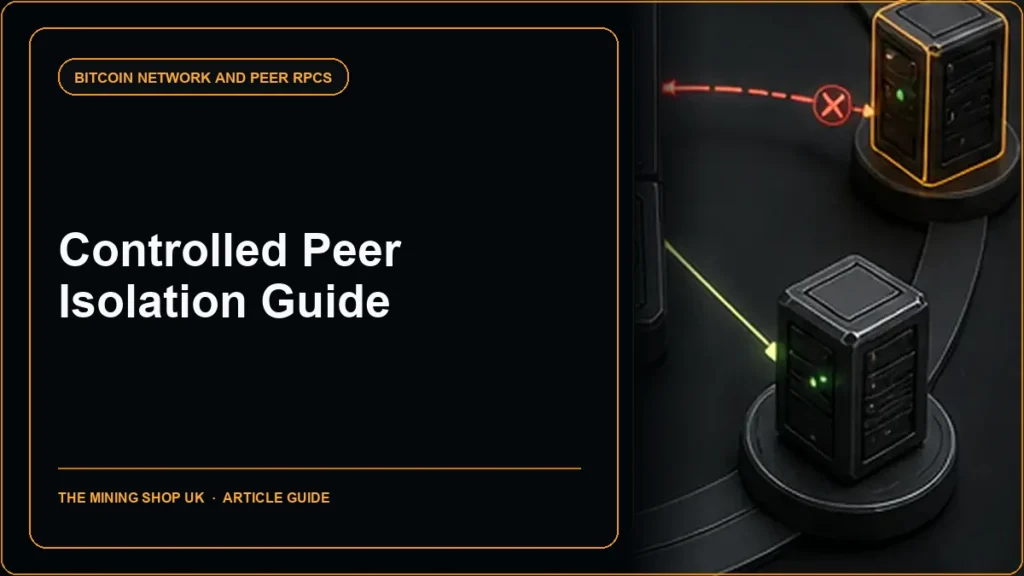
This guide explains Bitcoin Core disconnectnode RPC in plain English. It shows what the command does, what its result means and what it cannot prove.
TL;DR
What it is: Bitcoin Core 0.16.0 disconnectnode immediately disconnected one peer identified either by address and port or by node ID. Exactly one identifier could be supplied; named nodeid or an empty address plus positional node ID handled ID targeting.
Why it matters: disconnectnode ends one peer session; it is not a durable ban or trust decision. Safe use targets fresh identity data, checks manual-peer sources and confirms the remaining topology can continue validating and relaying independently.
Current position: Bitcoin Core 0.16.0 disconnectnode immediately disconnected one peer identified either by address and port or by node ID.
Bitcoin Core disconnectnode RPC in simple English
Bitcoin Core disconnectnode RPC: The RPC closes the current session. Peer discovery, an addnode entry, connect configuration or ordinary outbound selection may establish another session.
Simple example
A node operator is checking Bitcoin Core disconnectnode RPC. Verify the peer table after the call and after a suitable retry interval. If continued isolation is required, choose an explicit ban, configuration change or firewall action under its own review.
Key terms in plain English
Bitcoin Core:
Widely used software that validates Bitcoin and can provide wallet, network and operator tools.
RPC:
A command that software sends to a node to request information or a local action.
Node:
A computer running Bitcoin software that checks data and communicates with other peers.
Exclusive identifier rule
Supply either address or nodeid, never both. A node ID is runtime-local and can change after reconnection or restart, while an address can represent a different process later. Capture fresh getpeerinfo evidence, match protocol, services and direction, and act promptly without reusing a stale identifier from an old incident ticket.
Immediate but temporary effect
The RPC closes the current session. Peer discovery, an addnode entry, connect configuration or ordinary outbound selection may establish another session. Verify the peer table after the call and after a suitable retry interval. If continued isolation is required, choose an explicit ban, configuration change or firewall action under its own review.
Addnode overlap
A manually added peer may be retried because disconnectnode does not remove it from the addnode list. Inspect runtime and configuration sources before declaring success. Use addnode remove for list membership and disconnectnode for the current session, then verify both states rather than repeatedly disconnecting an automatically restored peer.
Addnode overlap: the fields, validation boundary and operational evidence that implementations need to agree.
Topology and sync impact
Disconnecting a peer can reduce diversity, remove the only useful block source or interrupt compact-block and transaction relay. Check remaining peers by direction, network, ASN, service bits, chainwork and last block announcement. Mining nodes should preserve independent upstreams before isolating a suspicious but operationally important link.
Incident evidence
Record the minimal peer identifier, reason, observed behaviour and node version before disconnection, while avoiding publication of private topology. Preserve relevant message and validation evidence so the decision can be reviewed. A high bandwidth or unusual user agent alone is not proof of malicious behaviour.
Access control
Network mutation belongs behind protected RPC authentication and an allowlisted operator workflow. Monitoring should use separate credentials. Reject arbitrary address text in wrappers, avoid shell interpolation and log the selected identifier and result without credentials, private addresses or full peer lists.
How specialists test it
Operators test the command on a non-production node first. They check a normal reply, an invalid request, a timeout and a restart. This shows what the response means and prevents one local result from being mistaken for a network-wide outcome.
Frequently asked questions
What is the main point of Bitcoin Core disconnectnode RPC?
Bitcoin Core disconnectnode RPC: The RPC closes the current session. Peer discovery, an addnode entry, connect configuration or ordinary outbound selection may establish another session.
For Bitcoin Core disconnectnode RPC, what should a beginner know about exclusive identifier rule?
Supply either address or nodeid, never both. A node ID is runtime-local and can change after reconnection or restart, while an address can represent a different process later.
For Bitcoin Core disconnectnode RPC, what should a beginner know about immediate but temporary effect?
The RPC closes the current session. Peer discovery, an addnode entry, connect configuration or ordinary outbound selection may establish another session.
For Bitcoin Core disconnectnode RPC, what should a beginner know about addnode overlap?
A manually added peer may be retried because disconnectnode does not remove it from the addnode list.
Conclusion
disconnectnode ends one peer session; it is not a durable ban or trust decision. Safe use targets fresh identity data, checks manual-peer sources and confirms the remaining topology can continue validating and relaying independently.
Check the current specification status and the documentation for the exact implementation you operate before moving production funds or changing a mining node.
About the Author:
Darren Waggott is the visionary Founder and CEO of The Mining Shop UK, with over a decade of leadership in the cryptocurrency mining sector. Renowned for driving innovation, Darren has built a company dedicated to providing high-quality ASIC miners and comprehensive hosting services. His forward-thinking approach places The Mining Shop UK at the forefront of the industry.
Membership helps us protect the discussion from spam and keep answers useful.
ASIC MINING SUPPORT
Need Help Choosing an ASIC Miner?
Tell us what you want to mine, your electricity cost and where the machine will run. We can help you compare hardware, power requirements, hosting and repairs.
We use necessary cookies to run the shop and optional analytics cookies to understand how visitors use the site and improve shopping and checkout. You can accept analytics, use only necessary cookies, or choose settings. You can change your choice at any time.
Functional
Always active
The technical storage or access is strictly necessary for the legitimate purpose of enabling the use of a specific service explicitly requested by the subscriber or user, or for the sole purpose of carrying out the transmission of a communication over an electronic communications network.
Preferences
The technical storage or access is necessary for the legitimate purpose of storing preferences that are not requested by the subscriber or user.
Statistics
The technical storage or access that is used exclusively for statistical purposes.The technical storage or access that is used exclusively for anonymous statistical purposes. Without a subpoena, voluntary compliance on the part of your Internet Service Provider, or additional records from a third party, information stored or retrieved for this purpose alone cannot usually be used to identify you.
Marketing
The technical storage or access is required to create user profiles to send advertising, or to track the user on a website or across several websites for similar marketing purposes.








Join the ASIC Mining Discussion
Members can read and join the discussion
Log in to read comments from other miners. Create a free account if you would like to ask a question or share your experience.
Membership helps us protect the discussion from spam and keep answers useful.